In His Words: Why Jon Matsubara Closed Feast Last Week (But You Can Still Get Lobster Rolls)
Feast still has its KCC Farmers Market booth, but the rest is up in the air. Here’s the story.

Photo: Mari Taketa
Jon Matsubara is sitting in the dining room at Feast Mānoa, its polished tabletops shimmering in the afternoon shadows, and he’s alone. It’s like the first time I met him there, in the fall of 2019, when the chef who rose from dishwasher at Roy’s and Alan Wong’s to cook at Michelin-starred Jean-Georges in New York City talked about opening the first real restaurant of his own.
Back then, he talked about DIY-ing Feast’s counters and floors with the help of his uncle and old colleagues and serving its first meals to family and friends whose happy chatter warmed the place and filled his heart. Feast followed a string of restaurants Matsubara opened or led for others: Stage, Azure, Japengo, Forty Carrots at Bloomingdale’s, Merriman’s Honolulu.
When his sister-in-law gave him lunchtime kitchen access at her Mō‘ili‘ili bar, Café Anasia, he grew a following with butter-poached crab salads, Hilo-style hamburger steaks grilled with oyster sauce, and salt beef watercress soup—a Super Bowl hangover favorite that, topped with foie gras, he served at Forty Carrots as “pot au feu,” its broth poured grandly at tableside from a ceramic teapot. That high-end style of comfort food became Matsubara’s signature, but it was his lobster roll, a runaway pandemic hit, that stabilized the restaurant and drove its expansion.
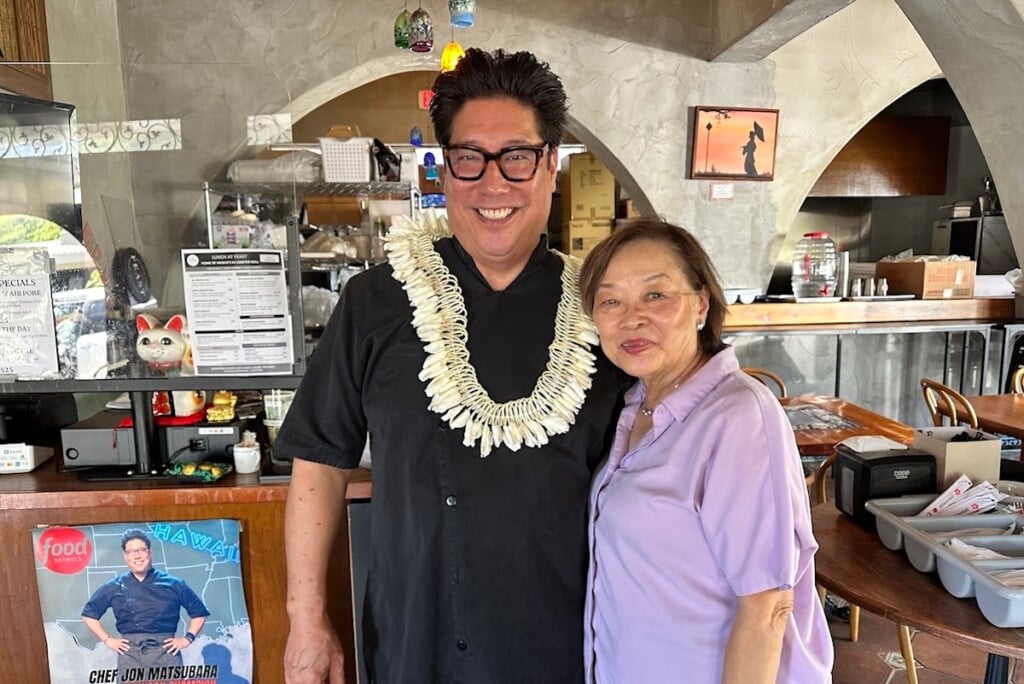
Last Saturday, Feast Mānoa’s last day, I get the last pickup order. It’s past closing, and a few regulars remain. Matsubara’s wife, J’mi, sits at a table eating salt beef watercress soup. “At last, I can give this to my son,” says his mother, Arlene, draping a ginger lei around his neck. Days earlier, Matsubara closed Feast’s Waikīkī restaurant; over the summer, he closed his third and newest location at Midtown Eats food hall near Ala Moana Center.
Of all the hard-working restaurateurs who’ve closed their doors and dreams, Matsubara is the restaurant world’s eternal spring, eyes shining every time he talks about a new idea, a different approach. This time, even though he’s still doing catering and selling lobster rolls at the Saturday KCC Farmers Market, is different. On Tuesday, we sit in the empty restaurant, and I ask how he’s feeling. I ask about the whole arc of things. Here are his words, edited for brevity.

Photo: Mari Taketa
“Everybody’s asking me how I’m doing, but we’re still busy. Still got catering tomorrow, one on Sunday, staff is coming in, I gotta orchestrate the prep and logistics. After that, we’re representing [Hawai‘i Tourism Authority] on a trip to Korea. It doesn’t feel like it’s over yet, you know?
When you open a restaurant, there’s a honeymoon stage. There’s a lot of attention, a lot of engagement, you’re busier. All restaurants go through that. And then boom, six months after we opened Feast, COVID. We were one of the only places serving food, so we were busy. After COVID, things started falling apart. People were getting paid not to work, all the other restaurants opened up.
SEE ALSO: How a Lobster Roll Changed the Game at Feast in Mānoa
Then it got worse. Now, you’re dealing with inflation, minimum wage going up, gotta adjust your prices. And people aren’t used to that. You increase your prices and keep up or you don’t, you eat it, and if you eat it, you’re not gonna hit your numbers.
So we were trying to find something that works. New menu, new concept that focuses on seafood, another concept that focuses more on breakfast, put in the time to get a liquor license, be like Tamura’s and Fujioka’s. We tried to make a market here, support local vendors—Pop Culture pops, Sage Creamery, sell all these different things.
You know what? The only consistent thing working for us is the [KCC] farmers market. Why? It’s in an area where people consistently come. We need to be where our market is. We need to be in traffic flow.
Mānoa, there’s not a lot of traffic. Where has traffic? The two places on O‘ahu with the most traffic are Waikīkī and Ala Moana. We get a shot over there, see what happens.
The thought behind Waikīkī was we would bring in Kaua‘i shrimp and local stuff you couldn’t get at that price in Waikīkī, cook invasives like ta‘ape and gorilla ogo, try to showcase local stores. Be a mom-and-pop place that gives what locals eat instead of this big corporate box that’s just like a robot factory. We had an opportunity, and we went for it.
Our location was awesome until Duty Free left. That was all the traffic, plus the trolleys. When we first went there and saw that, watching from across the street, we were like holy cow. But then, you know, things happen. DFS left, we had government shutdowns, war. We were like, where is everybody?
We rebranded Waikīkī. Change food, change menu, change time of operating, change the concept. Hit all the hotels with flyers. Offer $10 bentos for lunch. We hit the bell guys, front desk, concierges with flyers, samples, everything. Hit the delivery drivers for Uber. We kept pounding and pounding, tried every single thing we could. Didn’t work? We pivoted and tried something else. We had to find a way.
I called everybody I could think of. Every contact I had—marketing, media, hotels—and got their feedback. ‘We did all this, what else can we try?’
SEE ALSO: How and Why Little Plum and Lady Elaine Lowered Many of Their Prices
And we didn’t have enough staff. In Mānoa, we used to open Tuesday to Saturday, then because Mānoa was slow, we changed to Thursday, Friday, Saturday, and we moved the guys to cover Waikīkī and Midtown. We were still trying to hire but couldn’t find anybody.
Waikīkī was six days a week, by contract. Midtown was seven days a week. Waikīkī was lobster rolls and poke, it wasn’t cooking. We operated sometimes with one person that did cashier and cooking. And that suffered. Midtown had a flattop, fryer, bigger menu. You needed three people there. If we had two people, we couldn’t open. So we opened Waikīkī. It was horrible.
I think my wife and I were working every day for six months, from January to June or July. If someone took vacation, we had to shut down.
So I gotta shift. I’m a cashier and host at Midtown, cashier and host at Waikīkī, cashier and host in Mānoa, and I’m not in the back cooking. It’s whoever we can find.
If you have a good host, good cashier, you get greeted, they can talk about menu items, answer questions. You feel good paying $30 for a lobster roll, you’re satisfied you got your value. It’s not about the money, it’s about what you get for the money. Sometimes, you have to put cooks as cashiers, and they don’t have those skills. When labor issues and operational challenges become bigger than the execution of your standards, that affects value.
For me, when I cook, I always want to present a part of myself. It’s very personal. The color of the crust, the caramelization, the way it smells, I care, and that’s what I want to give to you. I can’t expect everyone to be like me. I’m grateful for my staff. They’re the backbone. But not every kid wants to be a chef.
It comes to the point where no matter what you do, there’s nothing that indicates that things are changing. Once you run out of options, just have to accept everything you learned and use it.
I don’t feel any regret. With all the opportunities that we were given, we did everything we could within our power. And we had a crew that followed us into the fire.
We just ran out of options.
Midtown opened in January, and we pulled out in June or July. Waikīkī opened a year ago in September, and we just shut it down this past week.
I am grateful I had opportunities to accomplish things I never thought possible through culinary. Living the dream still exists, and for those who are connected and engaged in cooking, anything is possible, and that’s where the magic happens. I get excited just talking about that energy and following your heart because it’s the most amazing experience.
Everything I’ve gone through in the last seven years, I am grateful for because I have learned. I feel fortunate that I was able to be a part of that because if I see it again, it’ll allow me to see around the corner. Whatever my next opportunity is, it is so valuable to be constantly stretched and fried.
I just have to adapt. Look at what’s going on. How can I become not extinct like a dinosaur?
I have a vision of what I want to do. I want to take everything that I’ve experienced and put it into a new project. There’s people that share the same vision that might help me get to where I gotta go.
Farmers market is the only thing that’s consistently steady. Last week, we sold out. Catering’s guaranteed, right. People order, you’re not overspending on food or labor, you’re getting paid. You’re not just opening your doors and waiting for people to come in.
We’re still at the farmers market. We have catering lined up through the holidays, so we want to honor those. Right now, I think it’s important that we just take a breather and assess what our options are. Then we’ll see.
Mari Taketa is editor of Frolic Hawai‘i and dining editor of HONOLULU Magazine.