Behind the Book with What Whispers Back Contributors
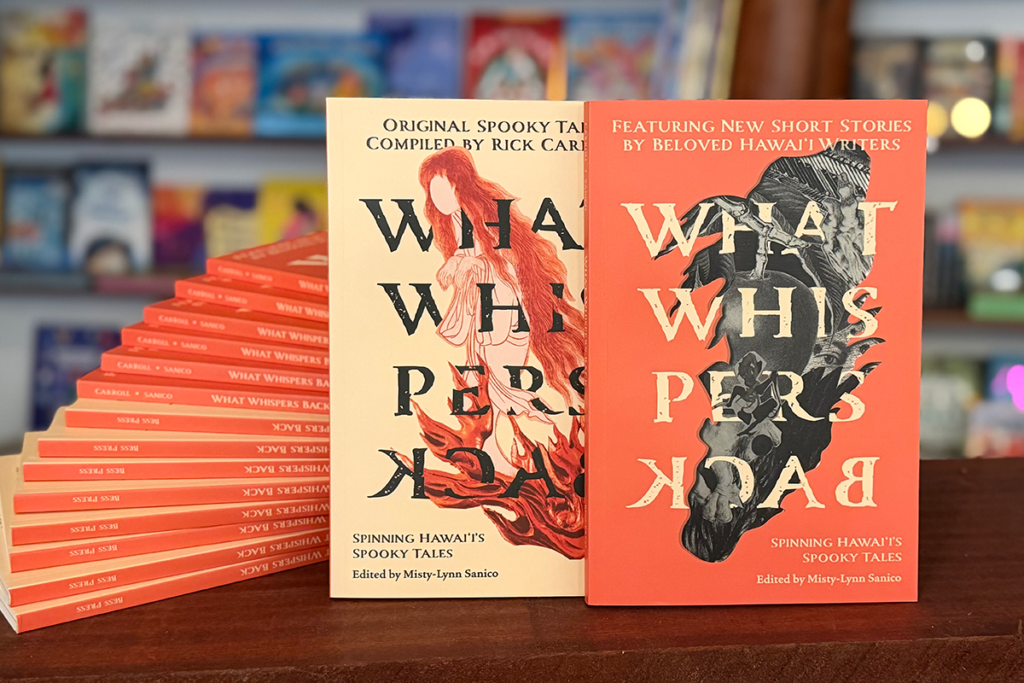
True local spine-tinglers are back in print alongside new works of eerie Hawai‘i fiction in this double-sided anthology.

Cover art: Mariko Merritt. Photo: Courtesy of Da Shop: Books + Curiosities
Think back to a spooky story you heard as a kid. You may not remember every part, but one image or strange detail probably stayed with you. A good ghost story works that way. It wants to be shared and always leaves something behind.
This was the inspiration for Rick Carroll’s popular Hawai‘i’s Best Spooky Tales series published by Bess Press that gathered firsthand accounts of strange and unexplained experiences from more than 130 contributors across the islands throughout the 1990s and early 2000s.
Decades later, those eerie encounters still have a few surprises left for a new generation of readers.
What Whispers Back: Spinning Hawai‘i’s Spooky Tales is a double-sided flip anthology that pairs 13 original tales from the Spooky Tales archive with 13 contemporary Hawai‘i writers who spun new stories from them. Edited by Misty-Lynn Sanico, with original tales compiled by Rick Carroll, this collection features new short fiction by Donald Carreira Ching, Thomas Iannucci, Megan Kamalei Kakimoto, Shay Kauwe, Kalehua Kim, Bryan Kamaoli Kuwada, R. Zamora Linmark, Melissa Llanes Brownlee, D. Keali‘i MacKenzie, Brandy Nālani McDougall, Kapili‘ula Naehu-Ramos and Lehua Parker.
Join us for a behind-the-book peek with editor Misty-Lynn Sanico in dialogue with some of the writers from What Whispers Back:
Misty-Lynn Sanico (MLS): What was the detail, image or idea in your source tale that you couldn’t let go of, and what made you want to follow it into a new story?
Megan Kamalei Kakimoto: I was fortunate enough to work with a story accompanied by primary sources; specifically, two newspaper articles heralding the piano’s journey from New York to Hawai‘i. I’m a big language nerd and found myself transfixed by the pointed word choice throughout the articles, such as ‘a rare specimen’ and especially the line ‘as Hawaiian as possible.’ The tension created at the intersection of such loaded language and the fact that its orators were later orchestrators of the illegal overthrow proved a rich entry point for my story.
Shay Kauwe: “The Spirit of Honokāne” features a supernatural melody being played in the wilderness, but all I could think about was the hand strumming those guitar strings. That image stuck with me and eventually even made its way into the title.
Thomas Iannucci: Fo me was da idea of leaving da skin ’n bones in one bag afta dey pau hunt. Soon as I seen dat line, I tot ‘ai, das my title.’ ’N den off to da races, I was.
Lehua Parker: In the original story, a man cuts down part of a tree and unintentionally deprives a spirit of shade. As I thought about it, I remembered big neighborhood mango trees and how much trouble I got into as a young kid for climbing, fussing around, and eating super green mangoes that didn’t belong to me … So I knew I wanted to write something about stealing mangoes.
Bryan Kamaoli Kuwada: The idea of being haunted by history and family. That is a common thing for us here in Hawai‘i, but I also think that people forgot how recent some of the difficult periods of our history are, and how we still feel the effects of things like the Overthrow because it was not that long ago. So the idea of the unseen spirits of the past being right there with us, fresh and alive in a certain sense, was really interesting to me.
MLS: Were there stories, cautions, beliefs or bits of knowledge you grew up with that stayed with you? Did any of them find their way into this story?
R. Zamora Linmark: I grew up in the Philippines hearing about gnome-like creatures that live in ant and termite hills, and then one sprouted from underneath my ancestral house. I remember grown-ups warning us not to play underneath the house because that was where they lived and terrifying us with stories of the physical harm they could inflict on us. But kids will be kids…
Donald Carreira Ching: Like a lot of my writing, I draw from personal experiences, situations and relationships. This is fiction because the truth is scarier, and I’m still trying to find a way to deal with those ghosts.
Shay Kauwe: My grandmother is a devout Catholic, so we grew up attending church on Sundays; but at the same time, she would never disrespect Pele or menehune or night marchers! I’m fascinated by the balance of modern religion and ancient forces in Hawai‘i and how they feel to exist comfortably together despite seemingly contradictory natures.
Kapili‘ula Naehu-Ramos: I grew up hearing stories about things hitchhiking in the bed of your truck on a night drive. There are still places I pass driving through Mana‘e where I refuse to look in the backseat or the truck bed. If something is there, I don’t want to know.
MLS: What do you hope follows the reader out of your story or lingers long enough to spark a memory or story for them?
R. Zamora Linmark: I hope that my story will reconnect them to the superstitions, folk beliefs and traditional medicine of their own cultures that Western medicine cannot treat.
Thomas Iannucci: Tek away da idea dat Pidgin can stand proudly in da literary world (or anywea else fo dat mattah!), n also dat dey can tink littlebit mo about dea own contributions to Local folklore.
Donald Carreira Ching: They talk about their own small hauntings and unexplained memories.
Lehua Parker: The value of talking story as a community. I think it’s becoming a lost art. I hope my story reminds people to slow down, sit in the shade and reconnect. Unfortunately, memory mangoes aren’t real. It would be a shame if our kūpuna’s personal stories and experiences simply faded away.
Bryan Kamaoli Kuwada: I would love it if people could see that our culture, ‘ike and mo‘olelo belong in contemporary stories that deal with contemporary issues, but also that we have to absolutely respect those things and do the hard work of researching and learning them well, doing our homework as George Helm used to say.
Megan Kamalei Kakimoto: The real horror is colonization!
Mahalo nui to editor Misty-Lynn Sanico and the writers from What Whispers Back for sharing their mana‘o with us.
What Whispers Back: Spinning Hawai‘i’s Spooky Tales launches on Saturday, Oct. 24, from 5 to 7:30 p.m. at the Bess Press Warehouse (3565 Harding Ave., Kaimukī). It’s a Spooky Tales Experience with displays and audio recordings, author signings, nibbles and eerie live readings throughout the evening.
Learn more about the book or RSVP for the launch celebration at besspress.com.
SEE ALSO: 5 Hawai‘i and Oceania Books to Take You on an Odyssey
Da Shop: Books + Curiosities, 3565 Harding Ave., Kaimukī, open Wednesday through Sunday from 10 a.m. to 4 p.m., (808) 421-9460, dashophnl.com, @dashophnl