Behind the Book with Local Poet Laurel Nakanishi, Author of Late Morning Before the Abyss
Laurel Nakanishi gives insights into her new poetry collection about mothering and climate change.

Photo: Courtesy of Da Shop: Books + Curiosities
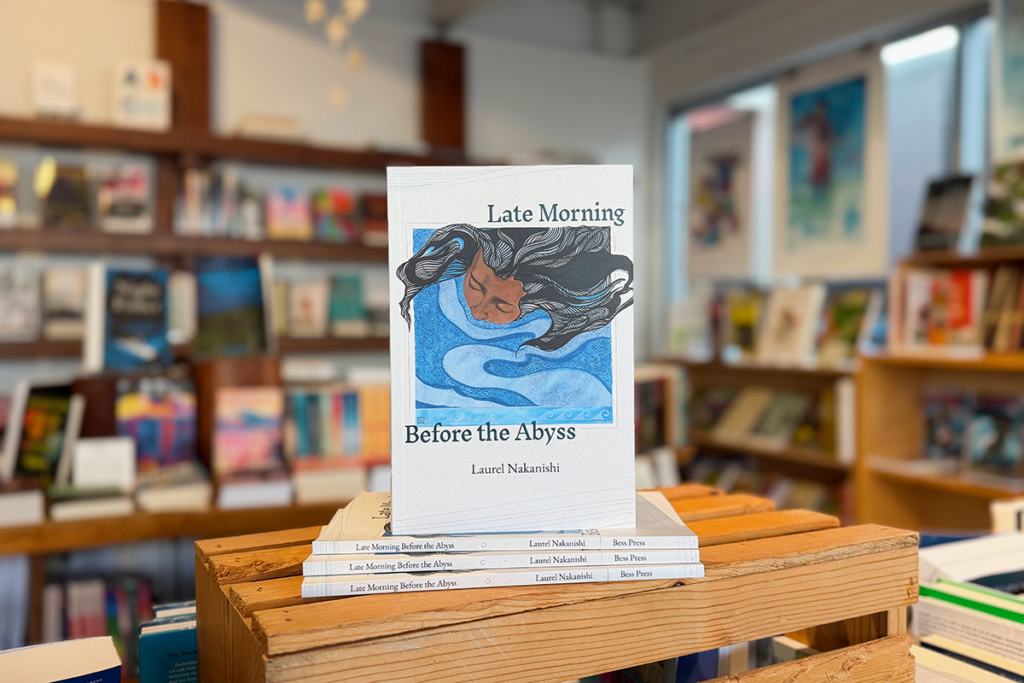
A forthcoming collection by award-winning poet Laurel Nakanishi, Late Morning Before the Abyss honors the sweetness and anxiety of bringing life into this fraught world. Through an array of poetic forms and poignant accounts, Nakanishi navigates climate disasters wreaking havoc on our ‘āina today while imagining a future for the precious infant in her arms.
Edited by Lyz Soto and featuring stunning cover art by Harinani Orme, this forthcoming poetry book from Bess Press invites readers to consider the tenderness and grit of mothering and redefine our relationship to hope.
Join us as we go behind the book with local poet Laurel Nakanishi, author of Late Morning Before the Abyss.
Da Shop (DS): Can you tell us about the journey of how this collection of poetry came to be? Did you have a clear idea of the whole collection from the start?

Laurel Nakanishi. Photo: Ashley Vos
Laurel Nakanishi (LN): I have a clear memory from the very early days of writing this book. My son was a couple weeks old. I was alone in the living room, sitting in a pool of yellow lamp light. I held him as he slept through an interminable blur of day/night. My mind was slow from lack of sleep, but I had a sense that I was missing something. Who was this baby? What had happened to my life? I wedged my journal under my forearm and started to write.
Before these poems became a book, they were just a writing practice. Initially, they were all love poems. I actually called each one, “Another Sappy Love Poem About My Baby,” to allow myself space to write badly, to be incoherent or cliché. Yet in time, the poems began to stretch out from their “love poem” label—growing capacious enough to hold my grappling with personal and global worries.
In the revision process, I also added poems that came to encompass a wider lens than just my baby. The soft vulnerability that I felt with my son contrasted so wildly to the horrors in the news. To begin to engage, I worked the text of these news stories into erasures, particularly about climate change and the Navy’s contamination of Red Hill.
In 2025, my second son was born. He came just as I was working with Lyz Soto on editing the collection. His birth and babyhood informed the revision of the poems and the addition of the poems towards the end that contemplate what it means to cultivate hope.
DS: So many of these poems are deeply connected to specific places, whether through a reference of rain, mo‘olelo, plants, animals, histories. Can you share a bit about what this looks like in your practice as a writer?
LN: Although I work by myself, writing is never a solitary act for me. I see everything that I create as a flowering of place that includes people, waters, animals and histories. The words I use and the stories I tell are all a part of a larger context. I try to honor this pilina by learning about the places that nourish me and actively taking care of them.
As a writer who is from Hawai‘i, but not Kanaka ‘Ōiwi, I often wonder about my place in writing about Hawai‘i. In the past, my struggle with identity was a lot more fraught. These days, I have been trying to spend my energy on creating a reciprocal and respectful relationship with Hawai‘i. This looks like learning mo‘olelo, observing plants and animals, recognizing the different types of wind and rain, learning from the past and working with mālama ‘āina organizations. I still have a lot to learn!
DS: What did writing look like for you as you cared for an infant? Did your process and practice evolve?
LN: When my son was first born, I worried that I wasn’t paying enough attention. He kept on changing. I wasn’t sleeping. Would I miss his babyhood when I wasn’t looking? So I turned to the practice I know best—writing. I made a promise to myself that I would write at least one poem a month for the first year of my child’s life. These poems became a space for me to dwell in a moment and pay attention. I was incredibly privileged to have the first six months home with my baby and part-time work the following year. This gift of time, along with the support of my family, allowed me the space to write. Nonetheless, writing often came in fragments and the act of writing felt more collage-like than past projects.
Now that my children are older and I’m working full-time, my writing life comes seasonally. In my most productive times, I am able to set aside a morning each week to work on poetry. I try to leave the house and write in a library so that the mountains of laundry or dirty dishes do not stare me down. Even when conditions are not ideal for writing, I try to jot down a word or image. Even if it goes nowhere, it still feels good to hold an experience in words.
DS: What do you hope will remain with readers after they have read Late Morning Before the Abyss?
LN: One of the gifts of parenthood that I have been enjoying is the opportunity to witness the world through my children’s eyes. Their attention, wonder and delight renew my own seeing and bring me into a different relationship with wonder. This is a similar invitation that I feel when reading a good book of poetry. I love stepping behind someone else’s eyes to see their life and hear their truths.
I hope that readers of Late Morning Before the Abyss will take the time to find their own meaning in the poems and come away with a sense of what is beautiful and precious to them. I would like readers to feel a renewed sense of wonder and invitation into the hard work of hope.
DS: And then finally, we have to ask: what are you reading now?
LN: The Epic Tale of Hi‘iakaikapoliopele – Ho‘oulumahiehie translated by M. Puakea Nogelmeier and American Hagwon by Min Jin Lee.
Mahalo nui e Laurel Nakanishi for sharing insight behind her forthcoming poetry book, Late Morning Before the Abyss.
SEE ALSO: Behind the Book with What Whispers Back Contributors
Da Shop: Books + Curiosities, 3565 Harding Ave., Kaimukī, open Wednesday through Sunday from 10 a.m. to 4 p.m., (808) 421-9460, dashophnl.com, @dashophnl