Dishes That Define O‘ahu
From chichi dango to lau lau stew to char siu croissants, our food reflects our stories.

Photos: Aaron K. Yoshino
Dishes on our tables narrate their own stories. They point to the land and oceans they came from, the cultures that shaped them and how they evolved (or didn’t). In ways subliminal and telling, the totality of these stories illuminates the story of us, the people who call Honolulu home.
So what array of dishes define our island? We assembled a panel of five food writers to come up with suggestions. Choices had to be currently available from a consistent business. They could be from any price point, anywhere on O‘ahu. And they had to shine a light on something uniquely Hawai‘i—and then some. Cake noodle, for instance, isn’t just a crossover local Chinese dish. The version we chose, from 8 Fat Fat 8, highlights the phenomenon of Honolulu bars that serve really good food.
We spent hours mulling our ideas, then more time hashing them out together. Still, the 24 dishes here are just a glimpse of our story—let’s call it a strong start. —Mari Taketa

Photo: Aaron K. Yoshino
Chichi Dango
Nisshodo Candy Store
Nisshodo is the kind of place you’d least expect to be a destination. From the outside, it’s a spartan gray door, complete with hardware-store doorknob, set in a gray warehouse. Inside is Hawai‘i’s 105-year-old mecca of mochi. Trays of pastel rounds line an ancient case, none more plain or popular than Nisshodo’s legendary chichi dango. Bite-size rectangles with a creamy undertone and pillowy bounce, they’re what locals bring to potlucks, take to Neighbor Island relatives and give as gifts on Girls’ Day every March 3, when production triples. Chichi dango’s roots in Japan—they’re from a village outside Hiroshima—have slipped into oblivion, so much so that a Japanese TV crew showed up one day to cover what they called a Hawaiian mochi. —Mari Taketa
1095 Dillingham Blvd., Kalihi, (808) 847-1244, nisshodomochicandy.com

Photo: Aaron K. Yoshino
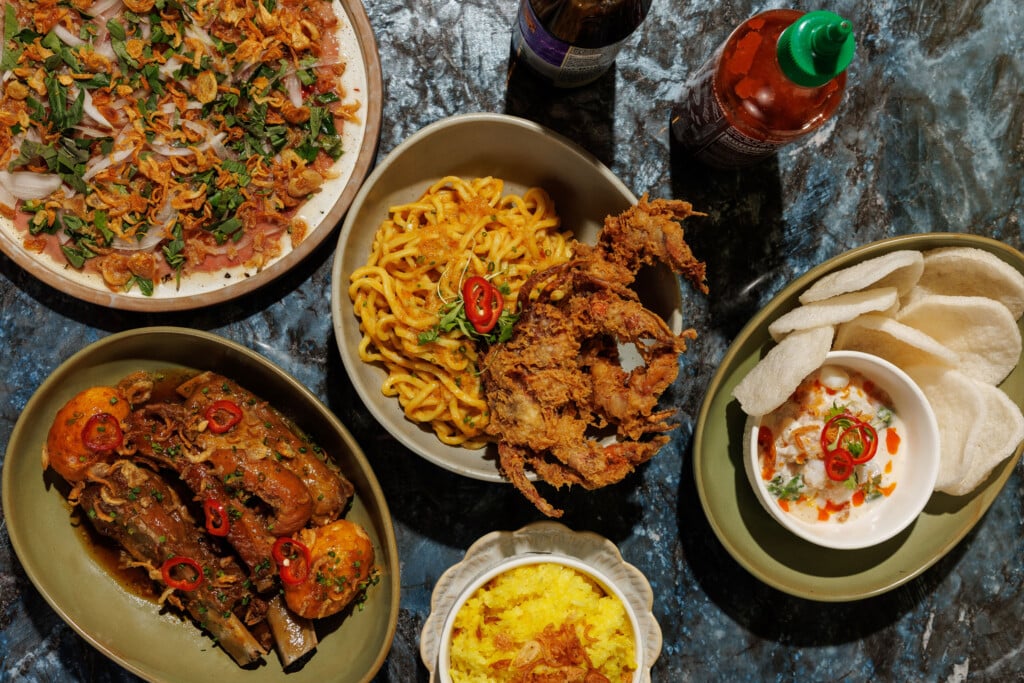
Cake Noodle
8 Fat Fat 8 Bar & Grille
Who could blame us for our fervor for cake noodle, a Hawai‘i Chinese dish of soft-boiled chow mein that’s fried to a crispy exterior, drenched in brown gravy and topped with crunchy chicken? Part of a rare breed of dive bars that cook up local Chinese food at restaurant quality, 8 Fat Fat 8 delivers cake noodle at its finest: crunchy on the outside and al dente on the inside. Those in the know can order an off-menu version (for a surcharge): Fried-to-order house chicken atop the noodles with a hit of ham har, a Cantonese fermented shrimp paste loved by local Chinese families for its pungent, explosive umami. It’s not for the faint of heart, but cake noodle doesn’t have to be. —Noelle Chun
1327 S. Beretania St., Makiki, (808) 596-2779, 8fatfat8hawaii.com, @eightfat

Photo: Steve Czerniak
Ginger-Crusted Onaga
Alan Wong’s
A co-founder of Hawai‘i Regional Cuisine, Alan Wong for decades has championed the state’s beekeepers, dairy producers, farmers, ranchers and fishers—among them the hook-and-line boats that catch his bestseller. Wong’s ginger-crusted onaga is addictive with sweet, savory, creamy flavors and a crust that teases the palate with a ginger essence. The dish was inspired by cold ginger chicken, a potluck staple many locals grew up with. Ginger-crusted onaga predates Wong’s original eponymous eatery, where a dedicated station produced 10,000 orders a year before the 25-year-old restaurant closed during the pandemic. Now, it’s back at his reprisal at The Kāhala Hotel & Resort, a dish as synonymous with Alan Wong’s as it is with modern Hawai‘i. —Melissa Chang
5000 Kāhala Ave., Kāhala, kahalaresort.com, @alanwongskahala

Photo: Aaron K. Yoshino
Lau Lau Stew
Faria
Kawehi Haug’s lau lau stew is a love letter to her grandpa. A Native Hawaiian firehouse cook, he packed salt-drizzled morsels of wild pig meat into lū‘au leaves and steamed them by the dozen; the next day, he stretched the leftovers to make lau lau stew. The dish is the lone holdover from Haug’s previous eatery and the only thing at her current one—Faria, O‘ahu’s only Portuguese restaurant—that’s not Portuguese. On a menu where nearly forgotten dishes like favish can bring local Portuguese to tears, lau lau stew has a similar effect on everyone. Its brothy mix of marinated pork and melting lū‘au with onions, carrots and potatoes is universal comfort food, and best eaten with a side of poi. —Mari Taketa
306 Ku‘ulei Road, Kailua, (808) 200-4953, fariahawaii.com, @fariahawaii

Photo: Aaron K. Yoshino
Coconut Cake
Halekūlani Hotel
When the coconut cake debuted at the Halekūlani, Hawai‘i wasn’t even a state and its hotels were the repositories of fine dining. Nearly 70 years later, the cake is one of the few holdovers on the Halekūlani’s menus. Subtle touches over the years, such as an amaretto pastry cream and coconut flakes, add elegance to layers of fluffy, gardenia-white sponge cake, which call to mind the not-too-sweet cakes of Chinese bakeries. At its heart, the signature cake is simple, much like the hotel’s original bungalows on the beach. That’s another reason we love this dessert: It doesn’t demand your attention, but is the quiet, finishing flourish to dinner. —Martha Cheng
2199 Kālia Road, Waikīkī, (808) 923-2311, halekulani.com, @halekulanihotel

Photo: Aaron K. Yoshino
Loco Moco
Liliha Bakery
Liliha Bakery may have not invented the ubiquitous loco moco—that honor goes to Café 100 in Hilo—but it may have perfected it. All six of the bakery’s locations serve loco moco, but die-hards insist you need to snag a seat at Liliha’s midcentury coffee shop counter on Kuakini Street to fully appreciate its greatness. Defined by simplicity, the loco moco shines in its details. Hand-formed hamburger patties charred on the grill and fresh eggs cooked to order harmonize over a bed of hot rice, all of it deluged with silky brown gravy. It’s a hearty balance of salt, fat, protein and starch that you’ll still be thinking about when you wake from your kanak attack. —Thomas Obungen
515 N. Kuakini St., Liliha, (808) 531-1651, lilihabakery.com, @lilihabakery

Photo: Aaron K. Yoshino
Guava Chiffon Pancakes
Cinnamon’s Restaurant
If breakfast is Hawai‘i’s main meal, then Kailua is its breakfast capital. At Cinnamon’s, a 41-year institution whose tables spill from the sunny yellow restaurant into the atrium of Kailua Square, you’ll see plenty of pops of glossy pink—the famous Guava Chiffon Pancakes, a morning take on the pink cake of the same name. Cinnamon’s layers cream cheese between buttermilk pancakes and covers the stack in a signature guava glaze crowned with a swirl of whipped cream. One bite and the jolt of sugar from the pink nectar zaps your sleepy brain into consciousness. When you think of Hawaiian-style pancakes, Cinnamon’s are the benchmark. —Thomas Obungen
315 Uluniu St., Kailua, (808) 261-8724, cinnamons808.com, @cinnamonskailua

Photo: Aaron K. Yoshino
Meat Jun
Kim Chee II
Save for a few local-style restaurants on the continent, you’ll only find meat jun at Korean eateries in the Islands—one reason it’s a dish Hawai‘i expats crave. Each version varies in its dipping sauce, batter and thickness of beef, but it’s tough to beat Kim Chee II. The Chun family’s marinated beef gets a thin coating of egg batter that turns golden in the pan. Sliced into tender, bite-size strips that soak up the soy-based sauce, it makes for the perfect plate lunch entrée. —Thomas Obungen
3569 Wai‘alae Ave., Kaimukī, (808) 737-7733, @kimchee2kaimuki

Photo: Aaron K. Yoshino
Aloha Combo
Blue Seafood Co.
In an island state whose coral reefs teem with tasty fish, ‘ahi still steals the show. The deep-sea tuna stars in today’s poke bowls and sashimi platters—but locals in the know seek out smaller reef fish you can eat fin to tail. Enter Blue Seafood Co. The Chinatown newcomer’s Aloha Combo is a Who’s Who of nearshore swimmers—including ta‘ape, menpachi, akule and weke—all on ice at Blue Seafood’s nearby market. Especially notable and delicately sweet is the ta‘ape, an invasive snapper crowding out Hawai‘i’s native species. We watch a cook toss the fish in a light coating and drop them into a deep fryer. Minutes later, we’re tearing into hot, succulent pieces with our fingers and munching the crunchy fins and tails like chips. With fresh mangosteen from another stall, it’s the best lunch of early summer. —Mari Taketa
Maunakea Marketplace, 1120 Maunakea St., Chinatown, (808) 888-0078, @blueseafoodcompany

Photo: Aaron K. Yoshino
Char Siu Croissant
The Local General Store
What do you get when Hawai‘i’s beloved manapua meets a classic French pastry? The answer is The Local General Store’s char siu croissant. Glossy with char siu glaze and packed with tender, bright red Chinese barbecued pork, the pastry pulls together both sides of the James Beard semifinalist shop, where Harley Tunac Chow is the baker and husband Jason Chow helms the all-local, whole-animal butchery. Chow’s family recipe showcases some of the finest char siu on the island, this one made with pork from Mountain View Farms in Wai‘anae and Kualoa Grown; the red comes not from artificial coloring but traditional Chinese ingredients. The croissant is stretchy and layered, merging Tunac Chow’s personal touch with her time at Jane the Bakery in San Francisco when it won the city’s Best Croissant Competition in 2018. —Noelle Chun
3458 Wai‘alae Ave., Kaimukī, (808) 777-2431, thelocalgeneralstorehi.com, @thelocalgeneralstorehi

Photo: Aaron K. Yoshino
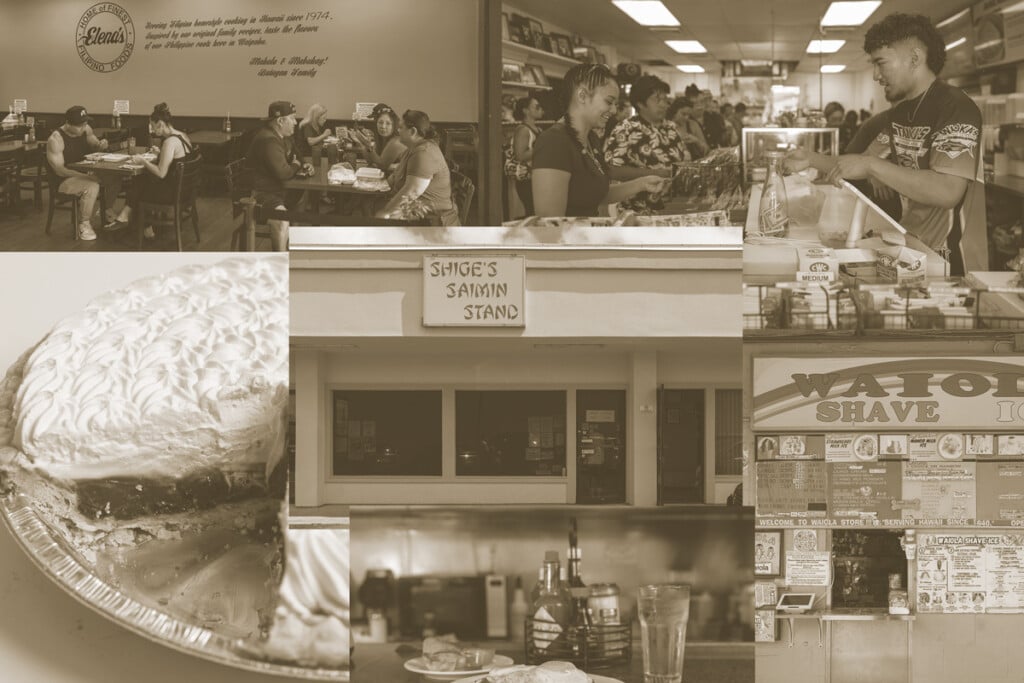
Chocolate Haupia Cream Pie
Ted’s Bakery
A few years after Ted Nakamura began making pies at his family’s grocery store in the 1990s, he accidentally created a legend. He’d just made a haupia cake, he told a local newspaper, and since someone had made chocolate pies, he combined the leftovers. Ted’s Bakery hasn’t been the same since. The pie’s buttery short crust cradles a generous well of dark chocolate cream and a jiggly layer of haupia pudding that’s topped with tufts of airy whipped cream. It gained cult status when grocery stores islandwide started buying them, fueling the bakery’s expansion to a takeout restaurant. —Thomas Obungen
59-024 Kamehameha Highway, Hale‘iwa, (808) 638-8207, tedsbakery.com, @tedsbakeryhi

Photo: Aaron K. Yoshino
Saimin and Burger
Shige’s Saimin Stand
Saimin is an anchor in our islands. We eat instant packages for breakfast or late night, order the soupy noodles at okazuyas and carnivals and tuck into artisan versions at high-end restaurants. But for saimin as local craft, it is difficult to not think of Shige’s, which has made its own dashi broth and handmade wheat noodles in Wahiawā since 1990. While saimin is often seen as the hero of the retro letterboard menu, the burger is the Robin to the soup noodles’ Batman. Shige’s faultless representation of the basic local burger is saimin’s essential companion. Simple stacks of lettuce, onion and tomato accentuate the beefy, juicy patties and soft buns—washed down with a slurp of saimin, of course, which maybe turns out to be the Robin after all. —Noelle Chun
70 Kukui St., Wahiawā, (808) 621-3621, @shigessaiminstand

Photo: Aaron K. Yoshino
Fried ‘Ulu
Mud Hen Water
OK, we know that fried ‘ulu is nothing groundbreaking: Chefs who try to incorporate the canoe crop usually default to frying or mashing the starchy fruit. And Ed Kenney has made more inventive ‘ulu dishes, such as roasted ‘ulu with black bean and orange, but it’s the fried ‘ulu that we order whenever it’s available. (When breadfruit isn’t in season, he subs in sweet potato.) It’s the Hawaiian version of the erstwhile Town’s fries, fried with fresh herbs like sage and parsley and served with “chili peppa wata mayo.” While fried ‘ulu can sometimes be leaden, Mud Hen Water’s are always crispy on the outside and fluffy, nearly creamy on the inside. It reminds us why we need more ‘ulu on menus: for resiliency, for cultural and environmental diversity, and for pure deliciousness. —Martha Cheng
3452 Wai‘alae Ave., Kaimukī, (808) 737-6000, mudhenwater.com, @mudhenwater

Photo: Aaron K. Yoshino
Garlic Chicken Sliders
Basalt
Lance Kosaka’s garlic chicken sliders predate Basalt. He’s brought them to every restaurant he’s helmed since coming up with them nearly two decades ago at The Pineapple Room. They were an instant winnah back then and still are now. The dish combines two of Hawai‘i’s favorite plate-lunch classics—furikake garlic chicken and mac salad—into a sandwich. The salty-sweet-crunchy fried chicken chunks combined with creamy mac salad underscores what we always knew about mac salad but perhaps couldn’t quite pinpoint until these sliders: Mac salad shines not as a side dish, but as a condiment. —Martha Cheng
2255 Kūhiō Ave., Waikīkī, (808) 923-5689, basaltwaikiki.com, @basaltwaikiki

Photo: Aaron K. Yoshino
Shave Ice
Waiola Shave Ice
Waiola knows how we think when we arrive at the shave ice counter—our favorite syrup flavors, please! And condensed milk! Mochi balls!—and Waiola isn’t having it. “Size?” It was more of a terse directive. “How many? NOW, what toppings and flavors?” That was then. The memories flavor our childhood in urban Honolulu, where Waiola, which opened in 1940, still reigns as the old-school shave ice king. Now, Waiola codifies its step-by-step ordering protocol on its menu boards. And even as 21st-century arrivals expand O‘ahu’s shave ice world—sporting fancier shaved milk ice and farm-to-table syrups with fresh fruit—Waiola’s generational allure of wispy soft ice, generous pours of kalakoa syrups and a place in the sun on its weatherworn bench keep us coming back. —Mari Taketa
Multiple locations, waiolashaveice.co, @waiolashaveice

Photo: Catherine Toth Fox
Malasadas
Agnes’ Portuguese Bakeshop Truck
A Shrovetide tradition turned year-round treat, malasadas are more popular in Hawai‘i than in their native Portugal. Plantation workers from Madeira and the Azores brought over the fried doughballs tossed in sugar and ate them to clear stocks of rich, indulgent ingredients in preparation for Lent. Today, you’re more likely to find malasadas in the office break room or under a dollop of ice cream for dessert. In Kailua, Agnes’ fries up crispy-craggy discs with holes in the middle, the closest version to malasadas in the old country. Public anguish ensued when the longtime bakery closed, until a superfan revived it as a food truck, bringing back Agnes’ malasadas—and with them relieved Windward residents who missed the eggy sweets. —Thomas Obungen
5 Ho‘olai St., Kailua, (808) 284-4963, @agnesbakeryhawaii

Photo: Aaron K. Yoshino
Hot Kūlolo Sundae
Niu Soft Serve Parlour
Poi is often the first solid food babies eat in Hawai‘i—and kūlolo is its playful teenage cousin. Niu’s sundae is the most fun version of a kūlolo dessert we’ve found. Whole kalo roots are cleaned and steamed in-house, mixed with brown sugar and coconut milk and nursed through a low, slow 24-hour simmer that produces the caramelly edge all kūlolo aspires to. The memory of it dripping molten down a soft-serve peak like lava down Kīlauea, followed by a drizzle of toasted mac nuts like a blessing rain, brings us back for another. Similes aside, hot kūlolo sundaes are what ‘Aiku‘e and Kekahu Napoleon-Ahn, brothers who own Niu, created as a chill expression of their Native Hawaiian heritage. —Mari Taketa
2320 S. King St., Mō‘ili‘ili, niusoftserve.com, @niusoftserve

Photo: Aaron K. Yoshino
Menu D
Helena’s Hawaiian Food
The line to get into Helena’s mirrors school schedules: It’s longer when kids stop by for their last taste of Hawaiian food before flying off to college, or their first taste when they come home. Regulars know their orders before they arrive. Many simply order Menu D, which combines kālua pig, lomi salmon, squid lū‘au and Helena’s famous pipi kaula short ribs with poi or rice. (There’s no discount—the different combos just expedite ordering.) From there, you can add on butterfish, ‘opihi, tripe stew or whatever else completes your favorite Hawaiian feast. All of it is unchanged from 80 years ago, when Helen Chock first opened her doors—and students sailed to college on steamships. —Melissa Chang
1240 N. School St., Kalihi, (808) 845-8044, helenashawaiianfood.com, @helenashawaiianfoood

Photo: Aaron K. Yoshino
Li Hing Float Sherbet
Asato’s Waikīkī
Scoops of Neale Asato’s li hing float sherbet take us back to hot and sticky afternoons after school, when we lined up at neighborhood crack seed stores. The prize: strawberry Icees slathered over vanilla ice cream, doused in salty-sour-sweet li hing juice and sprinkled with red li hing powder. Kids and kids at heart still seek out this nostalgic treat, but with crack seed stores disappearing around Hawai‘i, Asato, a James Beard Award nominee, preserves these flavors in a silky sherbet. He swirls ribbons of vanilla ice cream into strawberry sherbet and hits it with his signature li hing syrup—part of a repertoire of sherbets that celebrate local memories. —Noelle Chun
Hyatt Regency Waikīkī Beach, 2424 Kalākaua Ave., Suite 113, Waikīkī, pints available at Foodland Farms, asatos.com, @asatoswaikiki

Photo: Aaron K. Yoshino
Nori Chicken
Fukuya Deli
The size of our okazuya plate may vary, but certain items from Fukuya’s point-and-choose selection will always be in our order. At the top of the list is nori chicken. This is a Hawai‘i okazuya creation—but where others deep-fry their chicken, Fukuya marinates boneless pieces, wraps them in nori and pressure-cooks until tender. The resulting morsels are egg-ceptionally moister and tastier than their fried competitors. Nori chicken is newer, but items like shoyu chicken, chow fun and corned beef hash are as old as 87-year-old Fukuya, one of O‘ahu’s oldest okazuyas. Back in the day, it was local Japanese who flocked to these only-in-Hawai‘i delis in old neighborhoods. Now, it’s all of us. —Melissa Chang
2710 S. King St., Mō‘ili‘ili, (808) 946-2073, fukuyadeli.com, @fukuyadeli

Photo: Martha Cheng
Oxtail Soup
‘Aiea Bowl
People on the continent don’t understand: Even though it’s warm in Hawai‘i most of the time, we still love our hot soups. Of these, the most quintessential is oxtail soup. Local-style oxtail soup tends to have a Chinese bent with star anise, dried orange peel and ginger; ‘Aiea Bowl’s leans even more into this flavor profile with red dates and whole shiitake mushrooms. The broth is collagen-rich from the long-simmered oxtails, while the dipping sauce of ginger and ponzu adds a welcome brightness. And of course, no visit to this bowling alley diner is complete without a slice of lemon crunch cake. —Martha Cheng
99-115 ‘Aiea Heights Drive, ‘Aiea, (808) 488-6854, aieabowl.com, @aieabowl

Photo: Aaron K. Yoshino
Pork Adobo Fried Rice Omelet
Elena’s Restaurant
Family lore has it that Elena Butuyan had a dream about a pork adobo fried rice omelet. In it, the founder of Elena’s Restaurant saw her pork adobo diced up, stir-fried with rice on a flattop, seasoned and folded into a thin veil of scrambled egg—and a Filipino classic gave rise to a modern one. Over 50 years later, adobo fried rice omelet isn’t just the bestseller at the Waipahu eatery and its roving food truck, it’s Hawai‘i’s most loved and mainstream Filipino mashup. The crepelike omelet, fat with promise, holds in the heat of the griddle; cut in and poofs of steam diffuse aromas of vinegar and soy and pork fat. Now in its second generation at Elena’s, the Butuyan family has trademarked its creation along with sibling omelets. Now that’s legit. —Thomas Obungen
96-866 Moloalo St., Waipahu, (808) 676-8005, elenasrestaurant.com, @elenasfilipino

Photo: Aaron K. Yoshino
Haku Lei Po‘o
Kapa Hale
Keaka Lee’s playful side is evident in Kapa Hale’s menu. Listen to his servers explain items like Poke Doki, Naan Ya Business and U Win Sum & U Dim Sum and you’ll see. An exception is Lee’s Haku Lei Po‘o, a salad that celebrates Hawai‘i’s farmers. Baby greens fill an O-shaped bowl topped with seasonal fruits and vegetables (think ‘ulu chips and pickled star fruit) and a Kona coffee crumble. Indeed, you could put the bowl on your head and the salad would look like an extra-large version of the lei crown it’s named for. Haku Lei Po‘o was the first dish Lee created when he came home to Honolulu after years of cooking in New York City. As light as it is, it’s full of heartfelt respect. —Melissa Chang
4614 Kīlauea Ave., Kāhala, (808) 888-2060, kapahale.com, @4614kapahale

Photo: Aaron K. Yoshino
Poke
Tanioka’s
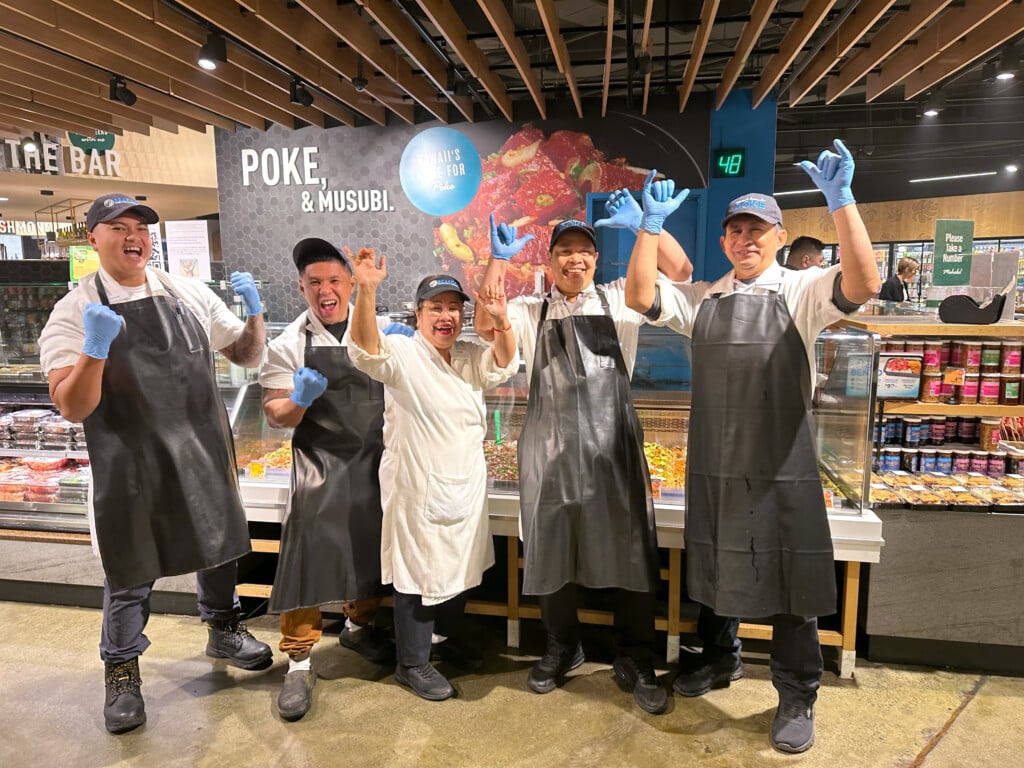
Whenever we get depressed about the trend toward cheap and low-quality, standing in line at Tanioka’s gives us hope. Here, we see locals in T-shirts and slippers buying poke even when it’s $35 a pound and up—a reminder that while poke may be everywhere (or maybe because it’s everywhere), we know and appreciate quality. While other poke spots offer previously frozen ‘ahi, Tanioka’s keeps the focus on fresh and local. Seasonings lean on the traditional, including onion and limu, but what’s fun about Tanioka’s is the way it combines poke with other dishes, as in the poke tater tots and miso butterfish poke bowl. What we love here: the willingness to experiment without losing sight of what made poke and Tanioka’s good in the first place. —Martha Cheng
94-903 Farrington Highway, Waipahu, (808) 888-0078, taniokas.com, @taniokas
Melissa Chang is a longtime contributor to Frolic Hawai‘i. @melissa808
Martha Cheng is the former dining editor of HONOLULU Magazine and now a contributor. @marthacheng
Noelle Chun is a contributor to HONOLULU Magazine. @aiyanoelle
Thomas Obungen is the former Special Projects Editor of HONOLULU Magazine and now a contributor. @thomasohhh
Mari Taketa is the dining editor of HONOLULU Magazine and editor of Frolic Hawai‘i.