Get ready to light up the night! The Mid-Autumn Festival and Parade presented by Hawai‘i National Bank Foundation is back on Saturday, Sept. 19, with a full day of culture, entertainment and moonlit magic. You can look forward to lion dances, martial arts demonstrations, traditional dishes, craft vendors, keiki activities and stargazing. This year, there will be two lantern-making workshops, so you can proudly carry your illuminated creation in the parade through Chinatown.
Often referred to as the Moon Festival, this Chinese holiday celebrates the conclusion of the fall harvest on the 15th day of the 8th lunar calendar month, corresponding with the full moon—this year, on Sept. 26. Loved ones usually come together to enjoy the moonlight, eat mooncakes and exchange well-wishes and greetings for good fortune.
The event is organized by Chinatown 808, a local nonprofit known for its lunar new year festival and dragon boat races. The organization aims to uplift Chinatown’s businesses and residents while breathing new life into the historic area through community programs.
The Mid-Autumn Festival will take place on Saturday, Sept. 19, from 10 a.m. to 10 p.m. at the Chinatown Cultural Plaza, 100 N. Beretania St.
How Much It Costs
Admission is free. Most vendors will accept both cash and credit card payments.
Where to Park
Parking is available in the Chinatown Cultural Plaza main parking lot (100 N. Beretania St., entrance on Maunakea Street) for $2 for the first hour and $2 for each additional 30 minutes. Or pay the $5 evening flat rate if you enter after 6 p.m. There are additional municipal lots nearby as well as street parking.
Photo: Andrea Lee
What to Do
The lantern parade is the highlight of the day’s festivities. You’re invited to dress up in Chinese cultural costumes and carry your own homemade lantern as you march. The parade procession will start at 6:30 p.m. at the Hawai‘i National Bank main branch and continue up Maunakea Street towards Sun Yat-sen Mall. Sign up to participate.
Bring a lantern from home or register for one of two lantern-making workshops ($5) at 11 a.m. and 2 p.m. You can also enter your lantern in the lantern-making contest. Submissions will be accepted from 2 to 2:30 p.m., and winners will be announced at 3:30 p.m. Register for the junior or open divisions for a chance to win a cash prize.
Photo: Courtesy of Chinatown 808
Families will stay entertained with keiki activities and a meet-and-greet with real bunnies. Once night falls, get a closer look at the moon and stars with help from Stargazers of Hawai‘i, who will set up a telescope on the second floor of the Chinatown Cultural Plaza from 6 to 10 p.m. You can also watch a packed schedule of live entertainment on the Moon Gate Stage with several dance troupes, martial arts groups and lion dances throughout the day and night.
Photo: Courtesy of Chinatown 808
What to See
10:30 a.m. Lung Doo Benevolent Society
11 a.m. Festival Blessing
11:30 a.m. Ryugen Taiko
1:30 p.m. Mun Lun School
3 p.m. Peony Dance Group
4 p.m. Hawai‘i Lion Dance Association
5 p.m. Chinese Lion Dance Association
6 p.m. Sing Yung Dragon & Lion Dance Association
6:30 p.m. Parade
7 p.m. Gee Yung International Dragon & Lion Dance Association
9 p.m. Yeung Dak Physical Culture Association
Note: Times are subject to change.
Photo: Courtesy of Chinatown 808
What to Eat & Buy
Don’t leave the festival without snacking on a traditional mooncake, a golden-brown pastry stuffed with a sweet or savory filling, representing reunion and togetherness. A selection of popular Chinese dishes will also be available for purchase. Plus, enjoy a variety of foods from local vendors, including potstickers, poke bowls, bubble tea and teppanyaki. You can also shop local crafts and cultural gifts.
Here’s a sampling of who will be there:
Anastacia’s Pizza
Andagi
Blue Truck Teppanyaki
Confections by Pakalana
Dozers Donuts
First Meet Studio
Good Luck Gems
Hawaiian Cane Juice
Hawaiian Honey Cones
HK Fashion
Ho‘ohana Creations
Hott Potstickers
I am Tanukis
Island Craves
Judy Shop
Kapa Moi Lions Club Shave Ice
Legend Seafood Restaurant
Mama Merce’s Kitchen
Mini Munchiez
Olay’s Thai Lao Express
Simply 3D Prints
Tamada Sweets
Teapresso Bar
Teddy Bear Mobile Hawai‘i
The Henna Shack
The OldTaku
These Stuffed Cookies
Treasures by Lokomai
Twisted Pretzel
UnitedHealthcare
Yang’s
Young’s ‘Ohana Mākeke
Tips
Make your own lantern to show off during the parade. Here’s a tutorial using supplies you probably already have at home.
It’s optional, but you’re encouraged to dress up in Chinese cultural costumes.
The Mid-Autumn Festival is all about spending time together as a family, so make sure to capture the moment by snapping a picture in the photo booth with a celestial moon background.
The best place to watch the parade is along Maunakea Street between King and Beretania Streets.
Mid-Autumn Festival, Saturday, Sept. 19, 10 a.m. to 10 p.m., Chinatown Cultural Plaza, 100 N. Beretania St., Chinatown, chinatown808.com, @chinatown808hi
Aloha Festivals is coming to West O‘ahu as part of its 80th anniversary festivities! Enjoy live performances, cultural demonstrations and a mākeke featuring local vendors and ʻono food. The Royal Court will make a special appearance, as well as Hālau Hula ‘O Hokulani, Da Anakalaz and Ke‘olu.
Monday, Sept. 14, to Friday, Sept. 18, 8 a.m. to 4 p.m.
Feast your eyes on dynamic 3-D structures built entirely of canned goods by teams of local architects and engineers. Stop by the contest’s new downtown location to cast your vote for the People’s Choice Award winner. Afterwards, the canned food will be donated to the Hawai‘i Foodbank.
Family-friendly, free to view, $1 donation per vote ($5 minimum) for People’s Choice Award, Central Pacific Bank atrium, 220 S. King St., Downtown, aiahonolulu.org, @aiahonolulu
Join a mega, harbor-to-harbor cleanup of the Magic Island and Ala Wai areas to remove plastic and trash debris from the coastline. You’ll be rewarded with a celebratory zero-waste party to follow, featuring a reggae set by Ooklah The Moc, an eco-friendly business marketplace, a community book swap, thrifted treasures and educational keiki activities.
Taste different types of taro, learn to pound poi, drink kava, listen to speakers, shop local vendors, enjoy cultural performances and get hands-on with keiki activities. There will also be hula by Halau I Ka Lima Kuhilani and live music from Jonah Davis. Save time by pre-registering for the event here.
Mānoa Valley Theatre opens its new season with an emotionally charged production driven by the music of Alanis Morissette’s iconic ’90s album. You’ll want to sing along to your favorite angst anthems, like “You Oughta Know” and “Ironic,” while following a plot line about the (seemingly) picture-perfect Healy family.
Oktoberfest at Salt at Our Kaka‘ako. Photo: Alexander Gates
Oktoberfest began as a Bavarian tradition to celebrate a prince’s wedding. Now it has spread around the world as a celebration of great German beers, food and music—even in the middle of the Pacific. There are some changes to this year’s lineup of festivals around Honolulu, so plan accordingly. Grab a stein and bring your empty belly!
One of Hawai‘i’s newest breweries is joining the celebration for the first time this year. Tenth anniversary limited-edition Teku stein-style glass mugs will be available for purchase ($25 including first pour), to be filled with three different German beers: hefeweizen, pilsner and dunkel.
The popular event from Village Bottle Shop & Tasting Room spans consecutive Saturdays and features stein-hoisting competitions (6 to 8 p.m.) with prizes. Look for the largest selection of German beers in Hawai‘i from classics such as Ayinger, Spaten and Paulaner. The first 96 people each night get a free stein. German brats will be available from Village Bottle Shop, with pretzels and other baked goods for sale from Aloha German Bakery. Wear your best lederhosen and dirndl with dancing shoes because dance music by Mike Lewis & Friends featuring The Matterhorns will be playing both evenings.
Hana Koa’s kickoff celebration starts Sept. 19 with the release of its annual Hammershlager Festbier and Foundling Dunkel Lager. German-inspired food will be available, including a schweinebraten plate ($28) of slow-roasted pork shoulder with mustard gravy, sauerkraut and warm potato salad, available only Sept. 19. Every day from the 19th to Oct. 3, you’ll find beer brat hot dogs ($10) with fixings and knotted soft pretzels ($6.50).
Waikīkī Brewing’s brewhouse remodel means it won’t be hosting a parking lot party this year, but four new Oktoberfest beers, the largest locally brewed selection on O‘ahu, will celebrate the season. The flight-and-pint bundle ($19) makes a return: receive 4-ounce pours of Munich-Style Helles Lager, German-Style Festbier, Munich Dunkel Lager and Traditional Bavarian Hefeweizen, then choose a full pint of your favorite (pints purchased separately are $9). Also starting Sept. 25 and going for a few weeks are German food specials. The Festbier is on tap to try now, with a matching limited edition T-shirt available for purchase. Growler fills of all four beers will be $28.
Kailua Fall Festival
Saturday, Sept. 26, 5 to 10 p.m.
Free entry, party bus wrist band ($22), or VIP for priority entry and seating ($65)
Kailua’s annual block party and trolley crawl is back, with free entry to the street festival and concert for the whole family, including pets. If you’re drinking, upgrade to a wristband that grants access to Windward side bars, including Lava Bar, Kailua Town Pub, Big City Diner, Uahi Grill, Banyans, Bottleheads and Lanikai Brewing. A party bus is included between venues. VIP tickets include guaranteed seating and discounts at some venues. See website for parking, transportation and entry details. This event is family-friendly with keiki activities as well.
Oktoberfest 2026 at Weyand Field, Schofield Barracks
Open to military/DOD ID holders and their guests, this family-friendly event includes traditional German beer, food and music by the 25th Infantry Division Band, plus a Keiki Root Beer Festival, Mr. & Mrs. Oktoberfest competition, keg competitions and bounce houses. The evening starts with a Wurst 5K Fun Run with pretzels, brats and chocolate cake to eat along the way ($25 registration, $30 late).
Beer Brats at Beer Lab Hawai‘i
Starts Thursday, Oct. 1
The Hall at Pearlridge and Puck’s Alley locations only
Beer Lab is joining the fun by hosting a Sausage Fest at two locations. Beginning Oct. 1, find homemade beer brats and other German-inspired food dishes and mega beer mugs for extra big pours!
Aloha Beer Co. takes advantage of its open-air beer garden in Kaka‘ako to celebrate the season. The Friday night party features the Aloha Fest Bier limited release, available in $25 keepsake steins ($10 refills all night). A Drindl & Lederhosen Contest will award the best dressed. Watch while enjoying Oktoberfest food menu specials.
Returning indoors to the Banyan Tree Showroom, this festival is open to active, retired, US military and DOD ID holders and their guests. It also sells out quickly, so book tables in advance. The event features a large selection of favorite German foods like sauerbraten, schweinshaxe, bratwurst and more, plus a few German beers. A live German band plays songs for dancing all night, with breaks for stein-hoisting competitions.
Lanikai Brewing is celebrating Oktoberfest with a full-day celebration at its biergarten-themed taproom in Kailua. Three German-style beers will be tapped: a märzen, a helles and a hefeweizen. There’ll also be non-alcoholic drink specials, an apfelschorle and lemon spezi. German-inspired food items will be available all day, but the highlight is the inaugural “Brat Boss” competition at 6 p.m. Competitors will have 10 minutes to eat as many brats as they can, and the winner gets a $100 gift card, a crown and bragging rights. Register online by Sept. 10. Entrants receive an exclusive T-shirt and swag.
Adorned in Hofbrauhaus decorations, the church’s cafeteria is transformed into a venue to drink, eat and dance the night away. A German buffet by Chef Stefan is paired with German beers on tap as well as German wine, both included in the price. Mike Lewis & the Matterhorns will play polka and other lively tunes and be joined by German dancers and other musicians throughout the evening.
Other bars and breweries will be celebrating too—check out food and beer specials at Off the Wall and other places around town. Remember, Oktoberfest isn’t just an excuse to drink beer. It’s an excuse to drink a lot of beer! And keep an eye out for local breweries releasing Oktoberfest beers this year. Prost!
Alexander B. Gates, a BJCP Certified Beer Judge and Cicerone Certified Beer Server, is a regular contributor to Frolic Hawai‘i.@alohastatebeer
Sept. 15 marks the start of Latine and Hispanic Heritage Month. Celebrations are as diverse as the multitude of identities, communities, and lived experiences honored today. Here in Hawai‘i, we remember the Mexican vaqueros invited by King Kamehameha III to share cattle ranching knowledge in the era of paniolo (a Hawaiian adaptation of the word “español”), the migration of Puerto Rican laborers during the rise of sugar in the islands and more.
From the early Boricua Hawaiiana to new Latine generations, these titles explore the vast histories and deep intersectionality of Hispanic and Latine locals through a poetry collection that considers mothering and mother tongues, an award-winning YA novel-in-verse about finding one’s voice and a beloved local picture book forthcoming in Spanish. We at Da Shop: Books + Curiosities hope these titles inspire learning, connection and celebration during Latine and Hispanic Heritage month.
This thoughtful and stunning tome documents the 200-year history of Latine and Hispanic peoples in Hawai‘i. Dr. Rudy P. Guevarra Jr. is a Mexican-Filipino scholar whose seminal work narrates the events, notable figures and socio-political context for centuries of Latinx migration and community building, while addressing complicated settler colonial structures, racism, and prejudices that challenge us to consider who we call “local” and who this definition continues to exclude.
This beautiful collection by local Xicana poet Amanda Galvan Huyhn is a moving ode to the heartache of mothering in both its abundance and its absence. In visceral text, Huynh considers the menacing calculations of assimilation cast against her cultural inheritance and the heft of carrying heritage forward to new generations and an imagined future. A powerful collection that is not to be missed.
“Vivo en Hawái. Tengo una ‘ohana,” says young Kainoa in this forthcoming Spanish-language translation of the beloved Ordinary ‘Ohana. The successive show-and-tell is an invitation of belonging, made warm and welcoming by the young narrator’s nonchalance: His big, diverse family is entirely normal, ordinary. This empowering and relatable story cheerily illustrates how our ‘ohana often expand beyond the definitions of bloodlines to those who lovingly show up in our lives. A joyful place-based picture book for Spanish language learners and native speakers alike!
While not rooted in Hawai‘i, The Poet X, written by former Youth Poet Laureate Afro-Latina Elizabeth Acevedo, navigates a coming-of-voice narrative of first generation Xiomara Batista that is relatable and accessible to our ‘ōpio here in the islands. Winner of the National Book Award and the prestigious Pura Belpré award, this novel-in-verse paces Xiomara’s hopes, rage, fear and angst with a masterful tempo. And P.S. you can grab an autographed copy at our shop that Elizabeth was so kind to sign when she visited!
It is not often we recommend a non-book item, but here is where publications fall short: Blase Camacho Souza, a trailblazing second-generation Boricua Hawaiiana, wrote extensively about the Puerto Rican experience in Hawai‘i. Her vast writing lives primarily in digital archives. Souza not only pursued her BA from the University of Hawai‘i but additionally gained a degree in Library Information and Sciences from the Pratt Institute. A longtime teacher for the Hawai‘i Department of Education, she also was a co-founder of the Hawai‘i Association of School Librarians, an organization that continues to enrich our library professionals today. For how she championed the preservation of her cultural history as an author, archivist, and advocate, and additionally built communities through her librarianship, we encourage you to peek into the online archives, read her work and celebrate her legacy.
Da Shop: Books + Curiosities, 3565 Harding Ave., Kaimukī, open Wednesday through Sunday from 10 a.m. to 4 p.m., (808) 421-9460, dashophnl.com, @dashophnl
AVAILABLE SERVICES
Emergency ambulance, fire, lifeguard, medical examiner and police services will be available.
TheBus will operate on a Sunday schedule. Visit thebus.org for routes and other information.
Skyline will operate on a normal schedule, from 4 a.m. to 10:30 p.m. Visit honolulu.gov/skyline for rider information.
Refuse will be collected. Transfer stations, convenience centers, H-POWER and the Waimānalo Gulch Sanitary Landfill will be open. Visit envhonolulu.org for more information.
CANCELLATIONS AND CLOSURES
The Neal S. Blaisdell Box Office will be closed.
The People’s Open Markets will not be held.
All satellite city halls and driver’s license offices will be closed.
All post offices will be closed.
All public libraries will be closed on Labor Day Weekend (Sept. 5–7).
Hanauma Bay Nature Preserve will be closed.
TRAFFIC REGULATIONS
On-street parking will be free, excluding the meters on Kalākaua Avenue along Queen Kapi‘olani Park, metered parking lots and other streets. See the full list here.
Parking in Lanikai will be restricted from 10 a.m. to 3 p.m. for the three-day holiday.
Traffic lanes will not be coned for contraflow.
Photo: Reid Shimabukuro
Now in its 4th year, Megabon presented by Pacific Media Group brings bon dance culture to Hawai‘i in a big way. Shop more than 60 local food and craft vendors, play Japanese festival games, listen to live entertainment and, of course, participate in a mega-sized bon dance. Last year, 12,000 attendees joined in on the fun, but organizers are aiming for 20,000 this year.
If you’ve attended in the past, you can expect a similar experience, with slight tweaks to the location of booths and a couple of new bon dance groups performing. This year for the first time, there will be an admission fee of $1 to help cover event costs.
The festival was created in 2023 by Todaiji Hawai‘i and JCI Honolulu to rekindle interest in bon dances in Hawai‘i and provide a space to promote local performers and vendors. The organizing team works with their sister chapters from Osaka to bring authentic games, merchandise and the true essence of the bon dance to Hawai‘i.
Megabon will take place on Saturday, Sept. 12, from 3:45 to 9 p.m. at Leeward Community College, 96-045 Ala ‘Ike Street, Pearl City.
How Much It Costs
The admission fee is $1. Children under 10 years old are free. An Early Access Pass ($10) will get you entry to the event at 3 p.m., so you can beat the crowds and snag a seat near the center stage. VIP Passes ($50) are already sold out and include early entry, VIP lounge access and parking.
Food, beverages, crafts and merchandise will be available for purchase with cash or credit card.
The festival games will require scrips, which can be purchased at the scrip booth with cash or credit card. Scrips will be sold for $20 per sheet of 25 scrips ($0.80 per scrip).
Here are the game prices:
Wanage (Ring Toss) – 5 scrips
Toy Sukui (Toy Fishing) – 6 scrips
Yo-Yo Sukui (Yo-Yo Fishing) – 6 scrips
Shateki (Shooting Game) – 7 scrips
Where to Park
No parking will be available at Leeward Community College, so here are your options:
Ride Skyline. There is a rail station at the front entrance of Megabon. Park for free at the rail stations and ride to the event for $3, which includes a 2-hour transfer period. Plan your route here.
Park for free at the following locations and take a complimentary shuttle to the event. Shuttles will run from 2:30 to 10 p.m.
Waipahu High School (3 lots including the football field lot in the back)
Pearl City Elementary
Pearl City Library
Take Lyft or Uber. The rideshare drop-off area will be at gate 2, lot 2 on the left side of Ala ‘Ike Street. Refer to the map here.
Photo: Rolo Tamasi
What to Do
You’ll feel like you’re strolling through an authentic Japanese street festival as you explore the food, craft and game booths. Gather around the giant 16’ by 16’ yagura (stage) to watch the heart-pounding taiko drum performances from Ryugen Taiko, then jump in the circle to follow the lead of five bon dance groups.
Shop for traditional bon dance merchandise such as uchiwa (fans), omamori (amulets), tenugui (towels) and even dog happi coats. Local vendors will be selling crafts and products too. Play traditional Japanese games, including Shateki (Shooting Gallery), Yo-Yo Sukui (Fishing Game) and Toy Sukui (Toy Fishing), most hand-built locally for the event. You’ll be rewarded with prizes sourced from Japan.
Visit community booths to gather information and learn something new. Here’s a list of who will be there:
Hamada Financial Group
Hi Point Roofing
Hitachi Rail, Department of Transportation (DTS) & Skyline
Japan Airlines
Japan-America Society of Hawai‘i (JASH)
Kaiser Permanente
Kawaii Kon
Leeward Community College
Moanalua High School World Language Learning Center
Come hungry so you can taste your way through the festival. Enjoy traditional Japanese festival foods, like skewers, taiyaki, udon and andagi, as well as local favorites served by O‘ahu small businesses. The beer garden by Aloha Beer Co. will serve local brews on tap, Japanese chuhai (hard seltzer) and sake.
Check out the list of food and beverage vendors:
Aloha Matcha Hawai‘i
Da Bald Guy
Currents Andagi
Fattitude
Hawaiian Honey Cones
HI Eats & Treats
Island Squeeze Lemonade
Kai’s Coolers
Kajiya
Kenny Boy Ice Cream
Livy’s Empanadas
Milky Way Shave Ice
Nicki’s Sweet Treats
Olay’s Thai Lao Express
Paddy Wagon
Pitch Sports Bar
Sato Seafood
Shantell’s Cocina
Slaybelles Fry & Grill
Str’Eats of Aloha
Sugah Daddeh’s Kane Juice
Supreme BBQ
Takoyaki Yamachan
Taqueria Hawai‘i
Tealicious Sweets
Teapresso Bar
Thai Lao Restaurant
The Local General Store
The Savellano’s Lechon
Waba Snacks
Waialua BBQ
Yamitsuki
Photo: Courtesy of Megabon
What to Buy
Here’s a list of craft, product and snack vendors:
The Women of Hālau Ka Waikahe Lani Mālie and Men of Hālau Kahulaliwai
Ryugen Taiko
4:35 p.m. Welcome Address
4:50 p.m. Bon Dance Part 1
Hawai‘i Shin Kobu Kai
Waipahu Soto Mission Bon Dance Class
O‘ahu District Bon Dance Club
‘Ewa Fukushima Bon Dance Club
6:10 p.m. Halftime Performance
Chinagu Eisa
Ryugen Taiko and Honolulu Fukushima
7 p.m. Bon Dance Part 2
Hawai‘i Shin Kobu Kai
Waipahu Soto Mission Bon Dance Class
O‘ahu District Bon Dance Club
Hawai‘i Eisa Shinyuu Kai
8:40 p.m. Closing Speech
8:45 p.m. Fukushima Ondo
‘Ewa Fukushima Bon Dance Club
Note: Times are subject to change.
Photo: Rolo Tamasi
Tips
Feel free to wear Japanese festival attire such as happi coats or yukata. Megabon happi coats and other merchandise will be for sale at the JCI Honolulu booth. If you spend $50 or more at the booth, score a complimentary limited-edition Megabon trading card (first 100 customers).
Wear sunscreen and a hat, especially if you come at 3 p.m.
Bring your own chairs if you want to sit around the yagura to enjoy the live performances.
Jump into the dance circle and try some moves! Watch the instructors in the inner circle, and you’ll catch on.
The first 500 people to visit the Department of Transportation Services booth will receive a free (unloaded) limited-edition Megabon Holo Card with a 2026 design.
Megabon, Saturday, Sept. 12, 3:45 to 9 p.m., Leeward Community College, 96-045 Ala ‘Ike Street, Pearl City, megabonhawaii.com, @megabonhawaii
Kame! Kame! (Eat! Eat!) The 7th Okinawan Feastival runs from Sept. 7–21 and features Uchinanchu-licious specials at 20 local restaurants and food businesses. Not only does it showcase a cuisine with a distinct flavor and character that is completely different from Japanese food, it’s also an ‘ono way to discover new eateries and revisit old favorites.
Go here for a complete list of specials and here to find out when each special is available and which you’ll need to preorder.
Okinawan Feastival is a delicious way we can support Okinawan-owned (and Okinawan-at-heart) restaurants and food businesses on O‘ahu. Since the opening of American Café in 1923, there have been over 350 in Hawai‘i. Most have closed, but a new generation of 57 Okinawan-owned eateries and food businesses are operating on O‘ahu today. Sadly, in the last six years, 21 have shut their doors. Feastival continues as a way to help the rest keep going.
Okinawan Feastival runs for just two weeks, but I hope these local restaurants will continue to get your support throughout the year. Here’s what each one is offering and when:
Photo: Courtesy of Alan Wong’s
Awamori Sunrise & Ghost of Okinawa
Alan Wong’s at The Veranda
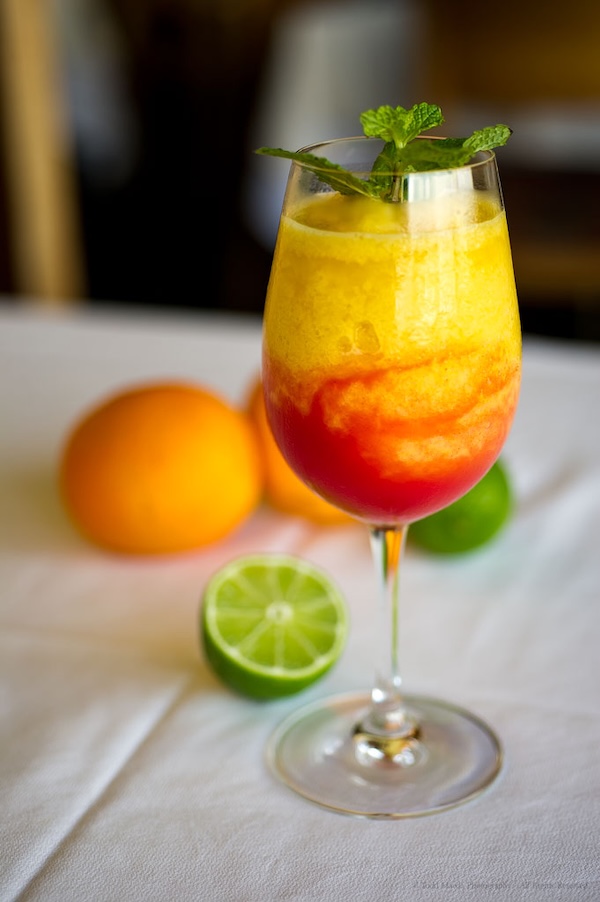
Okinawan-at-heart Alan Wong is bringing back two award-winning drinks featuring awamori, the heritage drink of Okinawa. Awamori Sunrise is a twist on a local favorite “POG” with liliko‘i, orange and guava. Ghost of Okinawa is a clear, “Blanc de Blancs” spin on the classic Manhattan using aged awamori.
Sept. 8-12, 5 to 10 p.m., Kāhala Hotel & Resort, 5000 Kāhala Ave.,@theverandakahala
Photo: Reid Shimabukuro
Andagi, Aloha Dog and Jushime
Aloha Andagi
Junko Bise and her crew will pop-up in the covered parking lot of Marukai Dillingham serving regular andagi, Aloha Dogs (Okinawan corn dog), and boroboro jushime (Okinawan seasoned rice). Cash only.
Sept. 19 and 20, 8 a.m. to 3 p.m. or until sold out, 2310 Kamehameha Highway, Kalihi,@alohaandagi_llc
Photo: Courtesy of Aloha Andagi
Photo: Reid Shimabukuro
Jimami Dofu
Aloha Tofu
From Sept. 7–21, Aloha Tofu Factory will hand-make Okinawan peanut tofu with a sweet sauce. This is not regularly offered, so don’t miss the chance to try this iconic Okinawan treat. No limits this year. Discounts on Yushidofu (soft, silky tofu with a custardy texture) and ‘Ohana soy sauce (a dashi shoyu that pairs well with tofu). Call to preorder and set your pickup date and time at Aloha Tofu Factory in Kalihi.
A special release, limited run of Kokuto Brown Sugar and Kinako Dark Lager with a new bingata design will be available to drink at Beer Lab HI locations starting Sept. 5, while supplies last. Preorder will launch Sept. 4 at 1:30 p.m. online (see website below).
Beer Lab’s Pearlridge location (98-1005 Moanalua Road) will serve Okinawan sweet potato croquette stuffed with rafute. Puck’s Alley location (2600 S. King St. #107) will serve Oki-dog Chimichanga filled with taco rice and a kokuto sugar shoyu hot dog.
Chibi’s is offering a shikuwasa (Okinawan lemon lime) “Jell-O” and Okinawan sweet potato crunch, an Okinawan take on the popular pumpkin crunch. Order via the website or call to inquire about pickup locations.
Chillest’s Aaron Wong will feature this Okinawan citrus shave ice while his syrup supply lasts. Cash only.
Sept. 7-21 (closed Wednesday), 11 a.m. to 6 p.m. (Tuesday 1 to 9 p.m.), 3408 Wai‘alae Ave. #102, Kaimukī, @chillestshaveice
Photo: Reid Shimabukuro
Okinawan Omakase
Hide Sushi
Chef Tsukasa “Tommy” Okino, Okinawan at heart, has created an omakase sushi and sashimi dinner whose assorted appetizers, soup and dessert are Okinawan-inspired. Appetizers: One-bite cold Okinawa soba noodles, Okinawan sweet potato tofu, black vinaigrette mozuku seaweed, “Biragara machi” fishcake wrapped with chives and shikuwasa miso, goya bitter melon salad. Cost: $120 per person. Reservations via OpenTable are required. Validated parking available.
Sept. 6-21, Sunday to Thursday, seatings at 5 and 7:30 p.m. at Waikīkī Business Plaza, 2270 Kalākaua Ave., Waikīkī, @hide_socialsushibar
Photo: Courtesy of Ige’s Halawa
Aunty Kay’s Sweet Potato Manju & Big Feastival Sale
Ige’s Halawa
Aunty Kay’s popular sweet potato manju is available to preorder online (see website below), with pickup on Sept. 9 and 16.
Ige’s Big Okinawan Feastival Sale will be on Saturday, Sept. 19, from 10 a.m. to 4 p.m. There will be a full bake sale (first come, first served). Preorder Okinawan mixed plate (shoyu pork, sweet and sour pigs feet, chicken tofu champuru), andagi and many other items.
Okinawan-at-heart chef RJ’s Shikuwasa Sinigang Pork Ribs comes with pickled Goya ensalada and vinegared rice; and his and Okinawan Sweet Potato “Tupig” is grated Okinawan sweet potato and sticky rice cake grilled over charcoal. Served with miso kokuto caramel, shikuwasa and calamansi koji syrup, and latik. Preorders accepted til Sept. 9 and Sept. 16 via Instagram DM or email ilaya.eat@gmail.com.
Izumi Randles of Izu’s Mochi will be making Okinawan sweet potato kasa muuchi. Kasa Muuchi is an Okinawan style of mochi that is wrapped in fragrant shell ginger leaves and steamed. The aroma of the shell ginger leaf permeates into the muuchi. Preorder before Sept. 19 via IG DM or email izumirandles@yahoo.com.
Keaka Lee, Okinawan at heart, will serve up his new Pandandagi (pandan andagi)! Pandan leaves are commonly used in Southeast Asian cuisines and are called the “vanilla of Southeast Asia.” This exclusive special will be made to order Sept. 5–21. Limited quantities per day. Preorder online (see website below) or phone in your order. Dine-in or takeout.
Kin Wah is celebrating its Okinawan part-owner Joy Sanchez. When you spend $50 or more on a single order, the restaurant will throw in a free order of pork and bitter melon in black bean sauce, or crispy gau gee. Call (808) 247-4812 to make a reservation or order. Must mention Feastival when you order.
This Kāne‘ohe okazuya will have several Feastival dishes: Okinawan abura miso (seasoned miso using crispy pork), jyu shi me (Okinawan rice soup), andagi, Okinawa soba, pig’s feet soup, Hawai‘i Okinawan-style oxtail soup, and Okinawan sweet potato mochi (grilled, not deep-fried). Call to preorder and set date and time of pickup.
Oide Kitchen will offer rafute (shoyu pork) donburi with ajitama (marinated soft-boiled egg) and Okinawan sweet potato salad. Until supplies last. Call to preorder.
Pitch is offering an Okinawan Feastival handroll set for $17.50. Each set includes imitation crab, spicy tuna and scallop mayo handrolls and a 12-ounce Orion beer. Reservations are not required but recommended via website.
Sept. 5–21, 11 a.m. to midnight (2 a.m. on Friday and Saturday), Salt at our Kaka‘ako, 685 Auahi St. Suite 216/217, Kaka‘ako, (808) 480-8198, pitchsportsbar.com, @pitchsportsbar
Photo: Reid Shimabukuro
Okinawan-Inspired 3-Course Dinner
Sky Waikīkī
Executive Chef Gary Tamashiro is Okinawan at heart. His tasting menu includes roasted Okinawan sweet potato hummus with grilled herb flatbread and goya; Okinawan Soki Soba Spaetzle with braised oxtail, fish cake, scallions, dashi broth, black garlic oil; and Fundagi a la Mode, an Okinawan-style donut funnel cake with chura kokuto and powdered sugar, served with Il Gelato Hawai‘i French vanilla gelato.
Sept. 5–21, 4 to 9:30 p.m., Waikīkī Business Plaza, 2270 Kalākaua Ave, Waikīkī, (808) 900-4240, skywaikiki.com, @skywaikiki
Photo: Reid Shimabukuro
Photo: Reid Shimabukuro
Sizzling Okinawan Taco Rice
Splash Bar
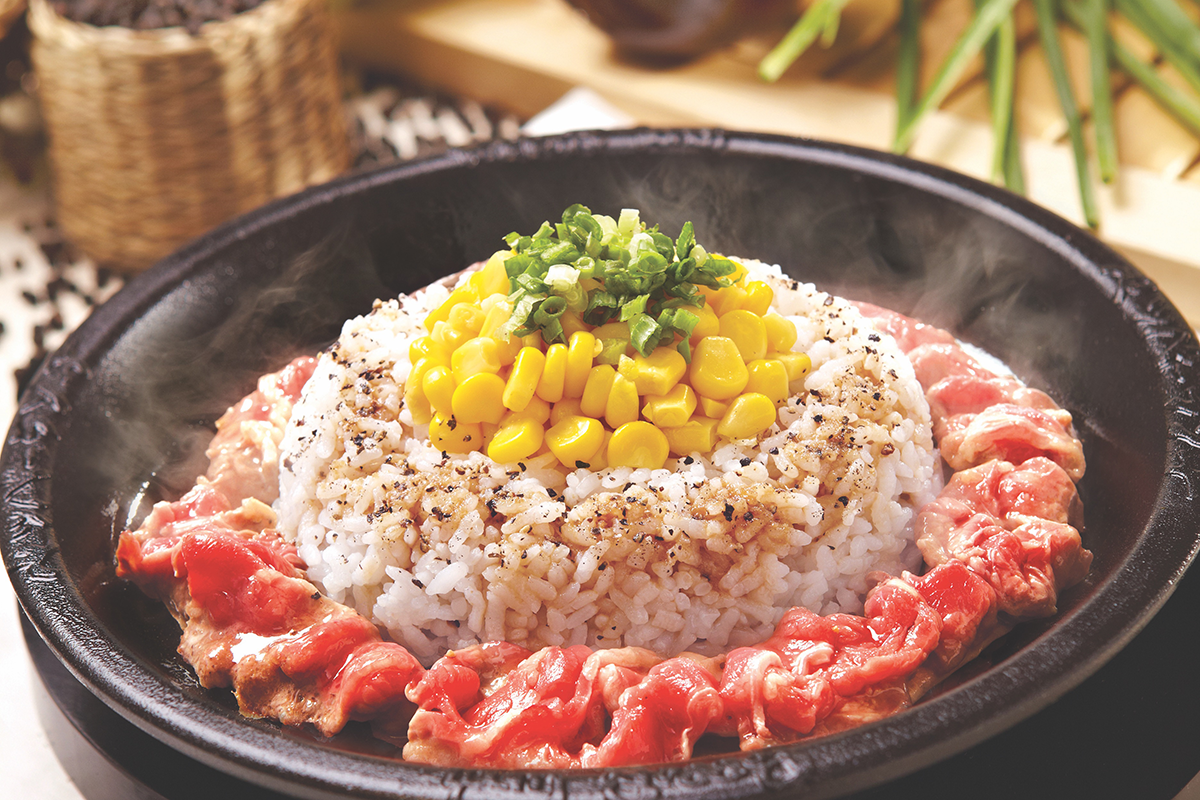
Splash Bar is offering two specials: Okinawan Sweet Potato/Whiskey Slushy and an Okinawan taco rice served on a sizzling skillet layered with seasoned wagyu ground beef, Japanese garlic butter white rice, melted cheese, lettuce, tomatoes and a savory taco sauce. Taco seasonings and salsa made by Okinawan-at-heart chef Blake Kajiwara. Validated parking available.
Sept. 4–11, Monday and Friday 10:30 a.m. to 8:45 p.m., Saturday and Sunday 11 a.m. to 8:45 p.m., Sheraton Princess Ka‘iulani, 120 Ka‘iulani Ave., Waikīkī, (808) 922-5811, @splashbarwaikiki
Photo: Reid Shimabukuro
Five Okinawan Soups
Sunrise Restaurant
Katsu and Tomoko Tamayose are offering takeout orders of pig’s feet soup, nakami (intestine) soup, spare rib soup, Okinawan miso soup, and Okinawa soba on weekdays. Nakami is not on the regular menu and worth a try. Preorder required.
Albert of Teruya’s Andagi will be serving up Andadog (hot dog on a stick, dipped in andagi batter and fried). $3 each piece. Call to preorder at least a day ahead. Andagi and sweet potato mochi also available.
Zigu’s Feastival specials are Okinawa-style pork belly rafute; pickled rakkyo with koregusu; Okinawan mozuku & umibudo; Spam, shiso & cheese katsu; Okinawan sweet potato pudding; Okinawan Sour and assorted Okinawan drinks and cocktails. Call for reservations. Validated parking across the street at Hyatt Centric.
Shari Tamashiro is the organizer of Okinawan Feastival and full-time cybrarian at Kapi‘olani Community College.
Photo: Redefined Media
Hale ‘Aina Gala: Fantasy Island
Saturday, Sept. 5, 6:30 to 9 p.m.
Escape to paradise for an evening of beauty, adventure and island nostalgia. You’ll dine on dreamy dishes from Hale ‘Aina award-winning restaurants, including Botanico, Hy’s Steakhouse, MW Restaurant and Kapa Hale. Plus, indulge in fresh oysters on the half-shell, espresso martinis and cocktail jellies while being enchanted by dancers, live bongo drummers, contortionists and more.
Ages 21+, $186 general admission, VIP sold out, The Kāhala Hotel & Resort, 5000 Kāhala Ave., Kāhala, hnltix.com, @honolulumag
Wear white to show your team spirit at the Rainbow Warriors’ first home football game of the season against UNLV. This year, the pre-game festivities are moving from upper campus to the roof of the Zone 20 parking structure and will include a walk-through by the team, live music, a beer garden and VIP areas. Grammy-nominated musician Henry Kapono will perform the national anthem and “Hawai‘i Pono‘ī,” ending with a flyover by a U.S. Army Apache helicopter.
Open Friday through Wednesday, 9:30 a.m. to 3:30 p.m., through Sept. 30
Sunday, Sept. 6, 1 to 3 p.m., Meet-the-Artists Reception
View a collection of pastel paintings from artists statewide. You’ll see local landscapes, portraits, still life and abstracts—all using soft, also known as dry, pastels. This traditional technique, used by legendary artists of the past, such as Mary Cassatt, Edgar Degas and Pablo Picasso, offers many ways of applying and manipulating color.
Saturday, Sept. 5 and Sunday, Sept. 6, 4 to 5 p.m., Mai Poina: The Overthrow
September’s Hawaiian History Month celebrates the 188th birthday of Queen Liliʻuokalani with concerts, walking tours, living history performances, panel discussions, films, cultural experiences, community conversations and more. This weekend’s highlights include a Memory Walk to Queen Liliʻuokalani’s special places and a dramatic interpretation of the Hawaiian Kingdom’s overthrow. Register and view the full event schedule here.
It may be your last chance to belt out “Don’t Stop Believing” at the top of your lungs at a Journey concert. As part of the rock band’s farewell tour, they’ll stop for three shows in Honolulu to play classic hits from their five-decade career, like “Any Way You Want It,” “Lights” and “Faithfully.”
We asked, more than 6,000 ballots were filled out, and now it’s time to unveil the winners of the 2026 Hale ‘Aina Awards!
Each year, our readers vote for their favorite restaurants in the Islands, and the HONOLULU dining team names the Restaurateur of the Year. This year, we added another editors’ pick as well to honor a classic favorite. The top restaurants were announced during a live reception held June 9, 2026, at The Kāhala Hotel & Resort.
The Hale ‘Aina Awards are the state’s longest-running and most prestigious dining honors, started by HONOLULU Magazine in 1984 to elevate the best restaurants in Hawai‘i. Whether you’re looking for weekend brunch spots, your new favorite cocktail or the best places to indulge your sweet tooth, we got you. This list of Hale ‘Aina-winning restaurants is your all-year, can’t-miss dining guide.
See our upcoming September 2026 issue for the stories behind some of the Hale ‘Aina Award honorees.
Congratulations to this year’s winners for operating at the highest levels of quality and offering Hawai‘i’s most delicious and innovative dishes.
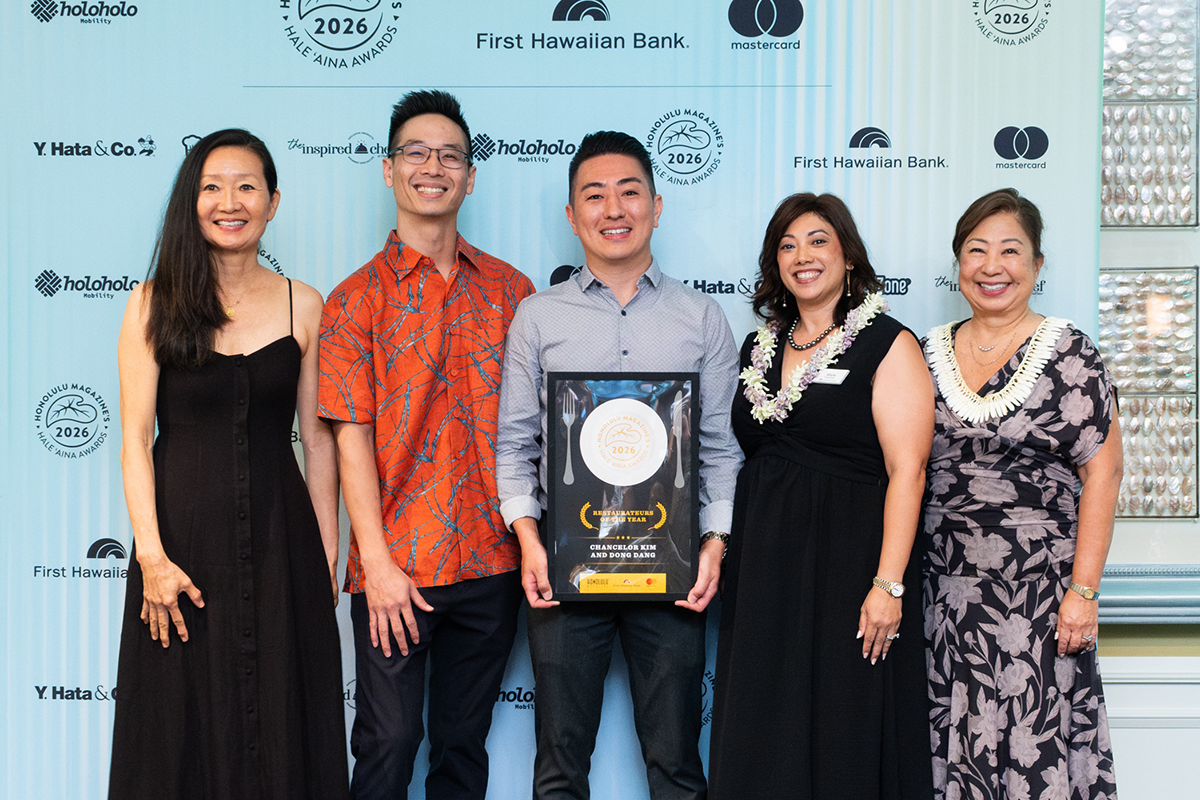
From left: Diane Seo; Dong Dang and Chancelor Kim, Restaurateurs of the Year; Shyla Cockett Fukushima, Senior Vice President and Division Manager, Retail Products and Services Division of First Hawaiian Bank; and Donna Kodama-Yee. Photo: Anthony Consillio
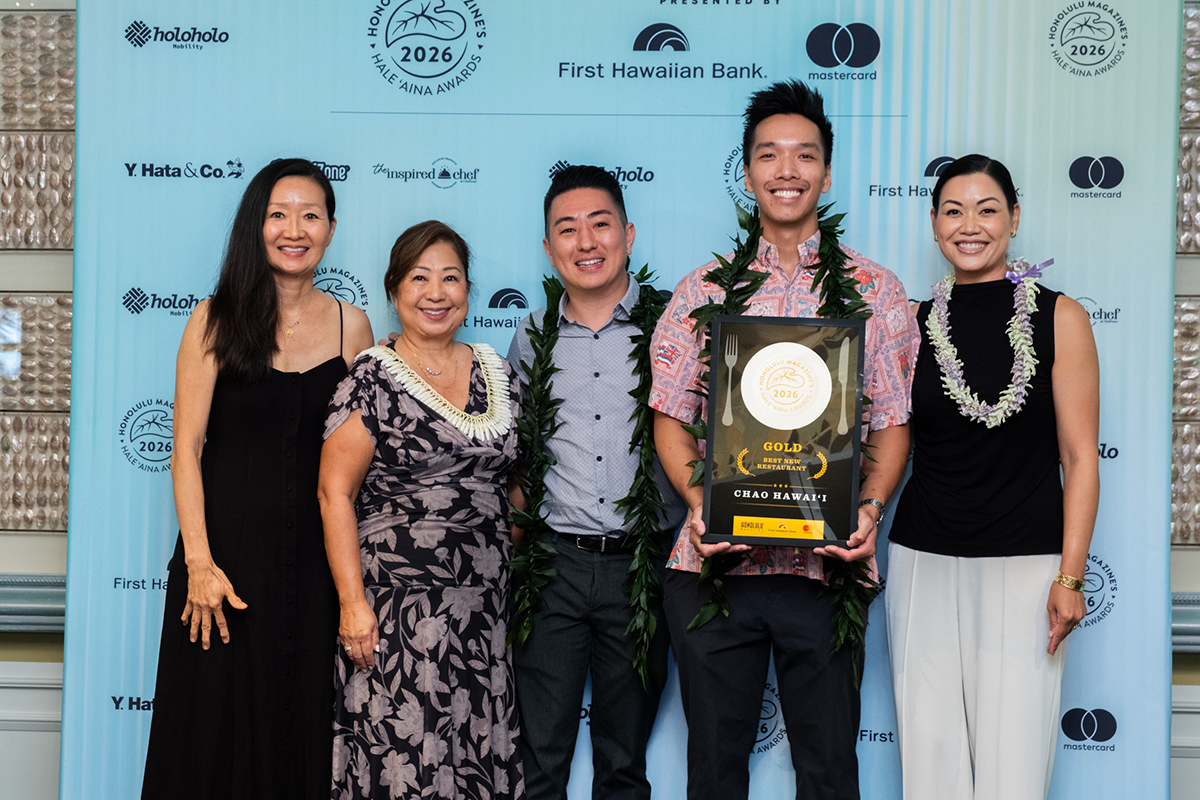
From left: Diane Seo; Donna Kodama-Yee; Chancelor Kim, managing partner, and Binh Ngo, executive chef and partner of Chao Hawai‘i; and Jeanine Fuentes, director of sales at Y. Hata. Photo: Anthony Consillio
Dishes on our tables narrate their own stories. They point to the land and oceans they came from, the cultures that shaped them and how they evolved (or didn’t). In ways subliminal and telling, the totality of these stories illuminates the story of us, the people who call Honolulu home.
So what array of dishes define our island? We assembled a panel of five food writers to come up with suggestions. Choices had to be currently available from a consistent business. They could be from any price point, anywhere on O‘ahu. And they had to shine a light on something uniquely Hawai‘i—and then some. Cake noodle, for instance, isn’t just a crossover local Chinese dish. The version we chose, from 8 Fat Fat 8, highlights the phenomenon of Honolulu bars that serve really good food.
We spent hours mulling our ideas, then more time hashing them out together. Still, the 24 dishes here are just a glimpse of our story—let’s call it a strong start. —Mari Taketa
Photo: Aaron K. Yoshino
Chichi Dango
Nisshodo Candy Store
Nisshodo is the kind of place you’d least expect to be a destination. From the outside, it’s a spartan gray door, complete with hardware-store doorknob, set in a gray warehouse. Inside is Hawai‘i’s 105-year-old mecca of mochi. Trays of pastel rounds line an ancient case, none more plain or popular than Nisshodo’s legendary chichi dango. Bite-size rectangles with a creamy undertone and pillowy bounce, they’re what locals bring to potlucks, take to Neighbor Island relatives and give as gifts on Girls’ Day every March 3, when production triples. Chichi dango’s roots in Japan—they’re from a village outside Hiroshima—have slipped into oblivion, so much so that a Japanese TV crew showed up one day to cover what they called a Hawaiian mochi. —Mari Taketa
Who could blame us for our fervor for cake noodle, a Hawai‘i Chinese dish of soft-boiled chow mein that’s fried to a crispy exterior, drenched in brown gravy and topped with crunchy chicken? Part of a rare breed of dive bars that cook up local Chinese food at restaurant quality, 8 Fat Fat 8 delivers cake noodle at its finest: crunchy on the outside and al dente on the inside. Those in the know can order an off-menu version (for a surcharge): Fried-to-order house chicken atop the noodles with, if you ask for it, a hit of ham har, a Cantonese fermented shrimp paste loved by local Chinese families for its pungent, explosive umami. It’s not for the faint of heart, but cake noodle doesn’t have to be. —Noelle Chun
A co-founder of Hawai‘i Regional Cuisine, Alan Wong for decades has championed the state’s beekeepers, dairy producers, farmers, ranchers and fishers—among them the hook-and-line boats that catch his bestseller. Wong’s ginger-crusted onaga is addictive with sweet, savory, creamy flavors and a crust that teases the palate with a ginger essence. The dish was inspired by cold ginger chicken, a potluck staple many locals grew up with. Ginger-crusted onaga predates Wong’s original eponymous eatery, where a dedicated station produced 10,000 orders a year before the 25-year-old restaurant closed during the pandemic. Now, it’s back at his reprisal at The Kāhala Hotel & Resort, a dish as synonymous with Alan Wong’s as it is with modern Hawai‘i. —Melissa Chang
Kawehi Haug’s lau lau stew is a love letter to her grandpa. A Native Hawaiian firehouse cook, he packed salt-drizzled morsels of wild pig meat into lū‘au leaves and steamed them by the dozen; the next day, he stretched the leftovers to make lau lau stew. The dish is the lone holdover from Haug’s previous eatery and the only thing at her current one—Faria, O‘ahu’s only Portuguese restaurant—that’s not Portuguese. On a menu where nearly forgotten dishes like favish can bring local Portuguese to tears, lau lau stew has a similar effect on everyone. Its brothy mix of marinated pork and melting lū‘au with onions, carrots and potatoes is universal comfort food, and best eaten with a side of poi. —Mari Taketa
When the coconut cake debuted at the Halekūlani, Hawai‘i wasn’t even a state and its hotels were the repositories of fine dining. Nearly 70 years later, the cake is one of the few holdovers on the Halekūlani’s menus. Subtle touches over the years, such as an amaretto pastry cream and coconut flakes, add elegance to layers of fluffy, gardenia-white sponge cake, which call to mind the not-too-sweet cakes of Chinese bakeries. At its heart, the signature cake is simple, much like the hotel’s original bungalows on the beach. That’s another reason we love this dessert: It doesn’t demand your attention, but is the quiet, finishing flourish to dinner. —Martha Cheng
Liliha Bakery may have not invented the ubiquitous loco moco—that honor goes to Café 100 in Hilo—but it may have perfected it. All six of the bakery’s locations serve loco moco, but die-hards insist you need to snag a seat at Liliha’s midcentury coffee shop counter on Kuakini Street to fully appreciate its greatness. Defined by simplicity, the loco moco shines in its details. Hand-formed hamburger patties charred on the grill and fresh eggs cooked to order harmonize over a bed of hot rice, all of it deluged with silky brown gravy. It’s a hearty balance of salt, fat, protein and starch that you’ll still be thinking about when you wake from your kanak attack. —Thomas Obungen
If breakfast is Hawai‘i’s main meal, then Kailua is its breakfast capital. At Cinnamon’s, a 41-year institution whose tables spill from the sunny yellow restaurant into the atrium of Kailua Square, you’ll see plenty of pops of glossy pink—the famous Guava Chiffon Pancakes, a morning take on the pink cake of the same name. Cinnamon’s layers cream cheese between buttermilk pancakes and covers the stack in a signature guava glaze crowned with a swirl of whipped cream. One bite and the jolt of sugar from the pink nectar zaps your sleepy brain into consciousness. When you think of Hawaiian-style pancakes, Cinnamon’s are the benchmark. —Thomas Obungen
Save for a few local-style restaurants on the continent, you’ll only find meat jun at Korean eateries in the Islands—one reason it’s a dish Hawai‘i expats crave. Each version varies in its dipping sauce, batter and thickness of beef, but it’s tough to beat Kim Chee II. The Chun family’s marinated beef gets a thin coating of egg batter that turns golden in the pan. Sliced into tender, bite-size strips that soak up the soy-based sauce, it makes for the perfect plate lunch entrée. —Thomas Obungen
In an island state whose coral reefs teem with tasty fish, ‘ahi still steals the show. The deep-sea tuna stars in today’s poke bowls and sashimi platters—but locals in the know seek out smaller reef fish you can eat fin to tail. Enter Blue Seafood Co. The Chinatown newcomer’s Aloha Combo is a Who’s Who of nearshore swimmers—including ta‘ape, menpachi, akule and weke—all on ice at Blue Seafood’s nearby market. Especially notable and delicately sweet is the ta‘ape, an invasive snapper crowding out Hawai‘i’s native species. We watch a cook toss the fish in a light coating and drop them into a deep fryer. Minutes later, we’re tearing into hot, succulent pieces with our fingers and munching the crunchy fins and tails like chips. With fresh mangosteen from another stall, it’s the best lunch of early summer. —Mari Taketa
What do you get when Hawai‘i’s beloved manapua meets a classic French pastry? The answer is The Local General Store’s char siu croissant. Glossy with char siu glaze and packed with tender, bright red Chinese barbecued pork, the pastry pulls together both sides of the James Beard semifinalist shop, where Harley Tunac Chow is the baker and husband Jason Chow helms the all-local, whole-animal butchery. Chow’s family recipe showcases some of the finest char siu on the island, this one made with pork from Mountain View Farms in Wai‘anae and Kualoa Grown; the red comes not from artificial coloring but traditional Chinese ingredients. The croissant is stretchy and layered, merging Tunac Chow’s personal touch with her time at Jane the Bakery in San Francisco when it won the city’s Best Croissant Competition in 2018. —Noelle Chun
A few years after Ted Nakamura began making pies at his family’s grocery store in the 1990s, he accidentally created a legend. He’d just made a haupia cake, he told a local newspaper, and since someone had made chocolate pies, he combined the leftovers. Ted’s Bakery hasn’t been the same since. The pie’s buttery short crust cradles a generous well of dark chocolate cream and a jiggly layer of haupia pudding that’s topped with tufts of airy whipped cream. It gained cult status when grocery stores islandwide started buying them, fueling the bakery’s expansion to a takeout restaurant. —Thomas Obungen
Saimin is an anchor in our islands. We eat instant packages for breakfast or late night, order the soupy noodles at okazuyas and carnivals and tuck into artisan versions at high-end restaurants. But for saimin as local craft, it is difficult to not think of Shige’s, which has made its own dashi broth and handmade wheat noodles in Wahiawā since 1990. While saimin is often seen as the hero of the retro letterboard menu, the burger is the Robin to the soup noodles’ Batman. Shige’s faultless representation of the basic local burger is saimin’s essential companion. Simple stacks of lettuce, onion and tomato accentuate the beefy, juicy patties and soft buns—washed down with a slurp of saimin, of course, which maybe turns out to be the Robin after all. —Noelle Chun
OK, we know that fried ‘ulu is nothing groundbreaking: Chefs who try to incorporate the canoe crop usually default to frying or mashing the starchy fruit. And Ed Kenney has made more inventive ‘ulu dishes, such as roasted ‘ulu with black bean and orange, but it’s the fried ‘ulu that we order whenever it’s available. (When breadfruit isn’t in season, he subs in sweet potato.) It’s the Hawaiian version of the erstwhile Town’s fries, fried with fresh herbs like sage and parsley and served with “chili peppa wata mayo.” While fried ‘ulu can sometimes be leaden, Mud Hen Water’s are always crispy on the outside and fluffy, nearly creamy on the inside. It reminds us why we need more ‘ulu on menus: for resiliency, for cultural and environmental diversity, and for pure deliciousness. —Martha Cheng
Lance Kosaka’s garlic chicken sliders predate Basalt. He’s brought them to every restaurant he’s helmed since coming up with them nearly two decades ago at The Pineapple Room. They were an instant winnah back then and still are now. The dish combines two of Hawai‘i’s favorite plate-lunch classics—furikake garlic chicken and mac salad—into a sandwich. The salty-sweet-crunchy fried chicken chunks combined with creamy mac salad underscores what we always knew about mac salad but perhaps couldn’t quite pinpoint until these sliders: Mac salad shines not as a side dish, but as a condiment. —Martha Cheng
Waiola knows how we think when we arrive at the shave ice counter—our favorite syrup flavors, please! And condensed milk! Mochi balls!—and Waiola isn’t having it. “Size?” It was more of a terse directive. “How many? NOW, what toppings and flavors?” That was then. The memories flavor our childhood in urban Honolulu, where Waiola, which opened in 1940, still reigns as the old-school shave ice king. Now, Waiola codifies its step-by-step ordering protocol on its menu boards. And even as 21st-century arrivals expand O‘ahu’s shave ice world—sporting fancier shaved milk ice and farm-to-table syrups with fresh fruit—Waiola’s generational allure of wispy soft ice, generous pours of kalakoa syrups and a place in the sun on its weatherworn bench keep us coming back. —Mari Taketa
A Shrovetide tradition turned year-round treat, malasadas are more popular in Hawai‘i than in their native Portugal. Plantation workers from Madeira and the Azores brought over the fried doughballs tossed in sugar and ate them to clear stocks of rich, indulgent ingredients in preparation for Lent. Today, you’re more likely to find malasadas in the office break room or under a dollop of ice cream for dessert. In Kailua, Agnes’ fries up crispy-craggy discs with holes in the middle, the closest version to malasadas in the old country. Public anguish ensued when the longtime bakery closed, until a superfan revived it as a food truck, bringing back Agnes’ malasadas—and with them relieved Windward residents who missed the eggy sweets. —Thomas Obungen
Poi is often the first solid food babies eat in Hawai‘i—and kūlolo is its playful teenage cousin. Niu’s sundae is the most fun version of a kūlolo dessert we’ve found. Whole kalo roots are cleaned and steamed in-house, mixed with brown sugar and coconut milk and nursed through a low, slow 24-hour simmer that produces the caramelly edge all kūlolo aspires to. The memory of it dripping molten down a soft-serve peak like lava down Kīlauea, followed by a drizzle of toasted mac nuts like a blessing rain, brings us back for another. Similes aside, hot kūlolo sundaes are what ‘Aiku‘e and Kekahu Napoleon-Ahn, brothers who own Niu, created as a chill expression of their Native Hawaiian heritage. —Mari Taketa
The line to get into Helena’s mirrors school schedules: It’s longer when kids stop by for their last taste of Hawaiian food before flying off to college, or their first taste when they come home. Regulars know their orders before they arrive. Many simply order Menu D, which combines kālua pig, lomi salmon, squid lū‘au and Helena’s famous pipi kaula short ribs with poi or rice. (There’s no discount—the different combos just expedite ordering.) From there, you can add on butterfish, ‘opihi, tripe stew or whatever else completes your favorite Hawaiian feast. All of it is unchanged from 80 years ago, when Helen Chock first opened her doors—and students sailed to college on steamships. —Melissa Chang
Scoops of Neale Asato’s li hing float sherbet take us back to hot and sticky afternoons after school, when we lined up at neighborhood crack seed stores. The prize: strawberry Icees slathered over vanilla ice cream, doused in salty-sour-sweet li hing juice and sprinkled with red li hing powder. Kids and kids at heart still seek out this nostalgic treat, but with crack seed stores disappearing around Hawai‘i, Asato, a James Beard Award nominee, preserves these flavors in a silky sherbet. He swirls ribbons of vanilla ice cream into strawberry sherbet and hits it with his signature li hing syrup—part of a repertoire of sherbets that celebrate local memories. —Noelle Chun
Hyatt Regency Waikīkī Beach, 2424 Kalākaua Ave., Suite 113, Waikīkī, pints available at Foodland Farms, asatos.com, @asatoswaikiki
Photo: Aaron K. Yoshino
Nori Chicken
Fukuya Deli
The size of our okazuya plate may vary, but certain items from Fukuya’s point-and-choose selection will always be in our order. At the top of the list is nori chicken. This is a Hawai‘i okazuya creation—but where others deep-fry their chicken, Fukuya marinates boneless pieces, wraps them in nori and pressure-fries until tender. The resulting morsels are exceptionally moister and tastier than their fried competitors. Nori chicken is newer, but items like shoyu chicken, chow fun and corned beef hash are as old as 87-year-old Fukuya, one of O‘ahu’s oldest okazuyas. Back in the day, it was local Japanese who flocked to these only-in-Hawai‘i delis in old neighborhoods. Now, it’s all of us. —Melissa Chang
People on the continent don’t understand: Even though it’s warm in Hawai‘i most of the time, we still love our hot soups. Of these, the most quintessential is oxtail soup. Local-style oxtail soup tends to have a Chinese bent with star anise, dried orange peel and ginger; ‘Aiea Bowl’s leans even more into this flavor profile with red dates and whole shiitake mushrooms. The broth is collagen-rich from the long-simmered oxtails, while the dipping sauce of ginger and ponzu adds a welcome brightness. And of course, no visit to this bowling alley diner is complete without a slice of lemon crunch cake. —Martha Cheng
Family lore has it that Elena Butuyan had a dream about a pork adobo fried rice omelet. In it, the founder of Elena’s Restaurant saw her pork adobo diced up, stir-fried with rice on a flattop, seasoned and folded into a thin veil of scrambled egg—and a Filipino classic gave rise to a modern one. Over 50 years later, adobo fried rice omelet isn’t just the bestseller at the Waipahu eatery and its roving food truck, it’s Hawai‘i’s most loved and mainstream Filipino mashup. The crepelike omelet, fat with promise, holds in the heat of the griddle; cut in and poofs of steam diffuse aromas of vinegar and soy and pork fat. Now in its second generation at Elena’s, the Butuyan family has trademarked its creation along with sibling omelets. Now that’s legit. —Thomas Obungen
Keaka Lee’s playful side is evident in Kapa Hale’s menu. Listen to his servers explain items like Poke Doki, Naan Ya Business and U Win Sum & U Dim Sum and you’ll see. An exception is Lee’s Haku Lei Po‘o, a salad that celebrates Hawai‘i’s farmers. Baby greens fill an O-shaped bowl topped with seasonal fruits and vegetables (think ‘ulu chips and pickled star fruit) and a Kona coffee crumble. Indeed, you could put the bowl on your head and the salad would look like an extra-large version of the lei crown it’s named for. Haku Lei Po‘o was the first dish Lee created when he came home to Honolulu after years of cooking in New York City. As light as it is, it’s full of heartfelt respect. —Melissa Chang
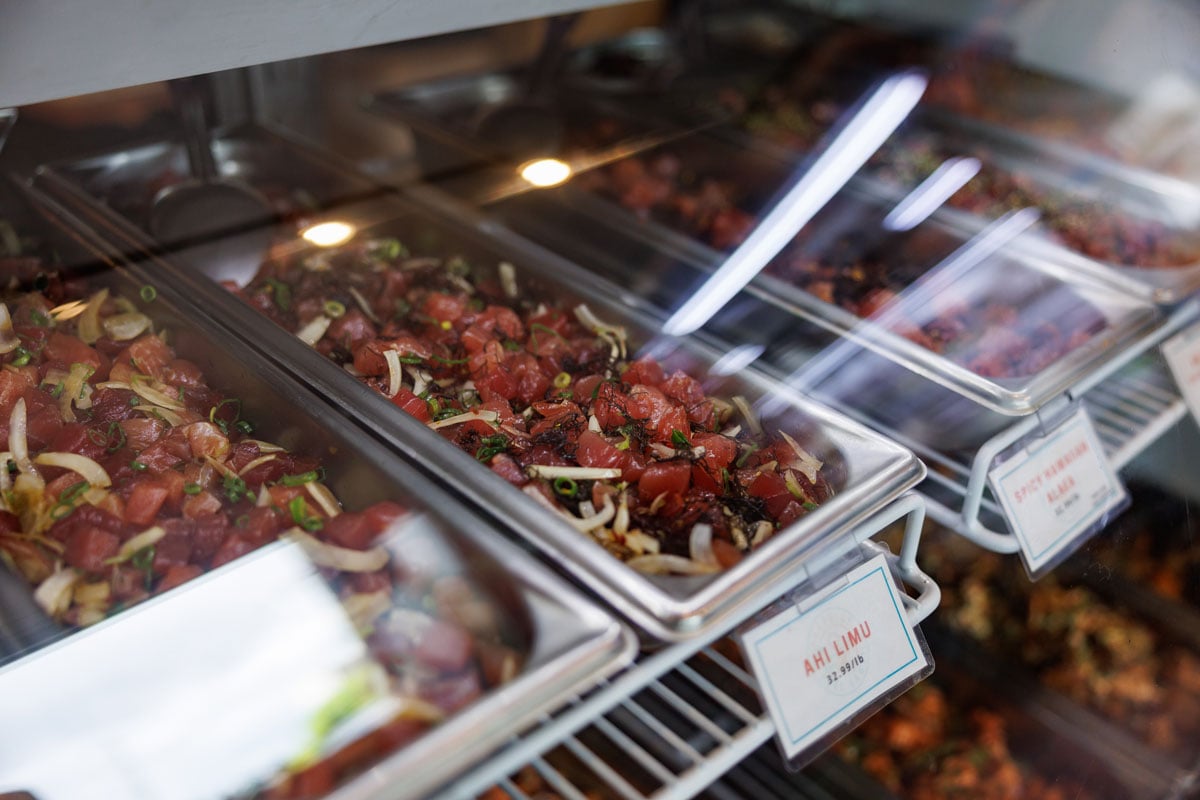
Whenever we get depressed about the trend toward cheap and low-quality, standing in line at Tanioka’s gives us hope. Here, we see locals in T-shirts and slippers buying poke even when it’s $35 a pound and up—a reminder that while poke may be everywhere (or maybe because it’s everywhere), we know and appreciate quality. While other poke spots offer previously frozen ‘ahi, Tanioka’s keeps the focus on fresh and local. Seasonings lean on the traditional, including onion and limu, but what’s fun about Tanioka’s is the way it combines poke with other dishes, as in the poke tater tots and miso butterfish poke bowl. What we love here: the willingness to experiment without losing sight of what made poke and Tanioka’s good in the first place. —Martha Cheng
Thomas Obungen is the former Special Projects Editor of HONOLULU Magazine and now a contributor. @thomasohhh
Mari Taketais the dining editor of HONOLULU Magazine and editor of Frolic Hawai‘i.
Editors’ Pick
RESTAURATEURS OF THE YEAR
“Why don’t you open a poke shop? We have good fish.”
A casual remark over homemade poke at a family table became the catalyst that would launch Chao Restaurant Group. It was as much encouragement as understatement. The Dang family owns Fresh Island Fish and its 27 Honolulu-based fishing boats. In Dong Dang’s recollection, his brother-in-law, Chancelor Kim, said something like, “This poke is so good. Why aren’t we selling it?” His mother’s response was a blessing.
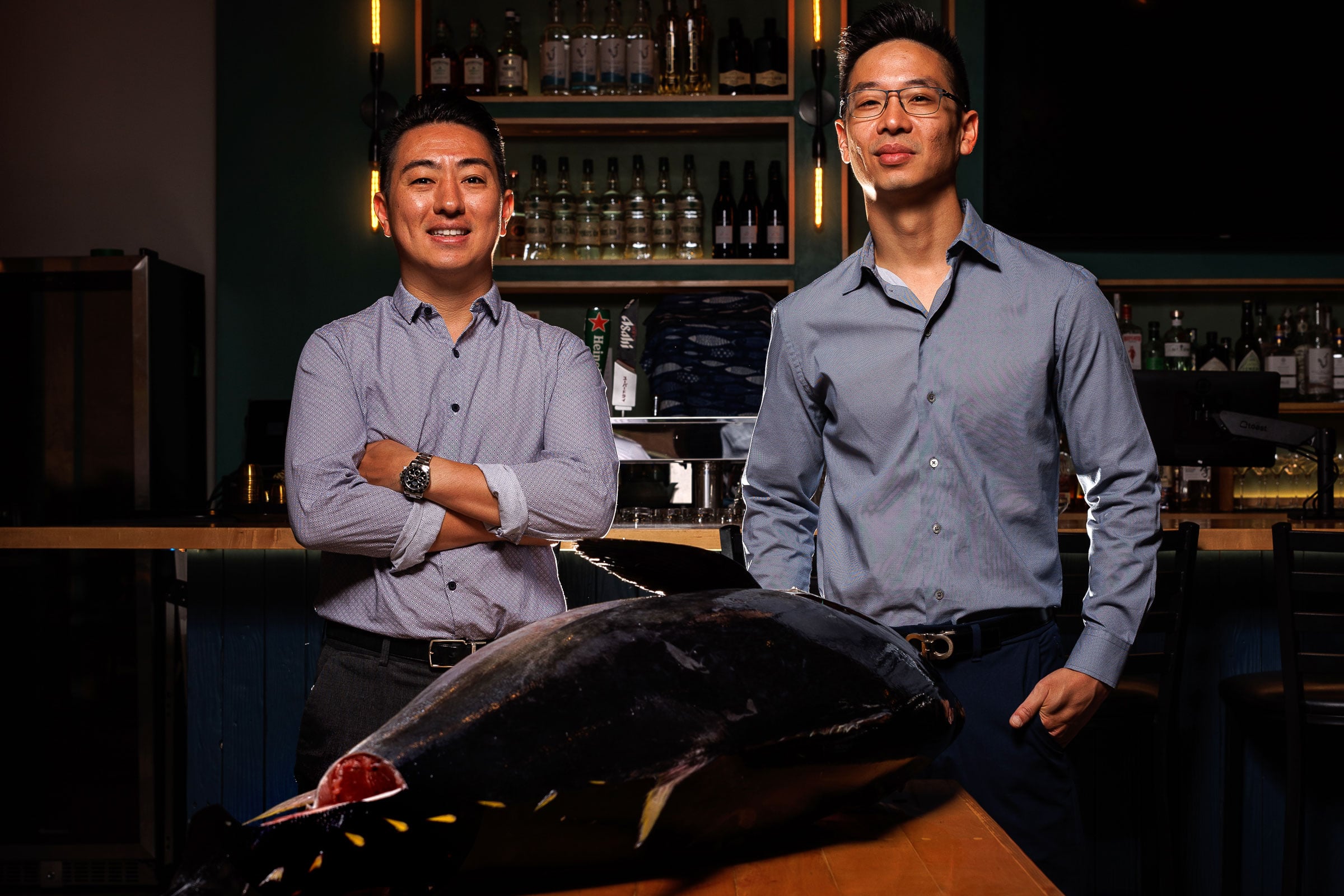
Seven years, four poke shops and three restaurants later, Kim and Dang lead their own fast-growing operation, one whose rise has broken convention. Aside from Kim’s college jobs as a busser and server, neither had worked in restaurants, much less run any. Their learn-as-you-go approach—from listening to podcasts and flying to industry conventions to creating a WhatsApp group of fellow local restaurateurs—set them apart in an industry where traditional formulas are losing relevance. And inspired us to select Kim and Dang as the 2026 Hale ‘Aina Awards’ Restaurateurs of the Year.
Photo: Aaron K. Yoshino
THE POKE SHOP SUGGESTION, which came in 2019, landed in the ears of an entrepreneur and a fishing boat supplier with a degree in entrepreneurship. Kim, 36, started early, waiting tables and running nightclub events at Ginza and Ka between classes at UH Mānoa. Stints in product development at 7-Eleven Hawai‘i and at Sysco—the world’s largest wholesale restaurant food distributor—provided training and ideas, and a venture Kim launched to deliver Nanding’s Bakery Spanish rolls, Pomai Kūlolo and other goods to O‘ahu stores grew to four trucks by the time he sold it.
Dang, 34, grew up in the family business. At first, it was a lone fishing boat that kept his father at sea for weeks at a time. Now, the family’s companies include a longline fishing fleet, a seafood wholesaler, a retail fish market and related businesses, including Pacific Fishing & Supply, where Dang—who double-majored in finance and entrepreneurship at UH—remains the general manager.
Paradise Poke, opened between a karaoke bar and a failing Radio Shack in Nu‘uanu, “was gonna be a single shop, with me working it,” Kim recalls. “I didn’t think it was gonna be a full-time thing.”
For nine months in 2020, while newbie mistakes with contracts and contractors delayed the opening, they teased social media about the poke shop coming mauka of Chinatown. “Our poke will always be made with fresh & locally caught fish fresh from the boats,” an Instagram post promised.
Photo: Aaron K. Yoshino
Photo: Aaron K. Yoshino
When Paradise finally opened in 2021 with poke, garlic shrimp and mac salad, pickled mango and breakfast musubi, business was good. “There really were only a handful of spots that use that quality fish, like Tanioka’s and Tamashiro’s,” Dang says. “When the boats come back and the captain pulls out the best of the catch, we divide it up between the captain, crew and our family. So at 4 a.m., we would come in, work till 7 or 8, go to our main job, come back and work until 9 or 10 at night. It was the challenge that made it so rewarding. We found joy, and it became a passion, hospitality and food and beverage. Chance made a comment recently, ‘Wow, we really didn’t know what we were doing.’”
Also, there were Kim’s wife, Quynh Dang, and Dong Dang’s fiancée, Julia Vu—whose parents had owned Chinatown’s longtime Rosarina Pizza and whose sister owns La Pizza Rina. Binh Ngo, a Dang cousin who trained under veteran chef Jason Peel at Nami Kaze and KCC’s Culinary Institute of the Pacific, was in the kitchen. The business’s low overhead gave them room to learn and make mistakes. Two years later, Paradise expanded to Waikīkī and Pearl City; a year later, it added a fourth shop in Hawai‘i Kai.
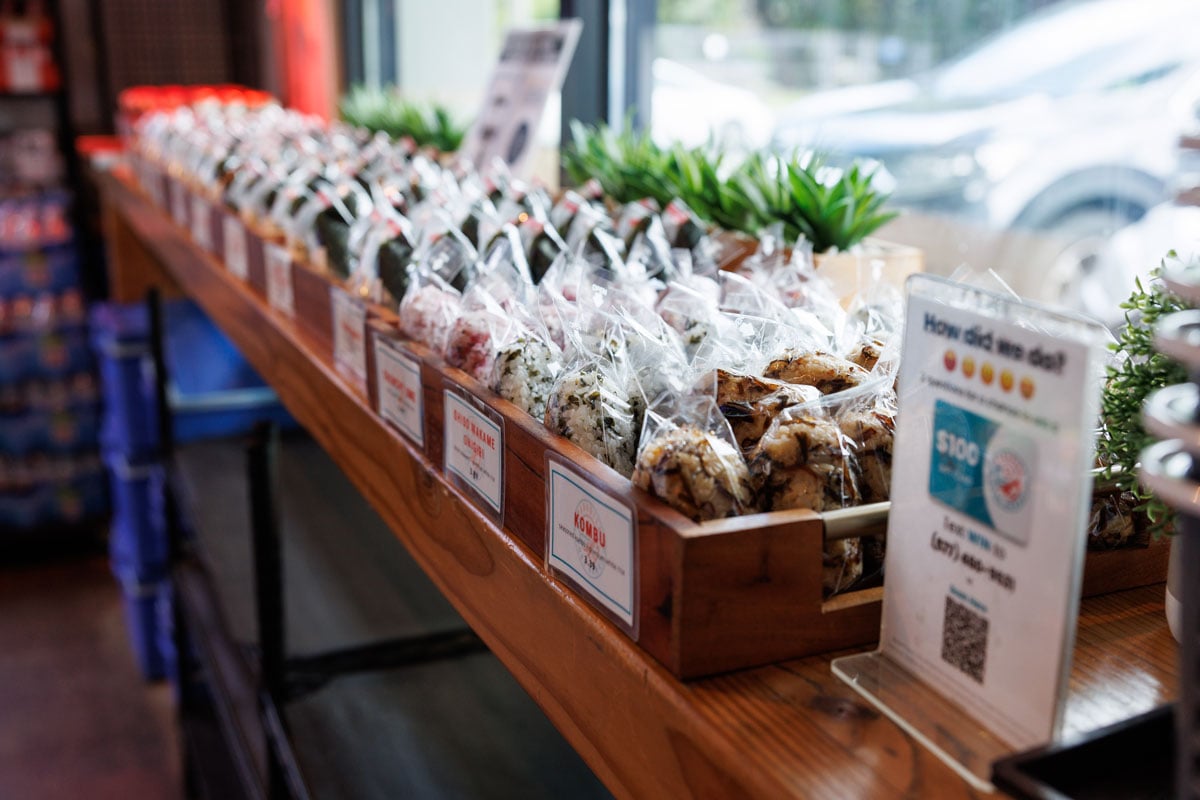
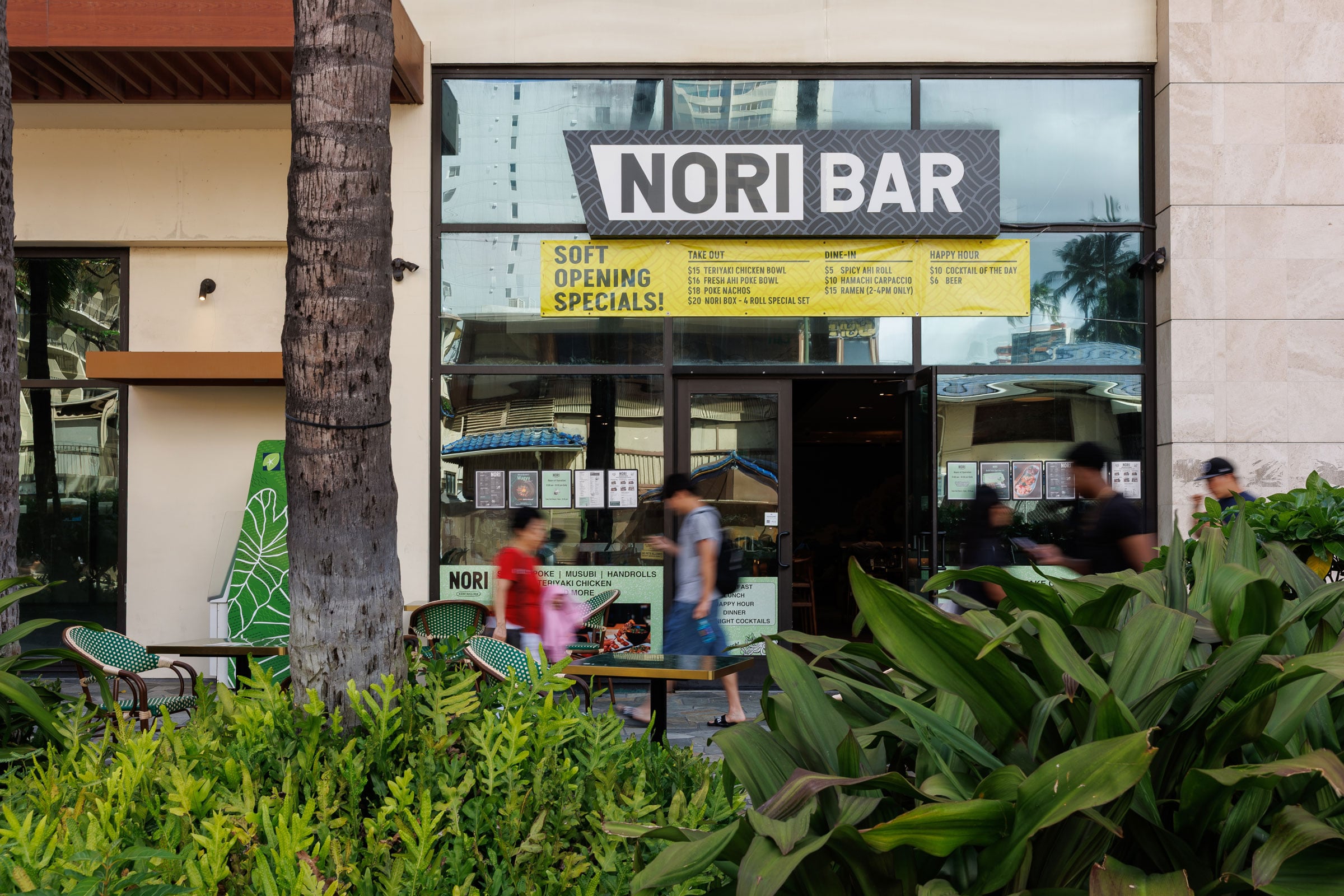
Nori Bar was a leveling up. Inspired by Japan’s stand-and-eat sushi bars and the trendy handrolls of LA and New York City, it was a restaurant—a 16-seat counter in a slip of space at Ward Village. Customers scanned QR codes to order and had 90 minutes for their premium ‘ahi with nikiri soy, Hokkaido scallops tinged with yuzu kosho, and freshly grilled unagi, all tucked in warm rice sheathed in crackling nori. The menu outgrew handrolls and the time limit fell by the wayside, but Nori Bar—where people running errands could pop in for quick snacks and couples could linger over sake and sushi—also found its groove.
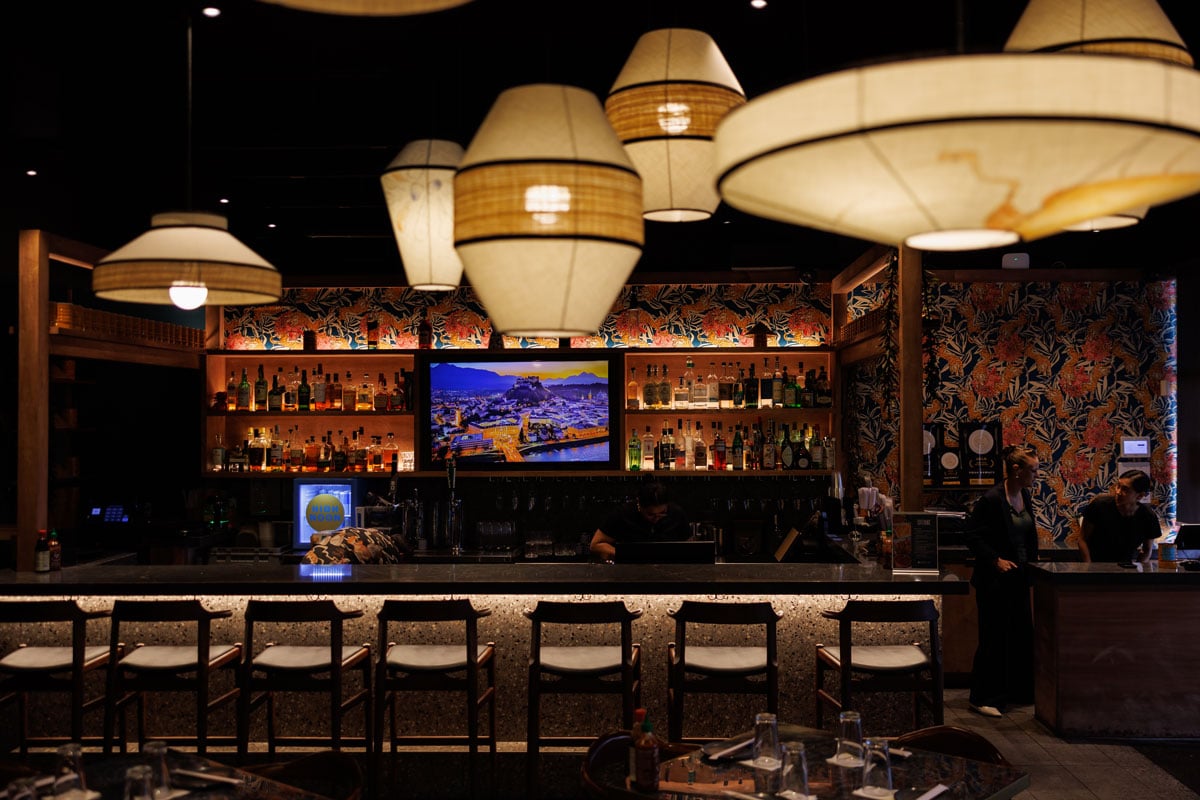
Chao Hawai‘i, in the same Nu‘uanu strip mall as Paradise Poke, was a chance to go beyond seafood. The nearest competitors were the karaoke bar and a Thai bar; no other full-service restaurants were within a half mile. With 70 seats, Chao’s tables could accommodate families and celebrations. Dang wanted a homestyle Vietnamese menu of dishes he’d grown up with; Kim wanted modern Vietnamese and cocktails. Chao would have all three. It opened in the summer of 2025 and ramped up with lunch, dinner, happy hour, Sunday brunch and late-night. Here, Ngo was the chef and partner; at Nori Bar, Dang’s brother Khang joined the partnership.
When a space opened up on Kūhiō Avenue in Waikīkī, they took it. The second Nori Bar was next to a Starbucks and more than triple the size of the first. With its opening in spring 2026, the group that started with six people at a poke shop had 152 on its payroll.
“The impetus for opening more restaurants came from the people we had working with us—creating opportunities for them,” Dang says. “Our employees had aspirations, bigger aspirations, and we did too.”
On Waikīkī’s Kūhiō Avenue, a second Nori Bar—triple the size of the first—opened earlier this year. Photo: Aaron K. Yoshino
Sushi, hand rolls and pūpū at seafood-centric Nori Bar Photo: Aaron K. Yoshino
HOW DID TWO PEOPLE with limited backgrounds in the industry open three restaurants and O‘ahu’s largest standalone poke chain? Asked twice, Kim starts his answer the same way: podcasts. Restaurant Unstoppable, featuring interviews with successful restaurant entrepreneurs, is his favorite. He also cites books, industry trade shows the group attended in Chicago and Shanghai and input from a WhatsApp group he created of mostly second- and third-generation restaurateurs in their 30s and 40s—including La Tour Café’s Brandon Lam, Juno Chung of Koa Pancake House, Chris Iwamura of Rainbow DriveIn and McDonald’s Hawai‘i’s Vincent Lim. “I just saw issues and I was like, someone’s gotta have these same issues as me,” Kim says. “The whole thing about this restaurant thing is you learn as you go. You learn, you grow. If you don’t like something, change it fast.”
What about role models? Or a mentor? Dang’s response echoes Kim’s: “I can’t say we had role models, to be honest. We just jumped into it and learned along the way.” Both came in as outsiders—avid diners from a younger generation attuned to fast-moving trends and technology. In a post-pandemic world, Chao and Nori Bar offered takeout from early on. Kim researched reservations apps and AI phone receptionists. Yelp reviews and customer feedback, via QR codes at the top of their checks, were routed to his phone.
Internally, realizing their growth was outpacing their abilities, Kim and Dang were filling in management gaps. Michelle Lee Jackson—a former senior line cook at New York’s Marea, manager at Waicoco on Maui and bartender and sous chef at Podmore—became the group’s director of food and beverage. Thomas O’Reilly, who bartended at Podmore, Hau Tree and Nomad in LA, is director of beverage. A human resources manager came onboard in the spring, as did a part-time marketing director.
Now, Chao Restaurant Group’s tentacles twine through other Island seafood eateries as well. ‘Ahi & Vegetable, a sushi-and-sashimi shop bought and expanded by Fresh Island Fish, hired the group to systematize and automate operations. And early this year, it took over management of Thirty Eight, a struggling seafood restaurant owned by Dang family members.
Photo: Aaron K. Yoshino
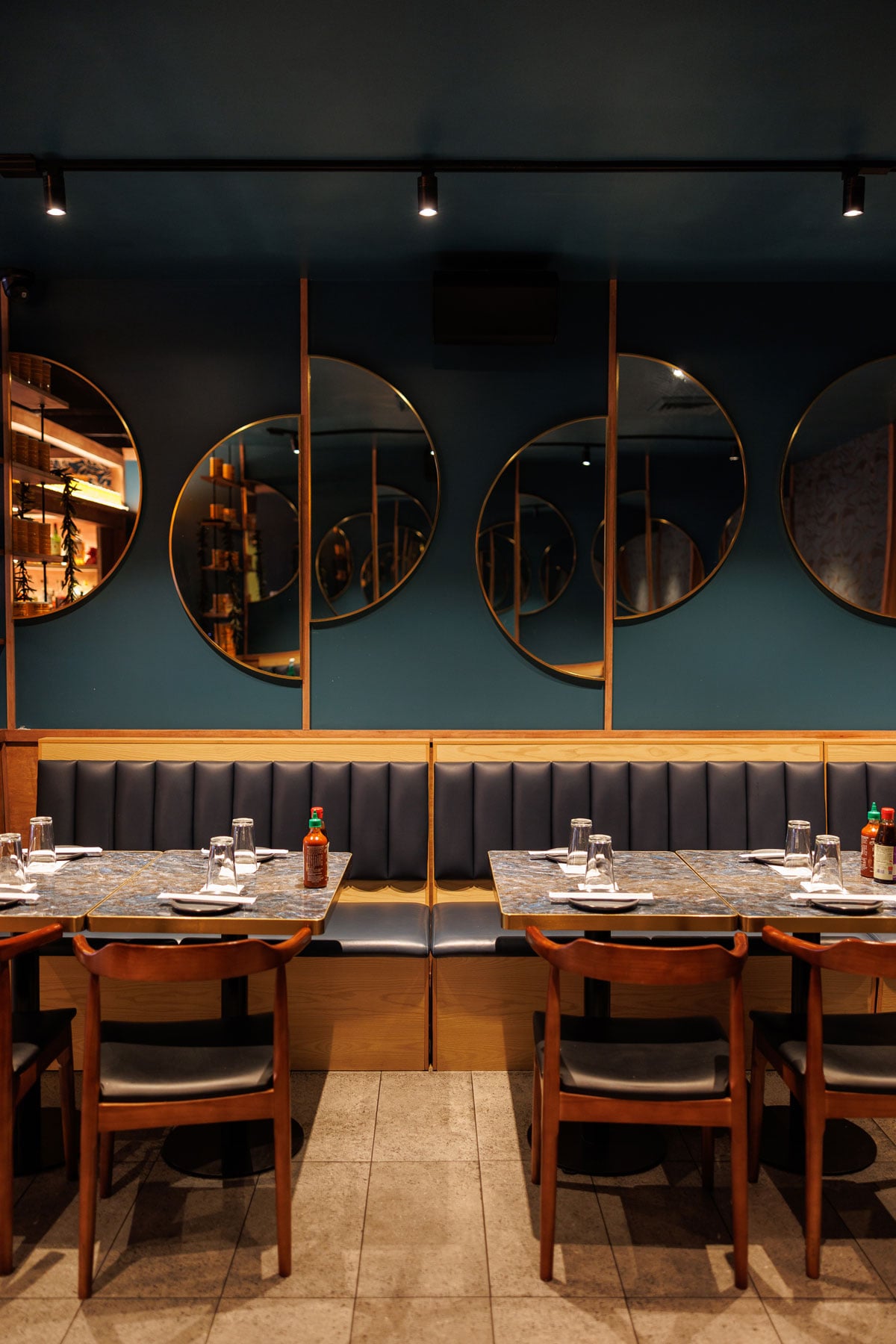
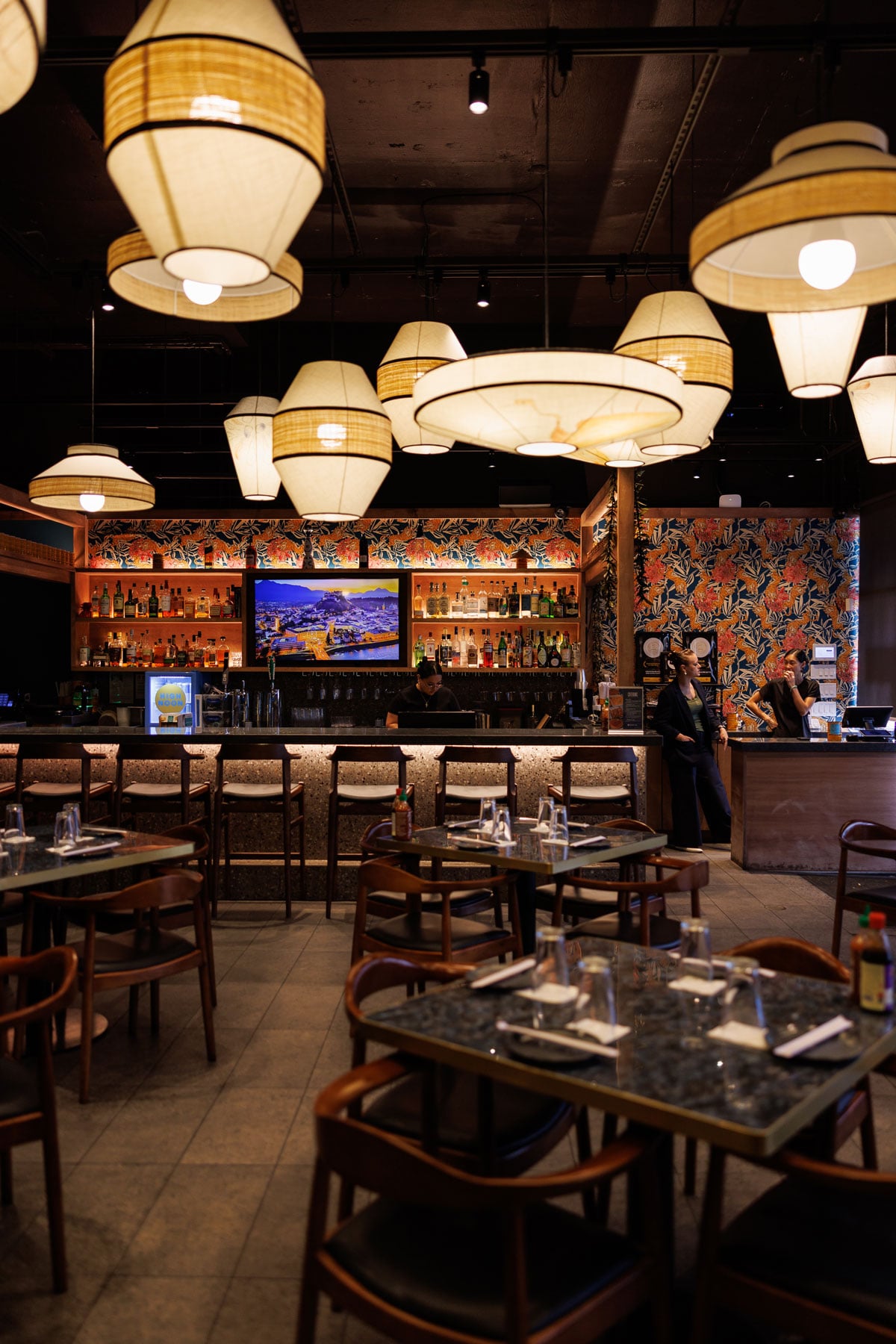
Chao, interior. Photo: Aaron K. Yoshino
Chao, interior. Photo: Aaron K. Yoshino
Chao group missed its target of opening Nori Bar Waikīkī in February to relaunch a rebranded Thirty Eight instead. Both places were still works in progress in early summer. Neither Iwilei nor Waikīkī were familiar neighborhoods to which the group was bringing a fresh concept. Thirty Eight and its 100 seats are next door to Nico’s Pier 38, a fresh fish destination for 22 years. Across town on restaurant-saturated Kūhiō Avenue, Nori Bar looks to passing tourists like another sushi spot. Never at a loss for ideas, Kim came up with two more: monthly poke-making classes at Nori Bar Waikīkī and a whole-‘ahi cutting demo followed by an omakase dinner made with that 100-plus-pound fish at Thirty Eight. Both would be sold on Resy and another platform that’s terra incognita for Honolulu restaurants—as an Airbnb Experience.
This is where Chao Restaurant Group hits pause—for now. “The entrepreneur will always want to do more, but we’re focused on solidifying our team and making sure every location is where it needs to be,” Dang says. “We always tell our wives, OK, this is the last one. Chao was supposed to be the last one. It’s always a back and forth.”
Mari Taketais the dining editor of HONOLULU Magazine and editor of Frolic Hawai‘i.
Readers’ Pick
BEST THAI
(GOLD)
Classic and contemporary dishes at Thai Issan Cuisine Photo: Aaron K. Yoshino
Brave the gauntlet of Market City’s parking lot and steer clear of shoppers rolling carts into Foodland, and you will happen upon the hole-in-the-wall gem that is Thai Issan Cuisine. The eight-table haunt has won the hearts of a varied crowd, from couples on dates to uncles at a four-top to multigenerational family gatherings with squirming little ones and quiet teenagers.
Perhaps it is unsurprising, then, that after being a finalist for Hale ‘Aina Best Thai in 2023 and 2025, this year, Thai Issan won gold.
This is the restaurant’s original location—a second location is at Old Stadium Square in Mō‘ili‘ili. At Market City, as upbeat Thai pop plays in the background and TVs loop mouthwatering scenes of food carts in Thailand, dishes with traditional and local flourishes cross the dining room. You choose your level of spice. The most popular order is a saucy pad thai that is slick, soft, bursting with flavor—and made with wide look fun noodles, a unique touch. The menu is rich in noodles and curries, a rainbow of yellow, green and red with eight flavors ranging from Massaman to pineapple.
Local touches include shell-on, wok-fried sweet Kahuku shrimp smothered in a chile and oyster sauce. The King of Chili is another house special: wok-fried ground beef, chicken or pork in a sweet and savory sauce with vegetables, topped with a runny fried egg—a version of pad krapow that Thai Issan’s website describes as a “Thai version of Loco Moco.”
Beverage offerings are concise with Thai iced tea, coffee or soft drinks, but pro tip: For a $5 corkage fee, you can bring your own bottle. And Fujioka’s Wine Times is around the corner, its staff ready to help with pairing requests. You are set for your next date.
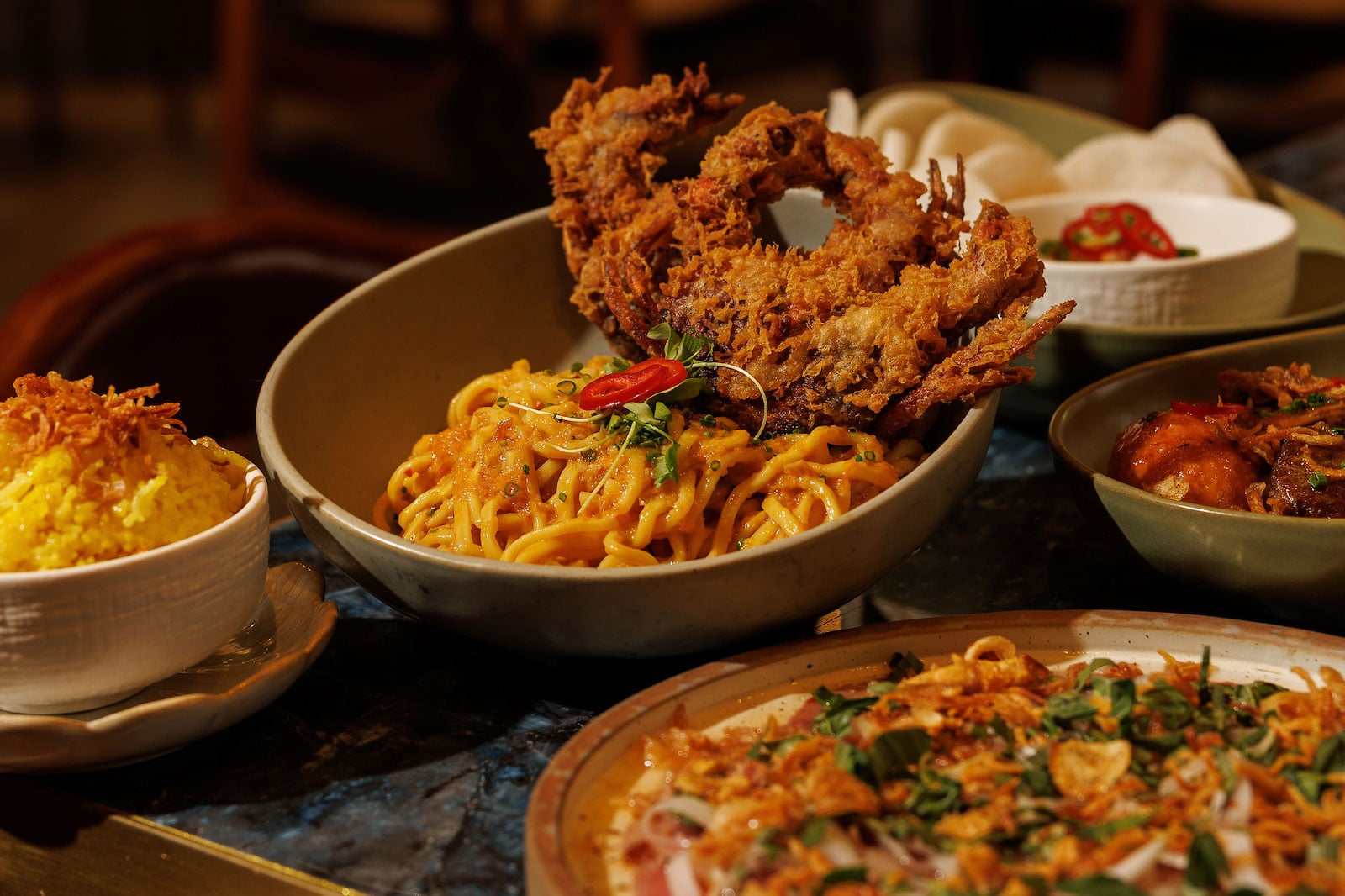
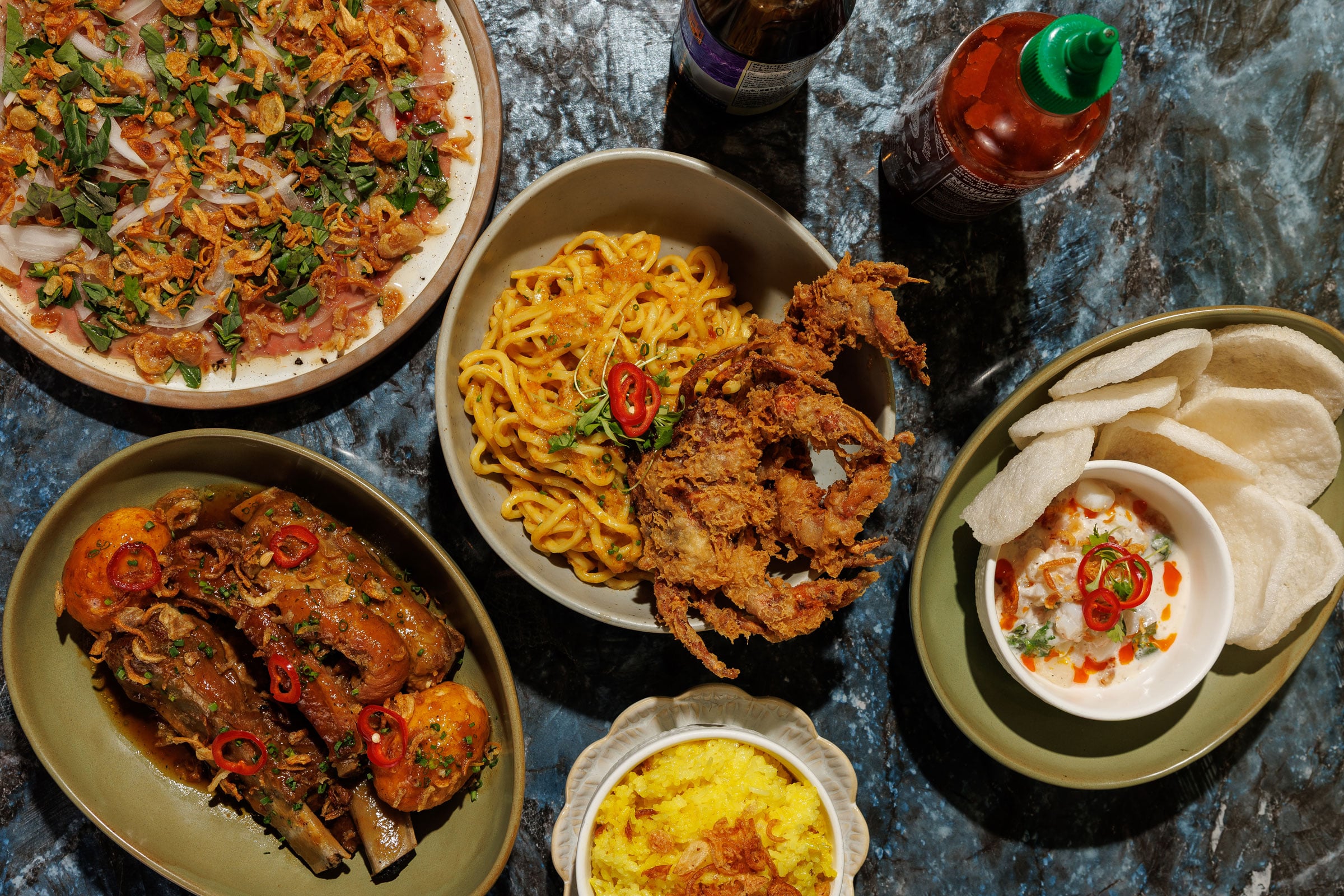
From top left: beef carpaccio, Pork Ribs and Dragon Eggs, soft-shell crab pasta, seafood ceviche. Photo: Aaron K. Yoshino
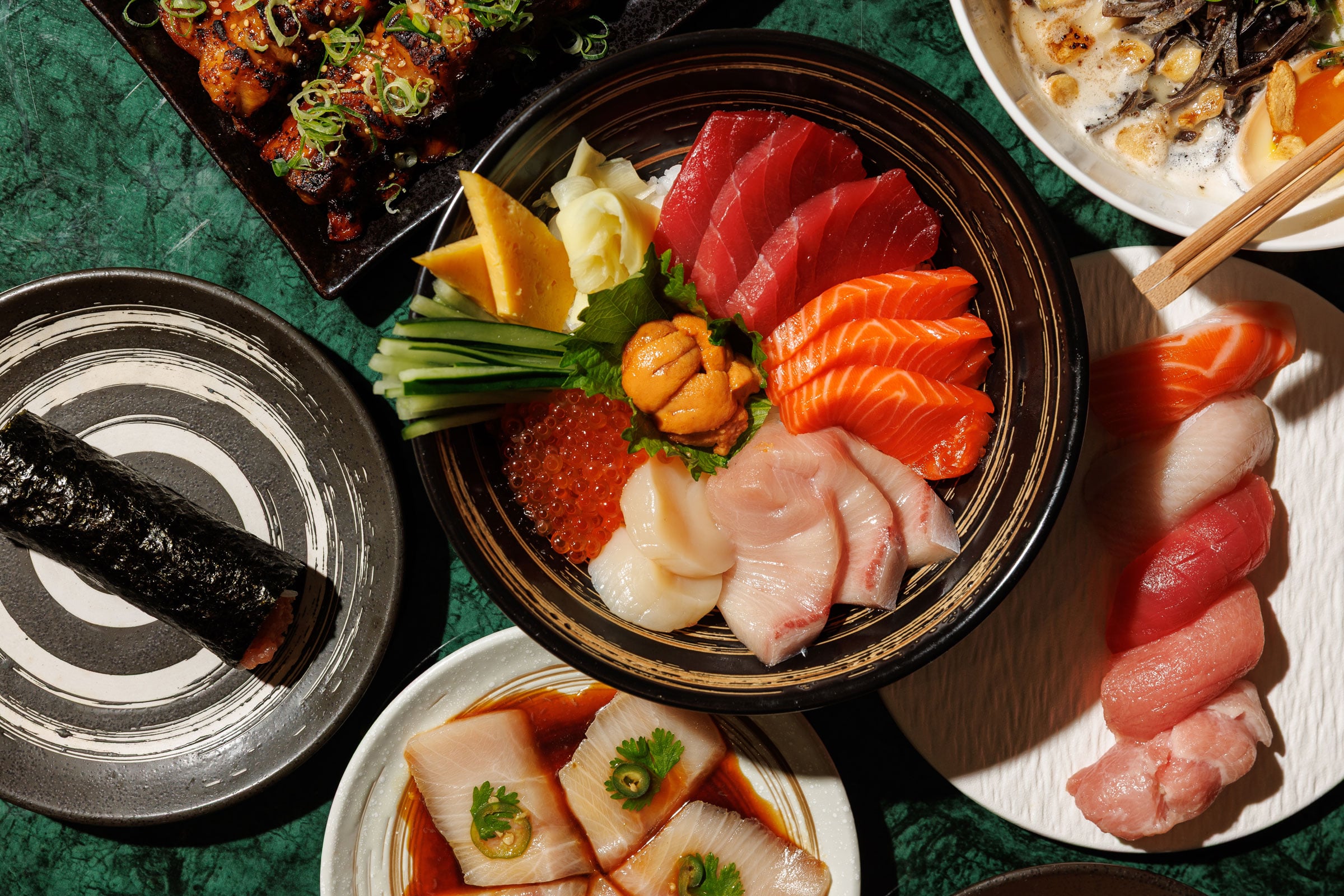
The menu at Chao wraps in dishes that lean conventionally Vietnamese and playfully Viet-inspired—like crispy batter-fried chunks of moi, reminiscent of fish and chips, that you DIY into lettuce wraps with silken rice vermicelli. Or Pork Ribs and Dragon Eggs, a take on a Vietnamese New Year’s dish, with the house chicken fat fried rice. Or, as a woman at the next table orders, “Bone marrow and the carpaccio, and the pasta. That sounds like fun.”
Like Faria, MW and The Pig & The Lady—Honolulu’s pioneering modern Vietnamese fusion eatery—Chao is an intensely personal restaurant. Its food tells stories of family and culture, broadened liberally for a modern palate. If you hew to tradition, like blood cakes in your bun bo hue, go elsewhere. If you like new forays that still feel familiar, you may be among the HONOLULU readers who voted Chao the Hale ‘Ainas’ Best New Restaurant.
That HONOLULU’s editors named Chao Restaurant Group the Restaurateurs of the Year was coincidence. We started watching Chao before it opened—because it was the peak of a steep learning curve for industry outsiders who started with a poke shop and ramped up to a handroll sushi counter. Chao represents a different direction for the seafood-focused group. We asked its chef, Honolulu-born Binh Ngo, for the stories behind some of our favorite dishes.
Photo: Aaron K. Yoshino
Photo: Aaron K. Yoshino
Seafood ceviche: scallop, shrimp and calamari in a lime-chile-coconut sauce
“Growing up, we didn’t have a lot of money, so dishes like this were a treat,” Ngo says. “Whenever we had the money to buy seafood, my mom would put raw tilapia or pompano and shrimp in there, mix it up with lime juice. She experimented with coconut and thought it was so good. I was drawing similarities between that and poisson cru, so this is rooted in Polynesia and my childhood.”
Beef carpaccio: thinly sliced raw beef with lime juice, chiles and other toppings
“That’s my favorite, actually. Whenever my dad ate pho, my mom would leave the raw beef slices on the side, and he would dress it up with lime juice, black pepper and onions. I thought it was weird. But as I grew up, I thought, what if I put it all together and give it the herbs and garnishes of pho? This dish is savory and sweet and salty and acidic, it has crunches from fried onion and shallots and Maldon sea salt, and fresh Thai basil, cilantro, Vietnamese coriander and culantro.”
Soft-shell crab pasta
“People in Hawai‘i tend to like indulgent things, so I started with a beurre monté butter sauce with lemongrass and garlic. We decided to add two whole fried soft-shell crabs—one wasn’t enough, and two was more than enough. The mochi noodles are from Sun Noodle. Vietnamese people don’t like dishes that are one-dimensional in flavor or texture—they’re ngan. I felt like a rich sauce coating a chewy noodle with crispy crab pretty much is a formula for an addicting dish.”
Pork Ribs and Dragon Eggs: a twist on thit kho nuoc dua—pork belly and boiled whole eggs simmered in coconut juice and fish sauce
“This dish is truly my mom’s. I use spareribs over pork belly because I like the textures of sinew and cartilage. But before my mom, I’d never seen anybody fry the eggs in a thit kho. I soft-boil them first, then peel and deep fry so they get the skin all around. The wrinkles soak up the sauce better, give the eggs that caramelized taste. It’s a staple for every Vietnamese family at New Year, so it had to have a place on the menu.”
Mari Taketais the dining editor of HONOLULU Magazine and editor of Frolic Hawai‘i.
Readers’ Pick
BEST MEXICAN
(GOLD)
Readers’ Pick
BEST SEAFOOD
(FINALIST)
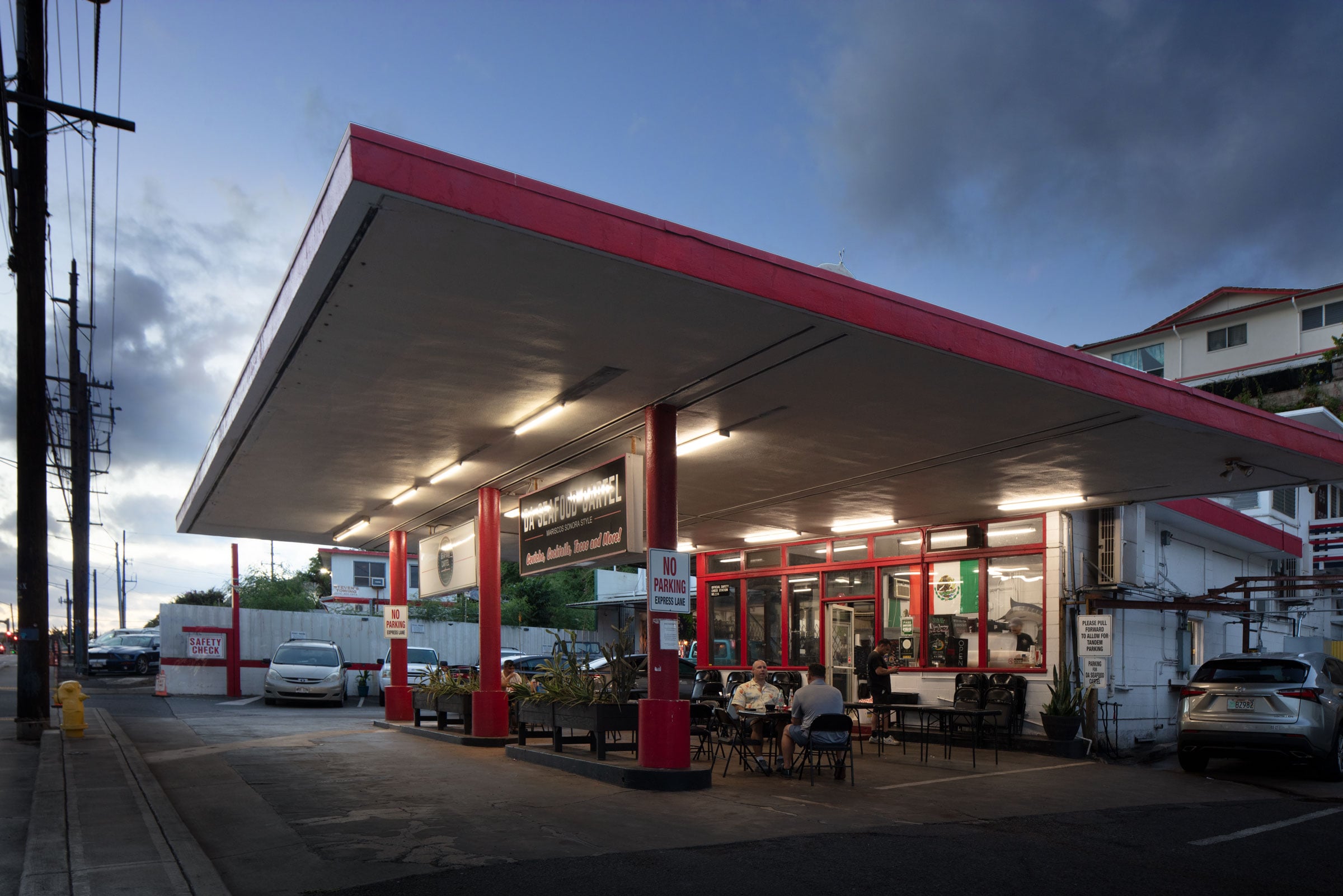
Da Seafood Cartel’s original location in ‘Aiea. Photo: Olivier Koning
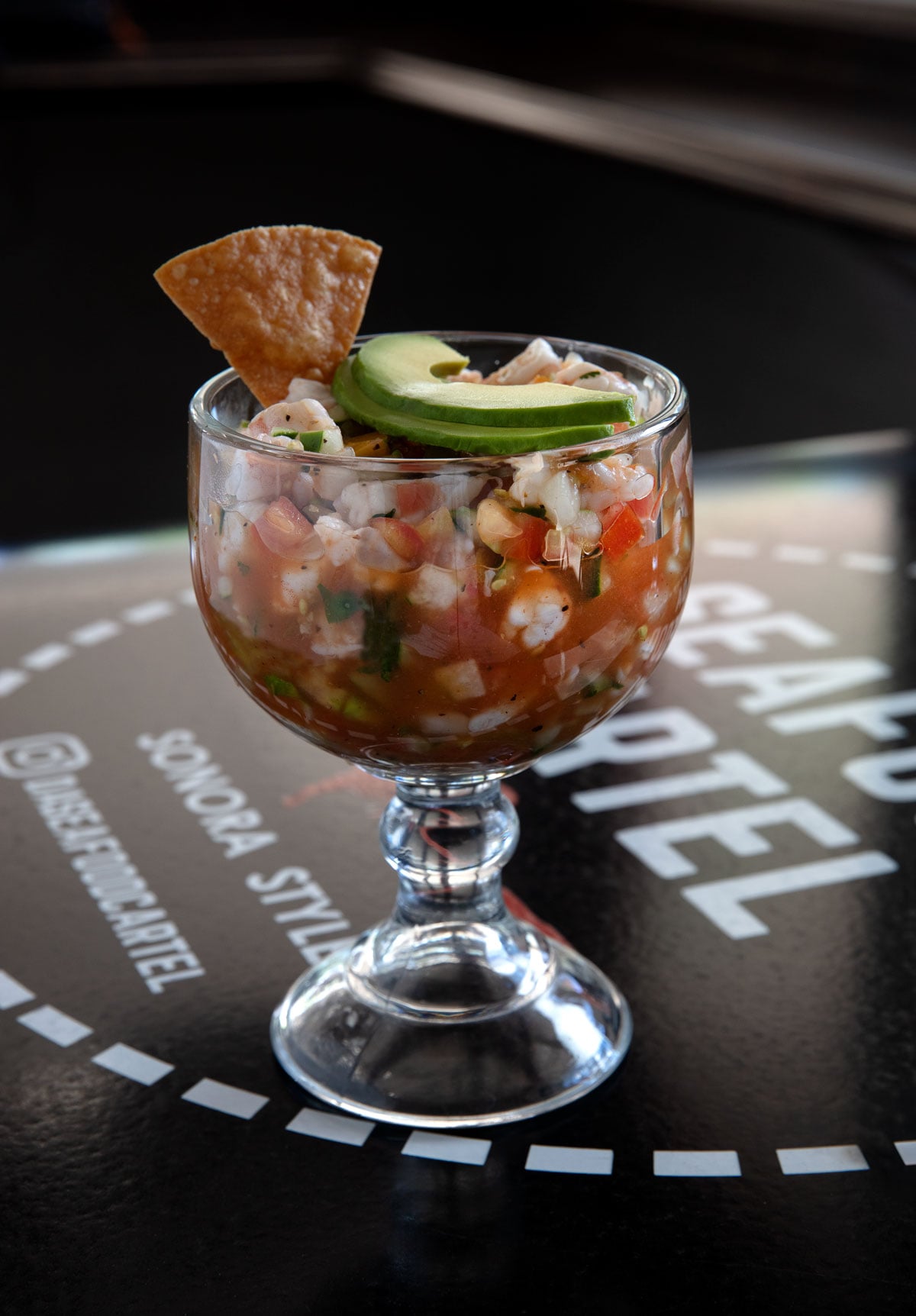
No burritos, birria tacos or chile rellenos cram the tables at Da Seafood Cartel. Dishes here celebrate seafood—northern Mexican coastal creations, to be exact—a distinction that sets the Hale ‘Aina Best Mexican winner apart from the meaty familiarity of carnitas and loaded nachos. While you will find beer-battered shrimp and fish tacos on the menu, follow the lead of Spanish-speaking regulars spooning tangy cocktails of shrimp ceviche from chabela glasses and tucking into crunchy corn tostadas mounded with avocado and seafood.
A farmers market startup, Da Seafood Cartel graduated first to a converted gas station off Kamehameha Highway in ‘Aiea, then expanded to a second spot in Hale‘iwa. Owner Amanda Cordes’ mother is from Sonora, Mexico; her father’s family owns Forty Niner Restaurant around the corner in ‘Aiea.
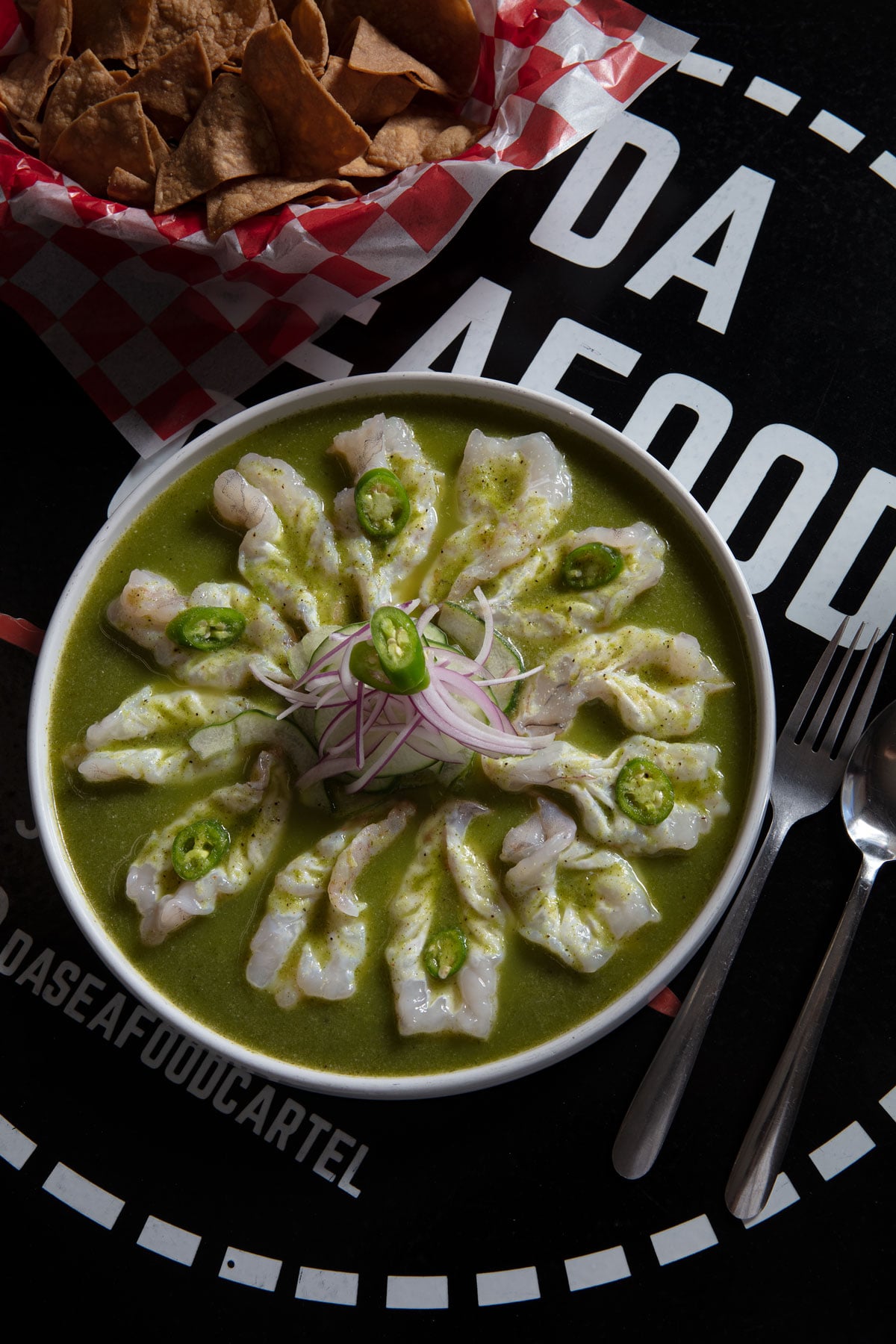
Aguachile. Photo: Olivier Koning
Ceviche in a chabela glass. Photo: Olivier Koning
With this pedigree, perhaps it was only a matter of time before Cordes’ aguachile—raw shrimp marinated in the seasoned juice of fresh limes and cilantro and crowned with slivers of serrano—made its appearance on O‘ahu. Alone, it’s a sprightly, eye-opening pop; setting it on a fresh corn tortilla chip with a smear of guacamole (a must-order on the side), its richness tinged with an edge of fresh onion, raises the bite to wow territory. Equally wow and more unexpected are toritos of guero chiles stuffed with plump, just-cooked shrimp bathed in a zesty shoyu-butter sauce, a favorite of Cordes’.
For most of us, nearly the entire menu is a foray into the unknown. For Latino families from around the island, it’s a regular destination. Tables on the lānai fill up quickly on weekends, with parking spilling onto nearby side streets. And neighborhood chickens patrol the perimeter for fallen morsels. Go regardless—Da Seafood Cartel is well worth the journey.
Mari Taketais the dining editor of HONOLULU Magazine and editor of Frolic Hawai‘i.
Readers’ Pick
BEST LATE-NIGHT EATS
(GOLD)
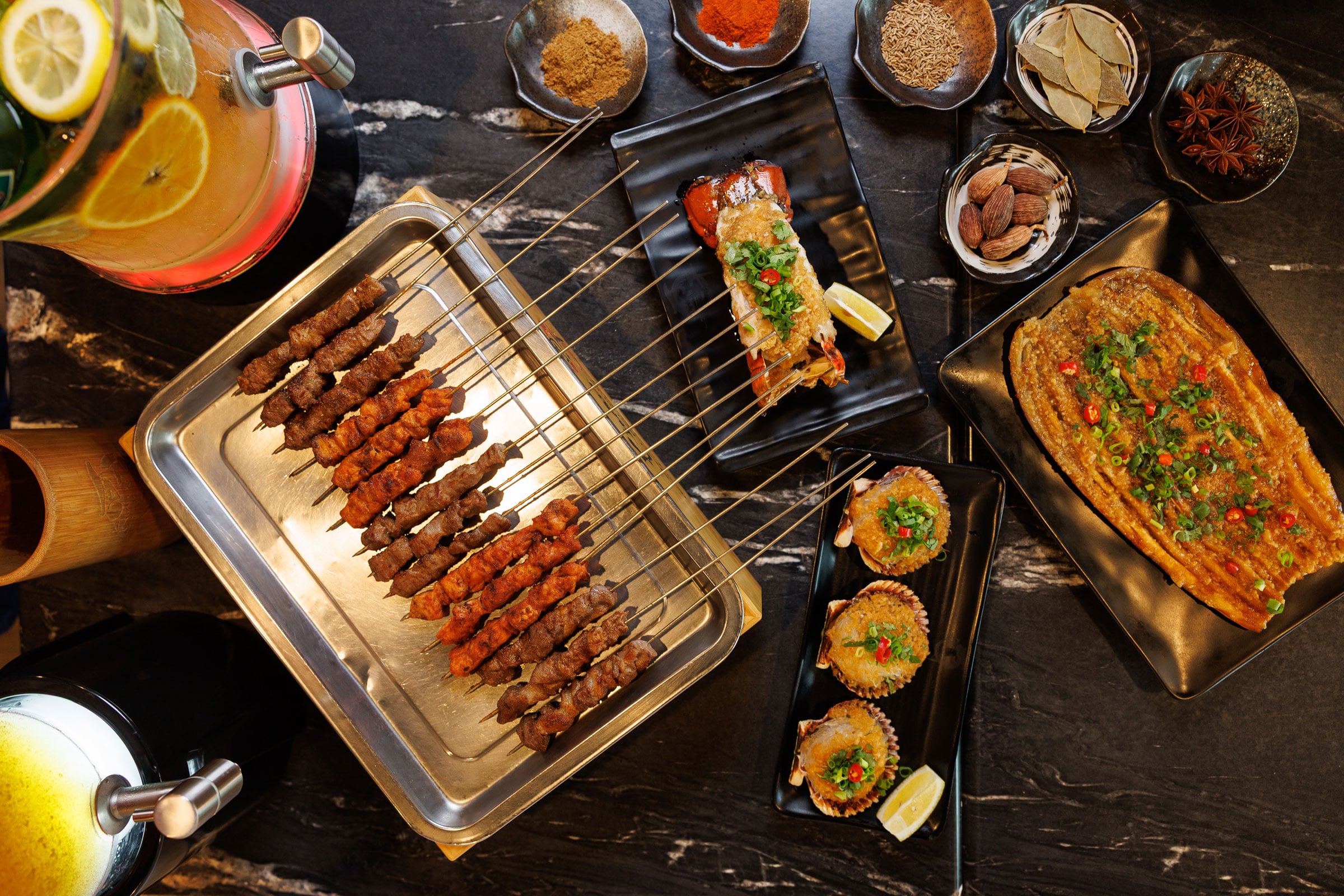
Skewers rule at Khan, though spicy and savory appetizers and drink towers deserve equal billing. Photo: Aaron K. Yoshino
Dining options narrow fast in Honolulu after 10 p.m. Luckily, there’s Khan Skewer Restaurant, open until 1 a.m. Thursdays to Sundays and 11 p.m. the rest of the week. The specialties? Spicy skewers, Mongolian-inspired stir-fry and plenty of beer, sake and soju.
On a recent late-night outing, our bellies (and hearts) were full after plates of sliced braised beef atop cucumber salad, diced century egg and tofu in shoyu chile oil, salt-and-pepper corn on the cob, flaky green onion pancakes, spicy shrimp and pork wontons, garlic scallops with vermicelli—and that’s just for starters.
The stars of the show are the skewers. They come in quantities of three or five, so if you know what you like, ordering five saves you a couple of bucks. For the less adventurous, there are lean sticks of beef, lamb, chicken wings and assorted veggies.
The eggplant, Maui venison and pork belly with enoki mushrooms are musts. Your wilder side will want the grilled beef tendon, chicken hearts and pork intestine. Khan’s two dips reflect its mix of patrons: one’s a milder pineapple-apple sauce with Thai chile, the other is a lively dry rub of Sichuan peppercorns, cumin and chile powder.
Skewers stay warm, thanks to tea candles beneath a metal tray and a cute warming station at your table—which gives us plenty of time for drinks, including a build-your-own DIY dispenser filled with four bottles of beer (Heineken, Sapporo or Maui Bikini Blonde), a bottle of soju (in strawberry, yogurt and a dozen other flavors), plus fresh fruits and citrus—all mixed together—for $38.99. A nonalcoholic version is $25.99.
Dessert is fun and complimentary with the meal: fluffy snow ice topped with Frosted Flakes and your choice of syrup. Tonight’s options are peach, brown sugar or chocolate. We opt for brown sugar—and plenty more late-night visits here.
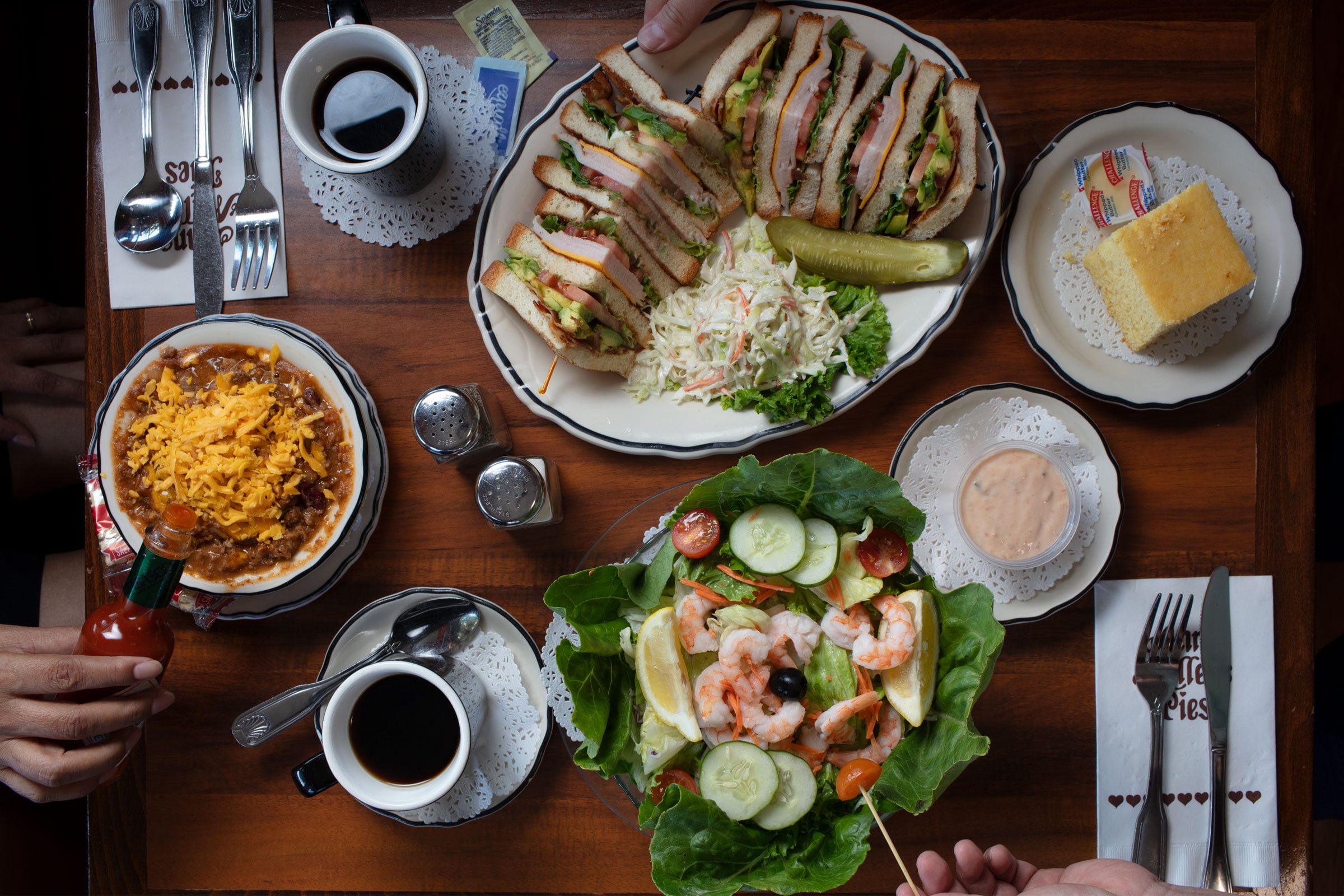
A lunch at Anna Miller’s: chili, clubhouse sandwich No. 5, shrimp Louie salad and cornbread. Photo: Olivier Koning
The cornbread. That chicken fried steak. Those lavish, fresh-baked pies. For half a century, Anna Miller’s has beckoned from its corner on Kamehameha Highway, a time-stamped sentry in a fast-changing world. It’s ingrained in much of O‘ahu’s collective nostalgia—the kind of place where regulars seat themselves at favorite servers’ tables and cooks know what to prepare as soon as they come in. As Hawai‘i poet laureate Lee Tonouchi wrote, “I’ve run into Mililani cousins, Neighbor Island relatives, and even some of my townie friends who insist dey NEVAH drive past Kalihi. Local people fully love Anna Miller’s.”
Founded by Stanley Miller in California in the late 1960s and spun off as a chain of 25 restaurants in Japan, at one time, there were 35 Anna Miller’s in the world. The one at Pearlridge Center opened in 1973. It was an era of homey American food—remember Chowder House and Yum Yum Tree?—and was named after Miller’s grandmother. And from 2022 until February, Hawai‘i’s Anna Miller’s was the only one on the planet.
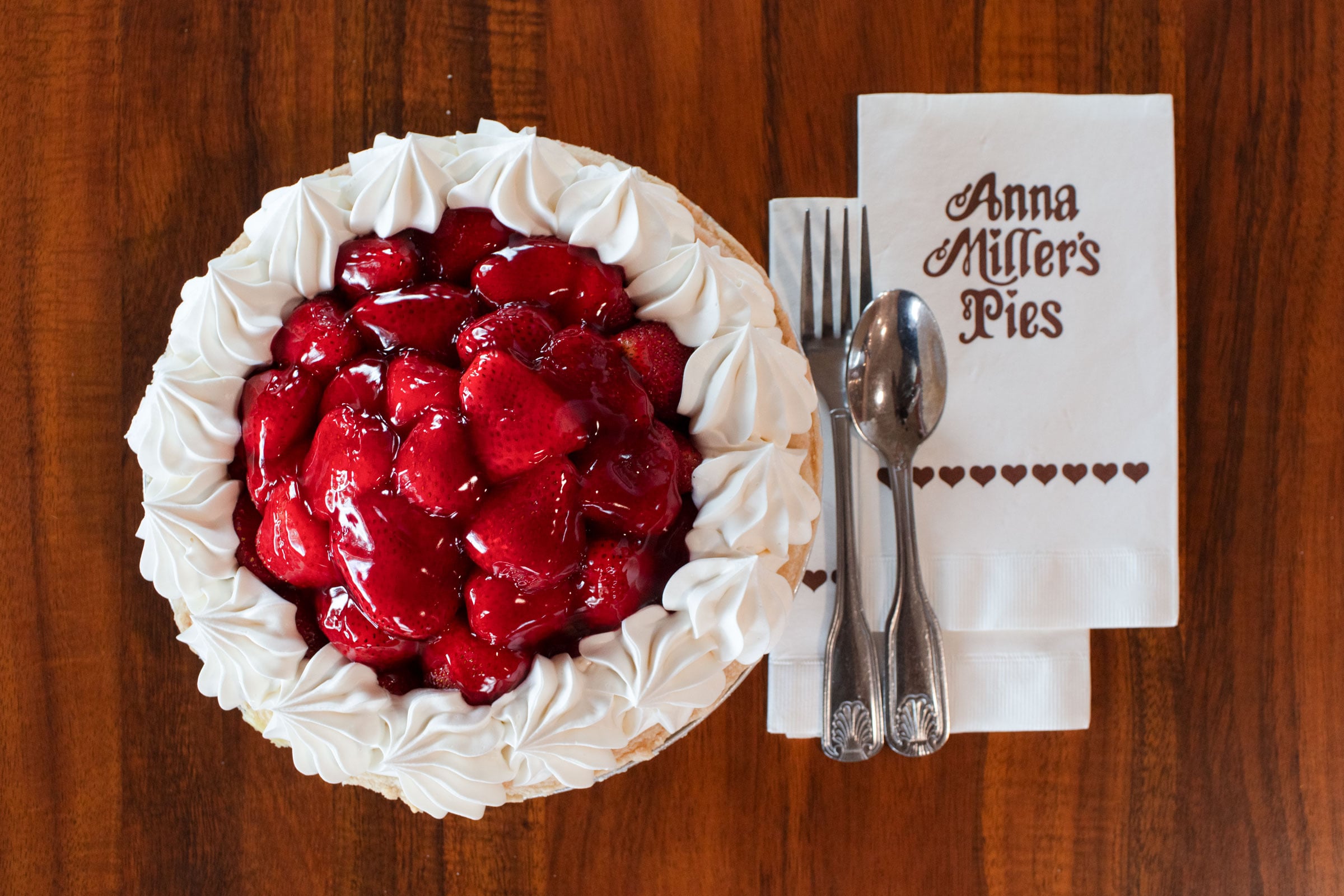
From late spring through summer, towering strawberry pies are in the pie case. Photo: Olivier Koning
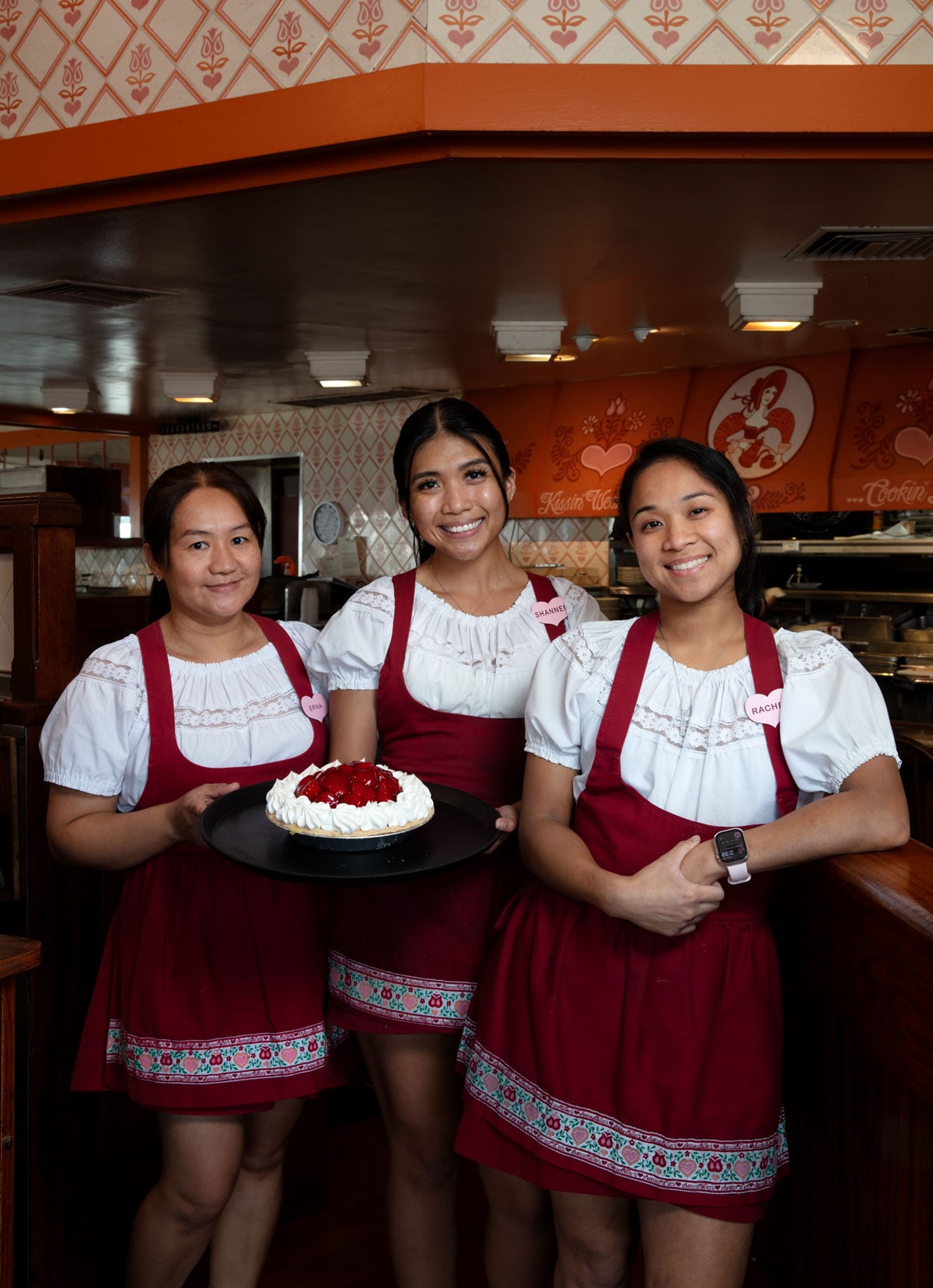
That makes it the repository of all things Anna Miller’s. The uniforms, complete with heart-shaped nametags, are still on every female server; they’re said to have inspired Japan’s maid cafés. The menu of classics shrank after the pandemic, which also turned the restaurant from a 24-hour stalwart into a breakfast, lunch and pie shop. But you can still get chicken fried steak with eggs for breakfast, and a hot pastrami sandwich or shrimp Louie salad for lunch. “Before, we used to have eight different clubhouse sandwiches,” area manager Antonio Natividad says. Now, there are five. “Club 5 is turkey, avocado, bacon, lettuce, tomato. That one is the most popular.”
Server uniforms and fresh strawberry pie, unchanged from the 1970s. Photo: Olivier Koning
Through 53 years, the backbone of Anna Miller’s consistency has been Stanley Miller, who still flies in regularly from the mainland, and his three managers. The first one’s tenure was short, but Wade Hashizume, the second manager, ran things for nearly 50 years. Now, Natividad is the third area manager, and his family is another secret to Anna Miller’s success. His mother worked there from very early, and as they came of working age, she brought in her four sons. Natividad started bussing tables in high school in 1978; to this day, it’s often him cooking your eggs and chili. With his wife, three daughters, son, a brother and a cousin, family members make up 16% of payroll.
In his mid-60s now, Natividad is already grooming a successor: his daughter and dining room manager Anna Marie Saoit. She grew up in the restaurant—literally, because Natividad and his wife worked their shifts while she watched from her highchair. Which means this Old-School Restaurant We Love will continue in good hands.
Mari Taketais the dining editor of HONOLULU Magazine and editor of Frolic Hawai‘i.
Photo: Courtesy of Aloha Got Soul
Did you know the Honolulu airport plays AI-generated music? Upon learning that from a Civil Beat article published earlier this year, record label Aloha Got Soul compiled a rebuttal in vinyl form, Music for the Airport, with 17 local, human-made songs pulled from its catalog of unreleased, licensed music.
Roger Bong, owner of Aloha Got Soul, selected many of the songs from the CD era of the ’90s and early 2000s, so the collection “gives people a nice slice of what Hawai‘i sounded like during this snapshot in time.” Having been recorded during the transitional period from analog to digital, the songs also represent a time when artists’ creativity grew with technological progress rather than being replaced or hindered by it. Ballads, instrumentals, contemporary Hawaiian mele, folksy ditties and jazzy tunes are arranged to flow and make you want to hit play again when the last track ends.
The number of songs was chosen intentionally to fill in for the 17 AI pieces if the airport ever decides to make a change. Hawai‘i Department of Transportation spokesperson Shelly Kunishige says the airport does play licensed Hawaiian music in addition to AI, and that it might consider utilizing the Aloha Got Soul album if its budget allows for it.
The 2LP vinyl is slated to release in September when it will also be available on all streaming platforms. You can pre-order the record online and stream it on Bandcamp pre-release.
Andrea Lee is the digital editor of HONOLULU Magazine.
The D Fin House, high on the slopes above Kealakekua Bay, offers panoramic views. Photo: Darren Bradley
A home with a musubi-shaped footprint or surfboard finlike structure isn’t something you often encounter in the Islands. That’s what’s so exciting about Craig Steely’s designs. The Hawai‘i Island- and San Francisco-based architect has a knack for dreaming up one-of-a-kind homes that break the mold of traditional Hawai‘i abodes, rooting them in deep respect for their unique locales.
“We’re known for smallish houses that fit into beautiful, complex sites,” Steely says. More than that, his considered designs harmoniously blend modern aesthetics with biophilic elements and eco-mindful materials. “We’re constantly trying to mitigate that level between human scale, the scale of time and the scale of topography,” he says.
Take Steely’s Musubi House for example. Situated on 100 acres of bucolic pastureland in Pa‘auilo on Hawai‘i Island, the off-grid home features a triangular concrete structure separated into three zones—a kitchen, living room and two bedrooms—by a central inverted atrium. “There are no doors, just open spaces that imply closure with spots that squeeze off,” he says. Outside, rolling fields of tall grass give it the feel of a ship among the swells.
In the equally striking D Fin House, high on the slopes above Kealakekua Bay, a steel-clad wood and glass barrel structure offers panoramic views of the ocean and lush mountainside. At its center sits an open-air courtyard. A steeped-roof loft, reminiscent of a ’60s-style skeg, overlooks a lap pool nestled into the earth. “There’s something about the remoteness of these sites and the contrast between site and house, where it fits in there; it’s not fighting it,” Steely says. “That always feels really precious and amazing.”
Brie Thalmann is the former home and style editor of HONOLULU Magazine and now a contributor.
Kilohana Square closed in Kapahulu after 55 years. Photo: Aaron K. Yoshino
“Auwē!” Maria Jane Chamberlain Forbes lamented the changes overtaking Honolulu. New projects were reshaping the place where she was born and raised, she wrote—back in the late 1800s. The dismay of Forbes, the first head of Lunalilo Home for Aged Hawaiians, was part of a Hawaiian Mission Houses performance of writings by historical figures in June. Forbes’ words were a reminder that in Hawai‘i and everywhere, the only constant is change.
That same month, Ward Centre and Kilohana Square in Kapahulu closed. Still up in the air in midsummer was the fate of Chinatown Cultural Plaza. All three—built in 1984, 1971 and 1974, respectively—stood for generations, clustering together the kinds of places that make up life in urban Honolulu. Remember the antique shops and eateries of Kilohana Square? Reading in the aisles of Borders at Ward Centre? The crab artichoke dip that started every pau hana at Ryan’s Grill? “So many Taco Tuesdays back in the day at Compadres!” one Instagram commenter wrote of the mall, which housed two dozen businesses in its final weeks. “Oh it was a step back in time,” someone else reminisced, “but in a lovely way.”
Ward Centre was the newest and last vestige of a sprawling complex that included Ward Farmers Market (where Haili’s Hawaiian Food and Real a Gastropub used to be) and Ward Warehouse, which shuttered in 2017. Now that Ward Centre is being redeveloped into condo towers with shops and a park, and a self-storage facility is replacing Kilohana Square, our laments are fresh and full-throated—just as they are every time we learn that an old bowling alley or other beloved landmark is closing.
Kilohana Square closed in Kapahulu after 55 years. Photo: Aaron K. Yoshino
The landscape Forbes saw in her lifetime was immeasurably different from what Native Hawaiians beheld a century earlier; a century from now it will be unrecognizable again. Change is like tradewinds and Kona weather: inexorable and inevitable.
At least we still have Chinatown Cultural Plaza. Though redevelopment seems all but certain for the aging monolith, more than 40 restaurants, jewelry shops, grocers, acupuncture clinics and others still do business there. Sunday dim sum lunches, shopping with Popo, praying for good luck at the courtyard altar: Memories here, we still have time to make.
Mari Taketais the dining editor of HONOLULU Magazine and editor of Frolic Hawai‘i.
Photo: Aaron K. Yoshino
Stephanie Matthew has a nose for memorable scents. “I still remember the exact smell of the rose geraniums in my grandma’s backyard,” she says. And just thinking about her early childhood in California, before her family moved to Hawai‘i and she established a career as a photographer, invites a rush of vivid scent memories of “Santa Ana winds, chlorine and chamomile.” Such is the power of scent. In an instant, it can hurl you back in time or whisk you off to a far-flung locale, something Matthew hopes to celebrate with Aaila, her recently opened fragrance boutique in Downtown Honolulu.
The shop focuses on niche fragrances—those created by dedicated perfume brands—from around the globe. Crafted in small batches by indie perfumers, these are highly imaginative fragrances designed to enthrall and delight. “Vietnamese brand D’Annam makes a scent that at first smells like white rice, then turns floral, then musky,” Matthew says. Inspired by Ching Shih, a fearless female pirate of the South China Seas in the early 1800s, one of New York perfumer Marissa Zappas’ scents layers notes of gunpowder with velvety orris and apricot-tinged osmanthus.
Potency ranges from extraits (the strongest) to toilettes and colognes. For the optimal experience, Matthew suggests coming in with an open mind and a willingness to explore. “Walk around and smell everything,” she says. “That’s what’s so cool about niche perfume—people come in thinking, I like this, I like that and then leave with something completely different!”
Brie Thalmann is the former home and style editor of HONOLULU Magazine and now a contributor.
Senior Jovi Lefotu plays as a guard for the Rainbow Wahine basketball team. Photo: Courtesy of UH Athletics
Since her freshman year, UH women’s basketball player Jovi Lefotu has received financial support from such brands as Waiākea and Hawai‘iUSA Federal Credit Union through the university’s Name, Image and Likeness program. “That was really helpful for me, and I loved it,” says Lefotu, now a senior. “It takes pressure off our shoulders during school, where our sport and academics become very demanding. So not having to worry as much about working gives us more time and energy to dedicate to our school and sport.”
College athletes across the country have been securing similar corporate sponsorships since 2021, when the NCAA approved noninstitutional name, image and likeness branding and compensation. In exchange, the student athletes might agree to such things as appearing at autograph signings or in commercials. The landmark policy allows all incoming and current college student athletes to monetize their names, images and likenesses without losing NCAA eligibility.
Name, image and likeness policies were expanded in July 2025, permitting universities to establish their own financial agreements with student athletes. Deep-pocketed colleges have quickly mobilized to establish funding for such efforts to help them recruit top athletes.
UH Mānoa assessed it needs about $5 million annually in name, image and likeness support to be competitive in the Mountain West Conference—which it recently joined as a full member—and nationally. At first, the university and the state Legislature couldn’t agree on how to fund the UH program, with a promising bill failing to pass this past May.
A month later, five contributors—Bank of Hawai‘i, First Hawaiian Bank, Matson, Jack Tsui and Walter Dods—each committed $200,000 annually for program funding, to be distributed by the UH Foundation. The funds totaling $1 million per year will be disbursed over the next five years. (Tsui and Dods are both former executives of First Hawaiian Bank.) UH plans to fundraise to make up the rest of the total.
“What this is able to do is allow our coaches to be able to go out and recruit and entertain elite student athletes,” says Hunter Niswander, director of development and NIL for UH Mānoa Athletics. “So what does that mean for us? Well, it starts with being able to keep the local talent here—that is like the No. 1 priority for our coaches—and then to be able to go out and recruit on top of that.”
Ideally, the NIL program will help draw student athletes to UH, and after they graduate, they’ll choose to stay in the Islands. “So hopefully, it’s kind of a full circle approach that is impacting the whole state, not just athletics. They’re taking their degrees and their experiences as a student athlete and deciding to stay here and be sort of that next generation for the next round of student athletes to look up to.”
Along with the $5 million raised from the donors, UH is welcoming donations from the public to the general Boost the ’Bows Fund or any of UH’s 21 athletic programs that have their own funds. “Let’s say it goes to a team—then it’s up to that coach to be able to utilize those funds to recruit and retain their student athletes,” Niswander says. “For example, support through the Boost the ’Bows Fund helps create the resources coaches can use to build their rosters, while providing student athletes with additional resources that support their success at UH.” This is different from noninstitutional name, image and likeness efforts, where student athletes can enter into direct partnerships with brands.
Other groups are also finding ways to raise funds and promote opportunities for Hawai‘i’s student athletes, such as the Downtown Athletic Club of Hawai‘i’s NIL Collective. UH also offers an official marketplace, ’Bows Exchange, to connect businesses with student athletes, and develops opportunities through corporate partnerships via Hawai‘i Sports Properties.
One thing is certain: Tadd Fujikawa is one of those gifted athletes whose story makes you go “geez” when you hear it. He started out with judo, and when he was 8, he took up golf mainly to build grip strength for the martial art. Eight years later (and this is where things get surreal), the feisty 16-year-old from Moanalua High School sank an eagle putt on the 18th hole to make the cut in the 2007 Sony Open. His Cinderella run made him an instant local celebrity, with huge crowds descending on the greens of Wai‘alae County Club to cheer him on and his Tiger Woods-esque fist pumps making headlines well beyond the Islands.
After that whirlwind run, Fujikawa went pro, basking in invites to golf events around the world. “When you’re that young and in the moment, you don’t realize the magnitude of everything that’s happening,” he says. “You’re there and enjoying the moment, but obviously, it was really cool to be in front of my home crowd and get to share that with my friends and family.”
Fujikawa played golf professionally for 15 years, not always on the PGA Tour. “I played most of the big tour events, then a lot of smaller professional tournaments, then I did qualifiers, trying to work my way up. Then I played on the Canadian tour for two years, then went back to mini tours.”
Fujikawa was living in Georgia and took up tennis for fun and, like with golf, had natural talent for the game—so much that he started teaching the game. During one lesson, a student urged him to try pickleball. “But I was a tennis snob, so I was like, ‘Nah, that’s OK. I’ll stick to tennis,’” Fujikawa recalls.
The student gave him pickleballs and said, “Just try it.”
Then in 2021, while on a visit home in Honolulu, he and his mom took a pickleball lesson from instructor Margie Katras.
“From the first ball he hit, I could tell he could play,” Katras says. “He was a tennis player, so he had a different swing. But having good hands for golf is a big part of it, and he knew when to hit hard, when to get soft. From the start, he had a good understanding of how to play the game.”
Fujikawa remembers that lesson well, saying he was “immediately hooked.”
“It was so fun, and I just couldn’t get enough of it,” he says. “So I basically quit tennis and started just playing pickleball.”
His love for pickleball only grew. After about seven or eight months, a resort in Georgia offered him a job as their pickleball pro. “I was still playing golf full time, and I knew the director of racket sports at the resort because I played tennis with him. He said, ‘Hey, we’re opening up these pickleball courts, and we’re looking for a pro.’ It was a random thing that I wasn’t planning, but it just happened.”
Fujikawa had by this time become a standout pickleball player, mastering as he puts it “soft touch and feel shots,” which he honed from golf. “The way my game is styled, it’s more placement than power.”
He started playing tournaments to keep his “competitive juices flowing,” and he loved being part of the fast-growing pickleball community. “You can go to a public court, see people playing, and they’ll invite you to play,” he says. “It’s very inclusive, and that was a big draw for me.”
Now 35 and having moved back to Hawai‘i, Fujikawa is a 5.0 rated player. According to USA Pickleball, a 5.0 rating indicates an expert-level, top-tier amateur player, and it’s the highest rating before reaching professional or senior professional status. He’s also co-tournament director of the upcoming Hawai‘i Pacific Health ESPN Honolulu Open pickleball tournaments. Who’s the other director? Katras, of course.
What’s interesting though is that despite his lifetime of athletic accomplishments, Fujikawa believes his truest passion is not as a competitor. “I love teaching, and that’s what I’m maybe most gifted at,” he says. “When my students get excited about playing, that brings me so much joy.”
What makes Fujikawa a great pickleball instructor, Katras says, is his strong technical eye, which picks up details that he relays to students. “He knows how to break things down,” she says. “But the biggest thing is that he cares. He genuinely wants his students to get better, and that makes all the difference.”
After last year’s successful debut, the Hawai‘i Pacific Health ESPN Honolulu Open pickleball tournament returns to the Hawai‘i Convention Center Oct. 8–11, this time with $15,000 in total prize money to be shared by the winners of men’s open doubles, women’s open doubles and mixed open doubles. “It’s a pretty good payout locally,” says Margie Katras, co-tournament director. There will also be a collegiate invitational.
Katras expects up to 900 players to take part in the tournament (produced by HONOLULU’s parent company, aio), a testament to the growing popularity of the game.
“Pickleball has become so popular everywhere, but in Hawai‘i, it’s special,” says Tadd Fujikawa, the other tournament director. “More people want to play, and more people want to get better.”
Diane Seo is the editorial director of HONOLULU Magazine.
Photo: Envato, Composite by James Nakamura
Like others navigating an increasingly tech-centric world, I’m still figuring out my relationship with AI both professionally and personally. It’s complicated.
As a journalist, the boundaries of usage appear clear, yet things are getting murkier as AI becomes more ingrained and sophisticated. One thing is certain: No editorial stories we publish in HONOLULU, whether in the magazine or on our website, have been or will be written by AI or passed through AI for editing.
Professional journalists intrinsically understand that people read our stories, expecting the reporting and writing to be done by humans. This includes generating our own story ideas. It’s our core offering—original reporting and writing and creative storytelling—and why we exist at all. Readers trust this, and it can’t be violated under any circumstances.
But when it comes to the process of reporting, our editorial team now relies on various tools, including AI transcription tools. When we interview people, we record the conversations, then upload the audio files into the tools of choice. Within minutes, we have Word documents with complete interviews transcribed. These transcripts help us outline stories and draw quotes. It’s immensely helpful and fast.
While working as a newspaper reporter in the early 1990s, I’d interview people in person or attend press conferences with a pen and reporter’s notebook. I’d scribble as furiously as I could to jot down what was said, but I missed a lot. I’d return to the newsroom and type my notes on a computer, sometimes struggling to read my own handwriting. The pressure of having to make sense of my notes and write stories quickly was stressful, to say the least.
Fast forward 30 years and now, not having to write everything down has allowed us to engage more in conversations and give people our full attention and eye contact. It’s made us more impactful reporters.
On the art front, our creative director doesn’t allow any generative AI to be used to create graphics, artwork or images for editorial content in the magazine or online. But the tools art directors use, like Photoshop, have built-in AI tools, so if they clip out artwork, AI can do it instantly. It used to take hours.
All of this is non-controversial in terms of journalistic integrity. But here’s where it gets murky. We’re upgrading our digital content management system to one that has built-in AI tools. One of them can assess our headlines and offer suggestions for improvement. The suggestions would improve our search engine optimization, or SEO, which anyone in the digital space knows is the holy grail of how you get Google and other search engines to showcase your stories. While members of our editorial team all have a good sense of SEO, AI is likely far more clued in than we are on the latest algorithms.
But there’s an art to coming up with clever and strong headlines, something that journalists should master. So do we use AI for headline generation? My answer: No. We have to hold on to the humanness of our work, which relies on brains to come up with ideas, sentences and headlines—sometimes with more nuance than AI is capable of. We could use AI to research effective keywords that would be helpful for SEO, but I believe we shouldn’t use it to generate editorial content.
So things are hardly clear cut with AI, and it’s going to increasingly be the case. It’s here to stay, part of our world, but it’s up to each person, whether it’s for work or for personal use, to set standards, guidelines and consider the benefits and drawbacks of extreme utility.
Diane Seo is the editorial director of HONOLULU Magazine.
Photo: Courtesy of Waimea Valley
Waimea Valley Sunrise Tour
Explore the beauty of Waimea Valley during golden hour, learn about the cultural and botanical significance of the park, and be the first to take a dip in the waterfall.
O‘ahu’s only Latin American market has opened a second, larger location with even more imported and locally made groceries and goods, including tortillas, quesos, salsas, snacks and liquors.
At the Kailua bottle shop’s second location at Koko Marina, you can have a glass of wine with light bites or desserts while perusing the old and new world selection and local gourmet finds. Plus, keep an eye out for events like tastings and book club meetings.
After closing in Kaka‘ako last year, Idea’s Music and Books has been reincarnated at Nā Lama Kukui Lifestyle & Design Center. Find the store at the back of the first floor with shelves of new and secondhand vinyl records, CDs, cassette tapes, books and comics, plus other collectibles.
Nā Lama Kukui Lifestyle & Design Center, 560 N. Nimitz Highway, #119A, Iwilei, @madplatterrecords_hawaii
Photo: Courtesy of Echoa Ridge
Echoa Ridge
Wet ’n’ Wild Hawai‘i is now home to a state-of-the-art outdoor performance venue with a 7,400-square-foot stage and more than 60,000 square feet of lawn space primed for concerts, festivals and other big events.
The Dirt Bike Experience at Coral Crater Adventure Park
Thrill-seekers age 9 and up can rev up electric dirt bikes to traverse a jungle and grassy terrain. The beginner-friendly 90-minute experience starts at $99 per person.
The once popular spot in Waikīkī has reopened in Ward Village, bringing its signature brunch dishes like soufflé pancakes and wagyu loco moco to an open-air bistro fronting Victoria Ward Park Mauka.
This Korean grocery store has taken over part of the former Ross space on Ke‘eaumoku Street with an extensive selection of produce, banchan, snacks, drinks, souvenirs and meal kits, some of which you won’t find elsewhere.
Longevity is the name of the game at Lawa, a wellness studio bringing innovative diagnostics and treatments to Kaimukī. With a blood or urine test, you can learn about everything from your biomarkers and hormones to your nutritional needs and genetics. Recommended services will be tailored to your results.
Here, the care is comprehensive and the treatment options extensive. To recover physically and mentally, enter the Ammortal Chamber, with therapies involving light, sound, electric fields, molecular hydrogen and breathwork. Boost your vitality with Precision Formulated IV Therapy, which delivers what your body needs based on your test results. And VSEL Cellular Regeneration directs your body’s stem cells to other areas, where they facilitate healing and new growth; this therapy is said to address a wide variety of issues, including chronic pain, neurodegenerative disorders and skin aging. If you have aesthetic concerns, the studio’s Alma Lasers can provide customized treatment to rejuvenate your skin.
Many more services are available that can be booked individually, or you can join the club for continual care. Lawa’s membership starts at $4,700 and comes with priority booking, all testing options, regular treatments and access to private lounges.
At this studio in the Coral Commercial Center, you can achieve your fitness goals with a range of beginner-friendly classes. Take barre for a low-impact, high-intensity experience that tones and strengthens muscles. Go for HIIT (high-intensity interval training) to burn fat with bursts of cardio and strength exercises. Yoga and sessions focused on strength, mobility and form are also offered.
Drop in for a class and take advantage of intro specials to try something new. Gear is provided; just wear grip socks. Ready to commit to a regular routine? Sign up for a membership or class pack.
Cat Café Moff Ala Moana’s new class will have you feline good: It’s an hourlong session of yoga with instructor Mami Furutani, plus time to hang out with and give treats to the resident cats, for $39.
The local women’s fashion brand has moved into the ‘Ewa wing on the third floor of Ala Moana Center, filling out the larger space with its latest collections and plenty of petite options.
Produced by the Hawaiian Council, this new cultural performance at Ocean’s Edge at Ko Olina Resort features Native Hawaiian storytelling, hula, music and chants brought to life with modern staging.
From the same family as Nori Bar and Chao comes a new seafood-focused restaurant on Pier 38 with notable dishes like misoyaki black cod with squid ink rice and fried leeks.
The mauka side of the park has reopened, providing an expansive green space, artful playground structures, open-air seating and public art installations by Hiroki Morinoue and David Kuraoka.
With more than a dozen locally owned eateries, this food hall in The Park on Ke‘eaumoku has Mexican, Mediterranean, Japanese and Korean food and other grinds too.
You can now shop men’s and women’s fashions inspired by native flora and fauna in the David Shepard showroom, by appointment only, with on-site tailoring offered for select pieces.
From sampling Kō Hana Hawaiian Agricole Rum and Mānoa Chocolate to admiring the larger-than-life Arlie Glass lei wall installation, the new Royal Hawaiian Center store with products from more than 70 local businesses is worth a visit.
The global teppanyaki chain has opened its first Hawai‘i location at Moanalua Shopping Center. Here, you mix your meal on a sizzling iron plate, add sauce and cook to your liking.