O‘ahu Grazers Provides Natural Vegetation Management With Sheep and Goats
O‘ahu Grazers brings sheep and goats to graze at solar farms, fire-prone areas and other sites that need vegetation management.

Photo: Alexandria Simone, Planit Branding
In the past six years, Raia Olsen and her family went from having a few sheep to a “flerd,” or flock and herd, of about 1,500 sheep and goats that help clear unwanted vegetation around the island.
“We’re a very odd operation,” says Olsen, who owns and manages O‘ahu Grazers and serves as president of the Hawai‘i Sheep and Goat Association. “Everybody says, ‘Oh, can we come visit your farm?’ And we don’t actually have a farm. We don’t own any land, either.” The Olsens are contracted to have their sheep at different locations to maintain grass levels.
Olsen and her husband, Daniel, were familiar with raising cattle, but after a friend gave them some sheep, she learned about solar grazing, which involves livestock naturally maintaining the land around solar panels by grazing on grass and weeds.
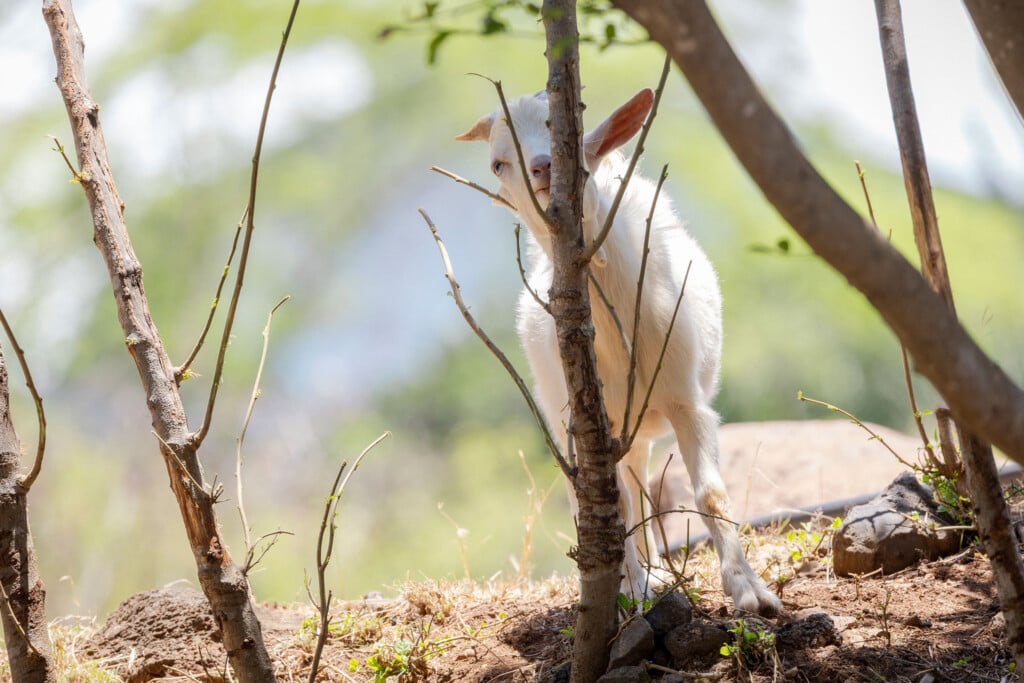
All of their sheep now live at five different solar sites, grazing beneath panels on grass that would otherwise be difficult to mow. Occasionally, they get called to other grazing projects, with the help of goats that have joined the flerd from a nearby dairy. Goats are “super kolohe,” Olsen says, “but they’re so worth their weight in grazing behavior,” which makes them great for fire mitigation and other vegetation management.

Photo: Alexandria Simone, Planit Branding
This past summer, O‘ahu Grazers introduced virtual fencing, where solar-powered collars keep the animals contained in specific areas, so no physical fencing is required.
“The flexibility it provides on the type of terrain that we have in Hawai‘i is going to be unmatched,” Olsen says. “A lot of the fire risk areas are these hillsides nobody’s been able to manage for all these years, and the invasive species are taking over and are going out of control.” Even if people could get there, mowing and weed whacking “just lay the fuels down on the ground, whereas sheep and goats are eating the grass and they’re depositing it back as manure, which is also good for the land.”
Olsen was nervous at first about bringing the flerd into residential areas for these types of projects. “I feel like there’s always a lot of complaining around animals in general,” she says. “But it was completely, absolutely opposite. Everybody loved having them.”

Photo: Alexandria Simone, Planit Branding
One community in Wai‘alae Iki organized a “Flerd Fest” by hosting a barbecue and making chalk art along the road to welcome the animals for a wildfire mitigation project this past spring. “All the kids were drawing pictures of the goats and the sheep as we came up, and they were so excited,” Olsen says. She pointed out a particular sheep nicknamed Minnie (who has three black dots on her shoulder), and the kids would try to spot her whenever they stopped by.
At another project, “there were all these people that realized they’d been living in the same community for the last 45 years, and they’d never met each other,” until coming outside to watch the sheep graze. This has been Olsen’s favorite part. “They were like, ‘Your sheep brought us all together.’”
oahugrazers.com, @oahu_grazers
Katrina Valcourt is the executive editor of HONOLULU Magazine.