Through an Okazuya Window: Behind the Scenes at 87-Year-Old Fukuya Deli
From 4:30 a.m. to noon, we saw all the hustle in the Fukuya Deli kitchen and the community life that this old-school okazuya preserves.
Japanese delis are a Hawai‘i phenomenon, thriving holdovers from plantation days when women sold home-style lunches to field workers. Chow fun, hot dog, mochiko chicken, vegetable tempura: At okazuya today, customers pick out favorites for DIY lunch plates and pay by the portion. The timeless simplicity belies every okazuya’s midnight bustle. From 4:30 a.m. to noon, we went behind the scenes at 87-year-old Fukuya Deli.
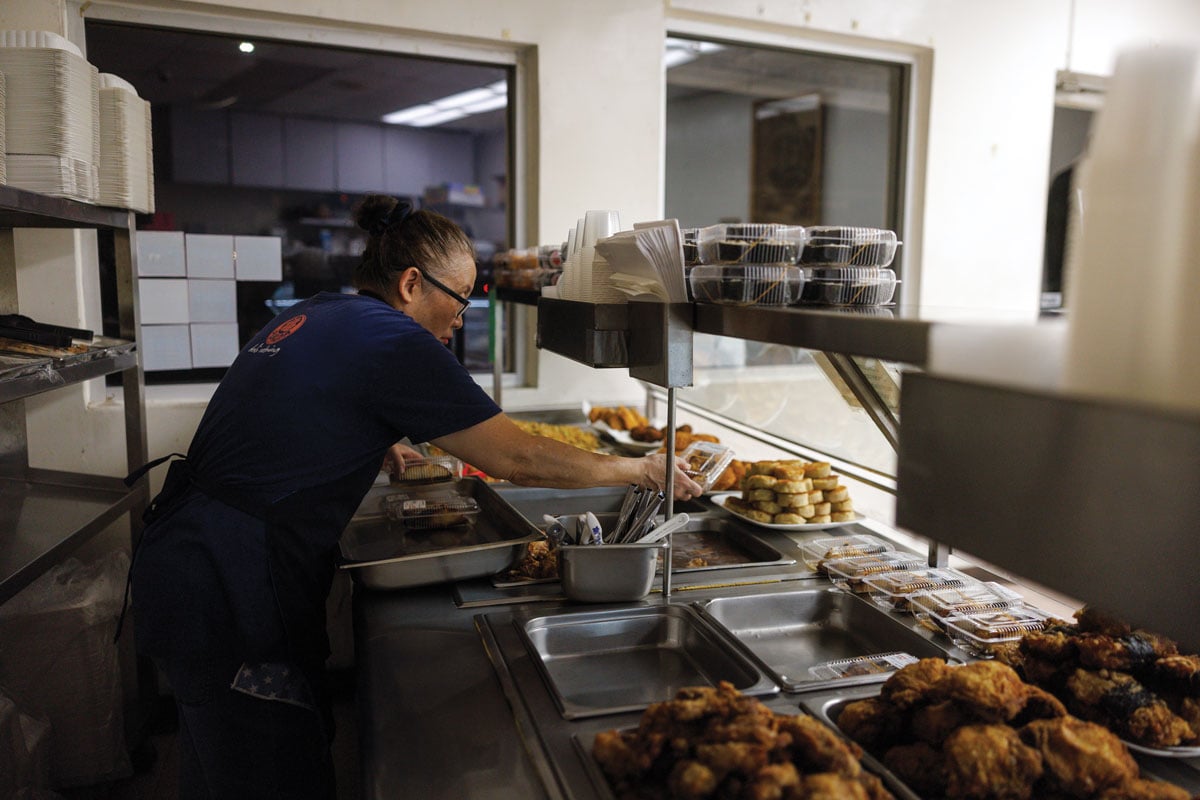
4:30 a.m.
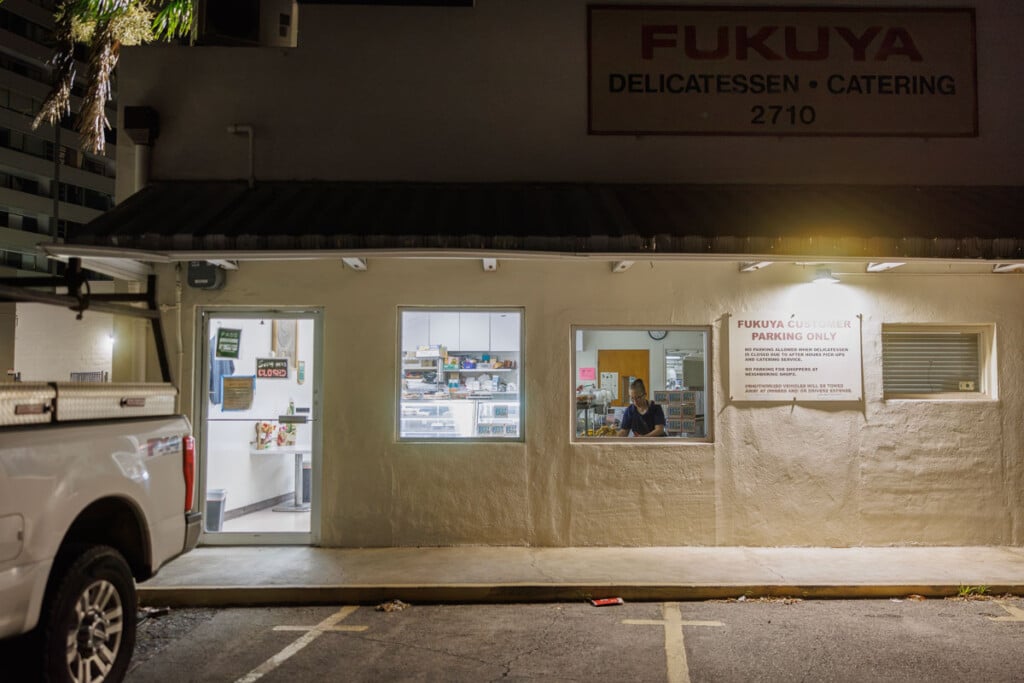
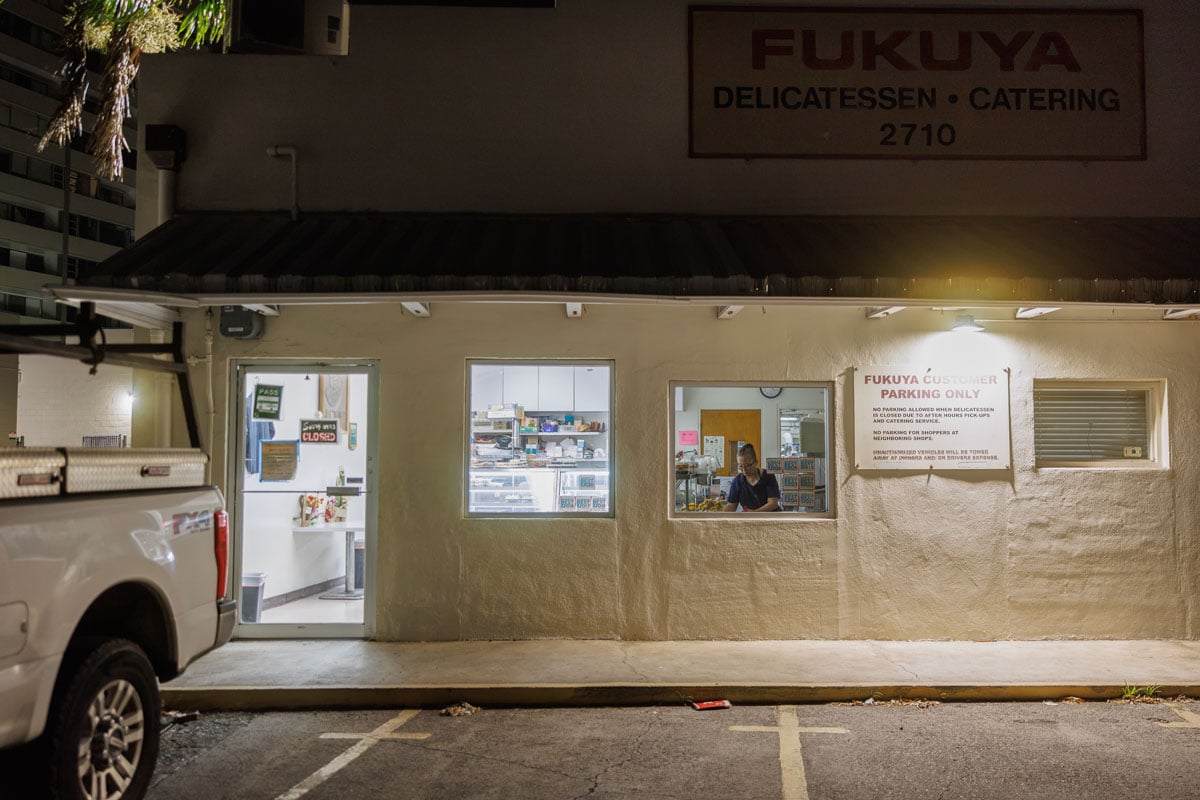
It’s still dark when the deli lights at Fukuya flick on. Behind the display case, Lori-Anne Inouye brings out platters of bread hash, fried akule and tofu patties, one by one. From outside on South King Street, quiet this early in the morning, the scene feels like a Honolulu version of Edward Hopper’s “Nighthawks.” But Inouye’s solitary figure carrying the homey melamine plates belies the bustle in the kitchen, which has been going since midnight. Fukuya’s space used to be a racing car parts factory—its kitchen would rival some high school cafeterias in square footage.
In one corner, Rodrigo Corrales Jr., who came to work at midnight, stir-fries chow fun in a wok. It will turn out to be one of the rare moments when he’s not marinating, wrapping, battering or frying Fukuya’s fried chicken variations: mochiko chicken, nori chicken, garlic chicken, plain fried chicken. On Saturdays and days with large catering orders, Fukuya will prepare 1,500 pieces of mochiko chicken alone—all in a small pressure fryer that handles just 50 pieces at a time.
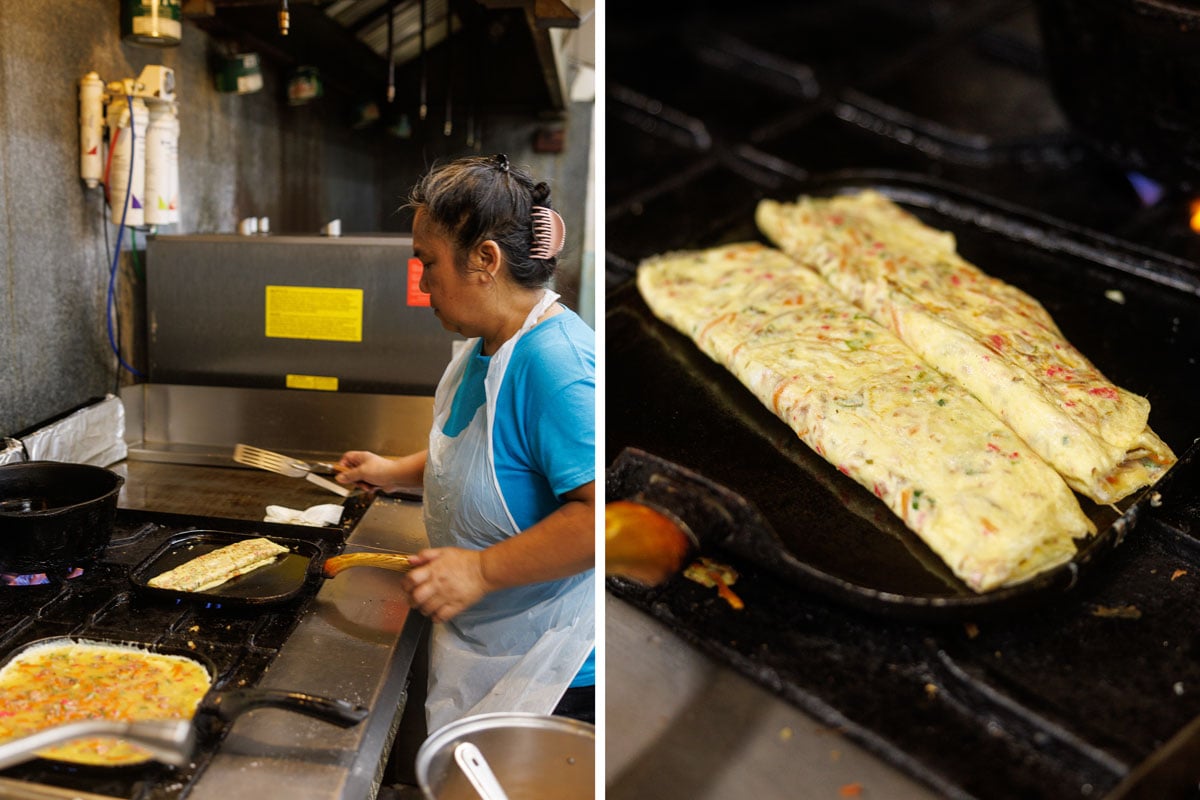
Despite the scale of production, cooks at this 87-year-old okazuya still make everything in very small batches. Today, Thanh Hoa Khieu needs to prepare 100 orders of egg omelet. And so, with two square pans over two burners, she makes the omelets one by one. Fukuya’s version of scaling up is a tabletop machine that can roll makizushi, and a musubi mold that presses three rice balls at a time.
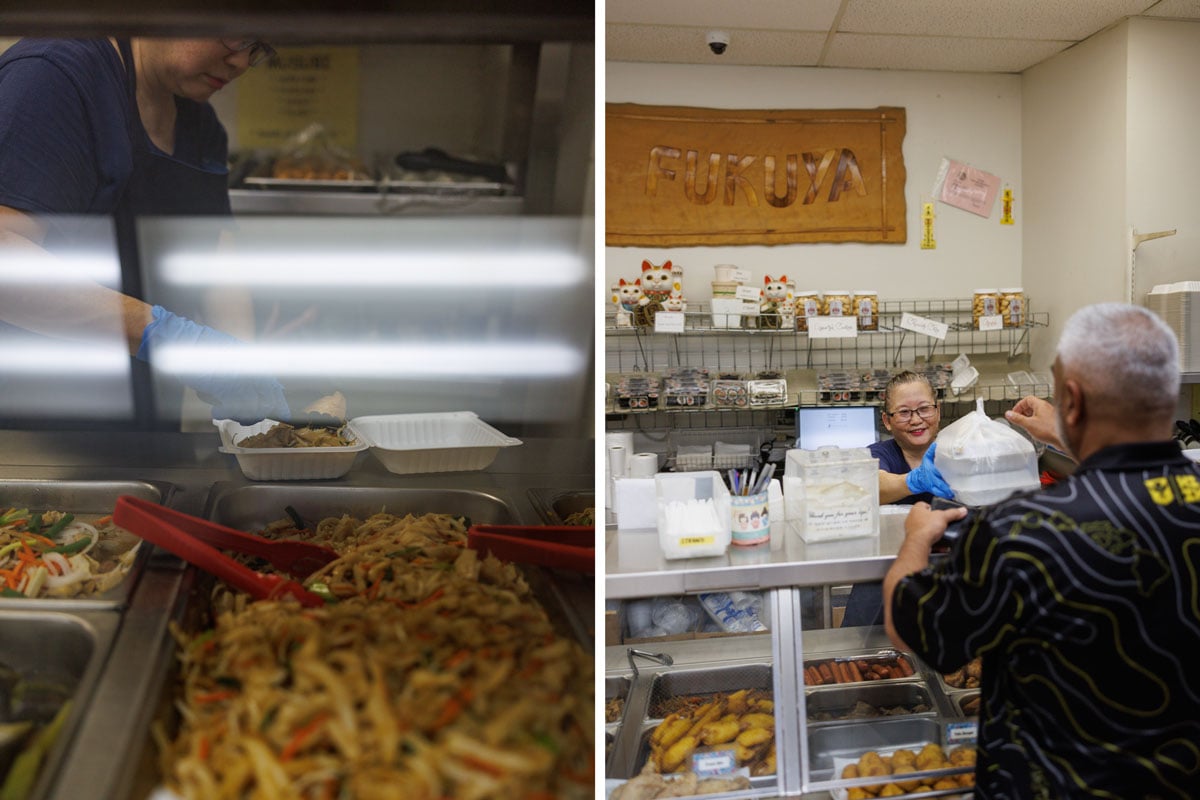
4:56 a.m.
When the display case is fully stocked with about 30 different items, the front door is unlocked. Customers immediately file in: a woman in a floor-length mu‘umu‘u in regal blue, a postal worker who has been stopping in on her way to work two to three times a week for 25 years, a construction worker who’s come daily since a high-rise condo broke ground nearby. One couple has been driving in from Mililani “maybe once a month” for 20 years. “It’s so good,” one of them says. “We’d come more, but the gas is expensive.”
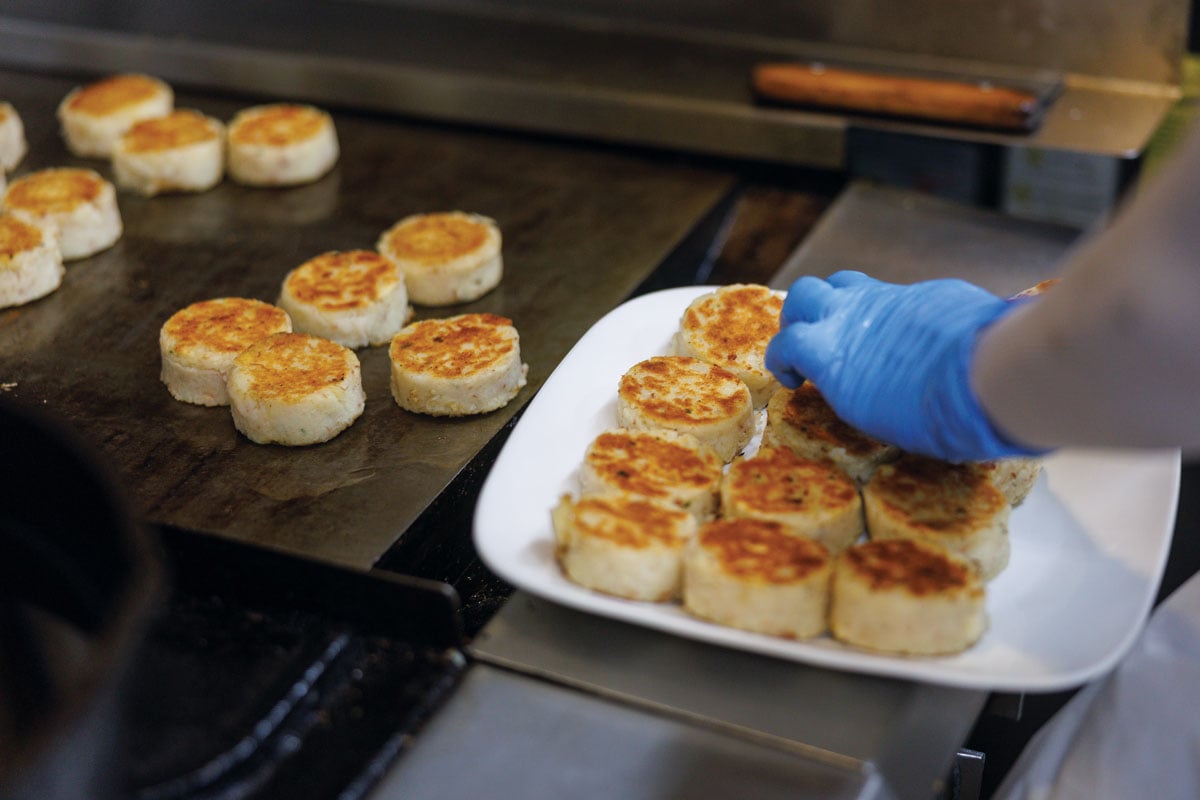
In the kitchen, Daisy Saupan uses a bowl to scoop nishime into a deli pan. Whether she’s pressing potato hash into hockey-puck shaped molds or spreading hot rice to cool by the fan for musubi, she keeps a watchful eye on the windowed door to the deli. When she sees customers waiting, she jumps behind the deli case to help Inouye.
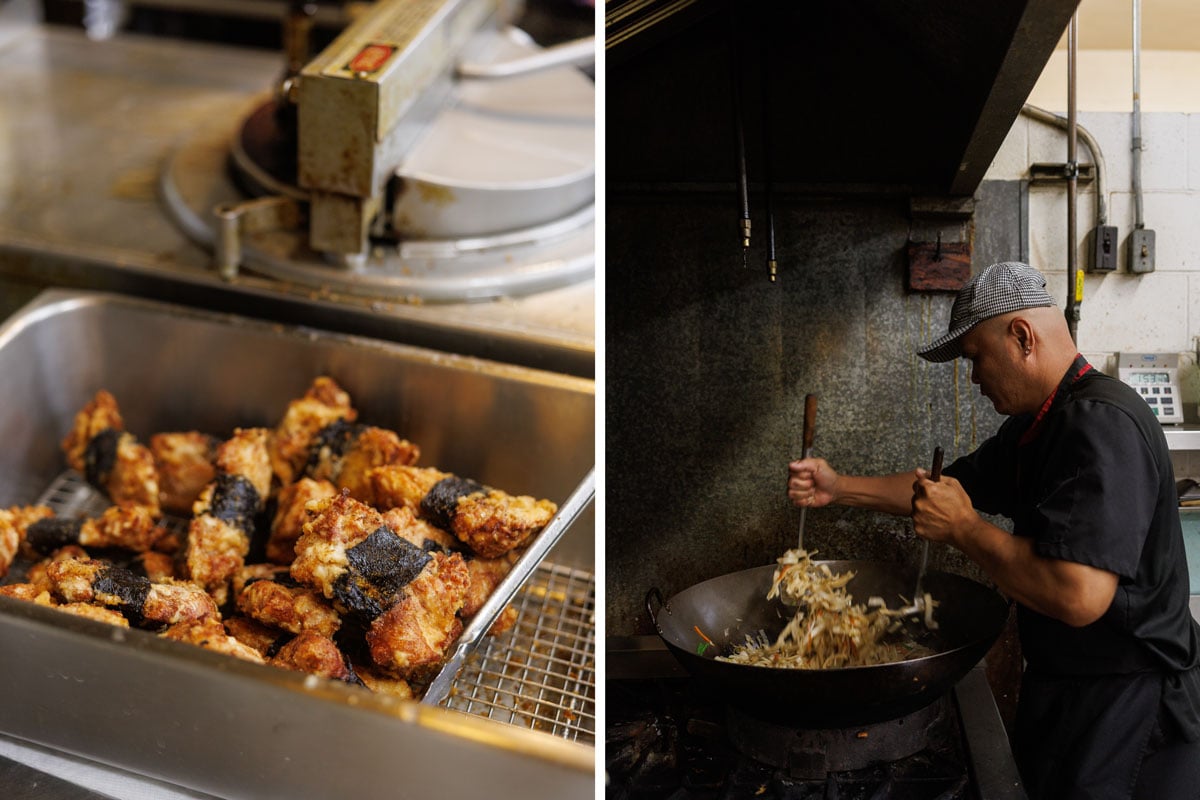
6 a.m.
Takeout containers line the counter for 50 bentos that will be picked up at 7 a.m. It’s one of two catering orders for Punahou today, along with two funeral orders to be delivered to Hosoi Garden Mortuary.
6:45 a.m.
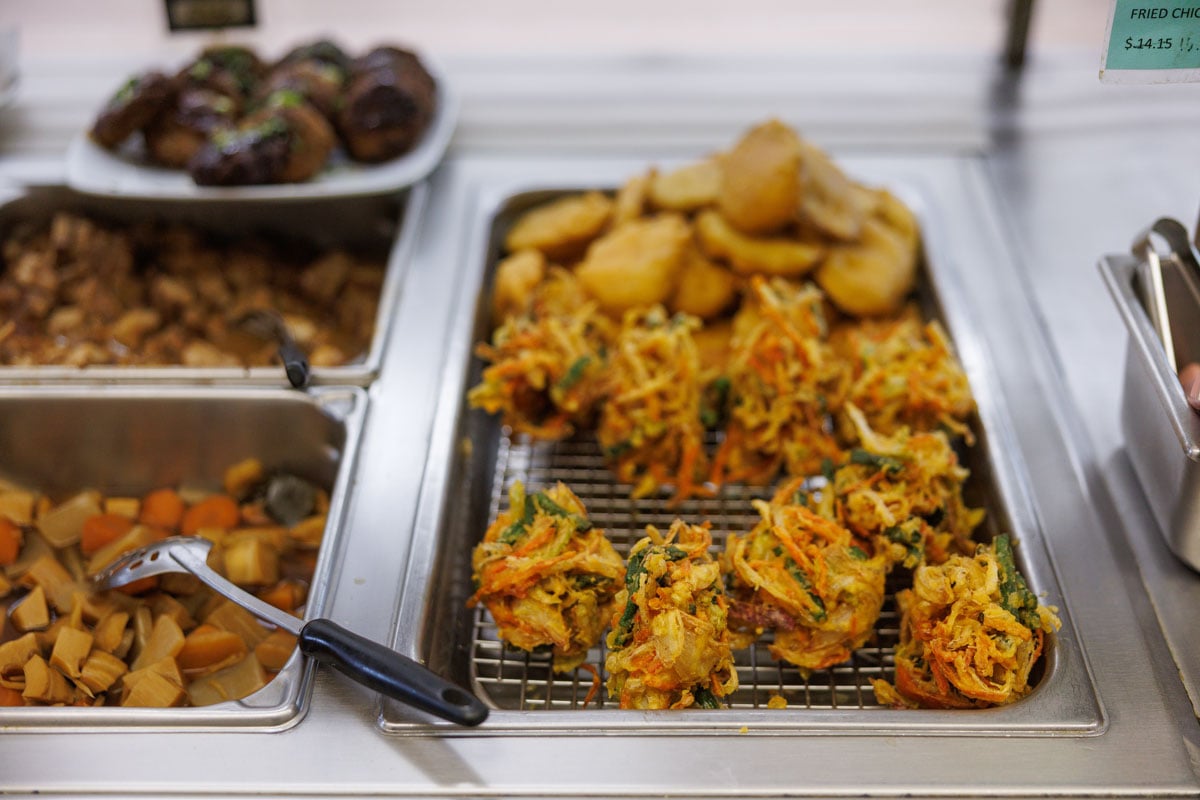
Hot dogs line the flattop, nests of vegetable kakiage tempura bubble in the deep fryer, green beans swirl in the wok, and then it’s time for another round of chow fun as sugar and shoyu reduce in a pot for long rice. Another batch of mochiko chicken goes in the pressure fryer for about four minutes, then nori chicken, then it’s on to wrapping even more marinated boneless chicken thighs in strips of seasoned seaweed.
“When we first started making nori chicken, we only made one batch a day,” says Arrison Iwahiro, Fukuya’s fourth-generation owner. He introduced it to the menu sometime in the 2000s, after hearing about it from the daughter of family friends who owned Hilo Lunch Shop. Intrigued, Iwahiro experimented with the idea until he was satisfied with his own version.
“They make it different” in Hilo, he says. “They make it really small—I’m guessing a good size thigh deboned, they get two or three pieces. I’m not wrapping all of that. That’s too much time.” It’s easy to forget how quickly seconds add up when producing 500 pieces of nori chicken. If it takes 10 seconds to wrap each piece, a cook could spend nearly an hour and a half on the nori alone. At Fukuya’s, one piece of nori chicken is a whole thigh.
The success of the nori chicken scares Iwahiro about introducing new menu items. “When you start something, you gotta kind of think ahead, right? Like if this catches on, is it feasible, you know, time-wise, to do this?”
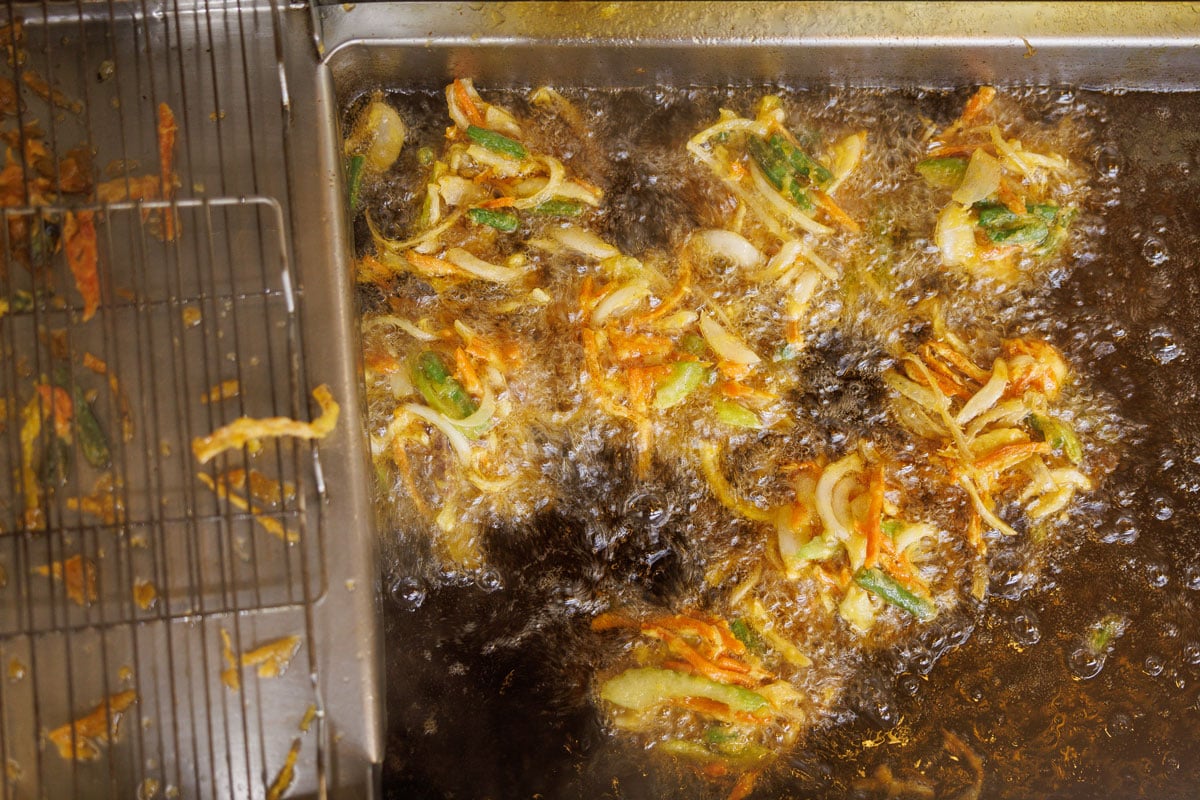
8 a.m.
A woman in her 20s gets out of a car in Fukuya’s parking lot. “We come twice a month for seven, eight years. We get nori chicken—there’s not that many other places you can get it. And we like their poke, the spicy ‘ahi poke.”
Fresh ‘ahi is another item Iwahiro introduced. On Fridays, he picks up a whole fish from the auction at Pier 38 and breaks it down for poke and fried ‘ahi on the weekends.
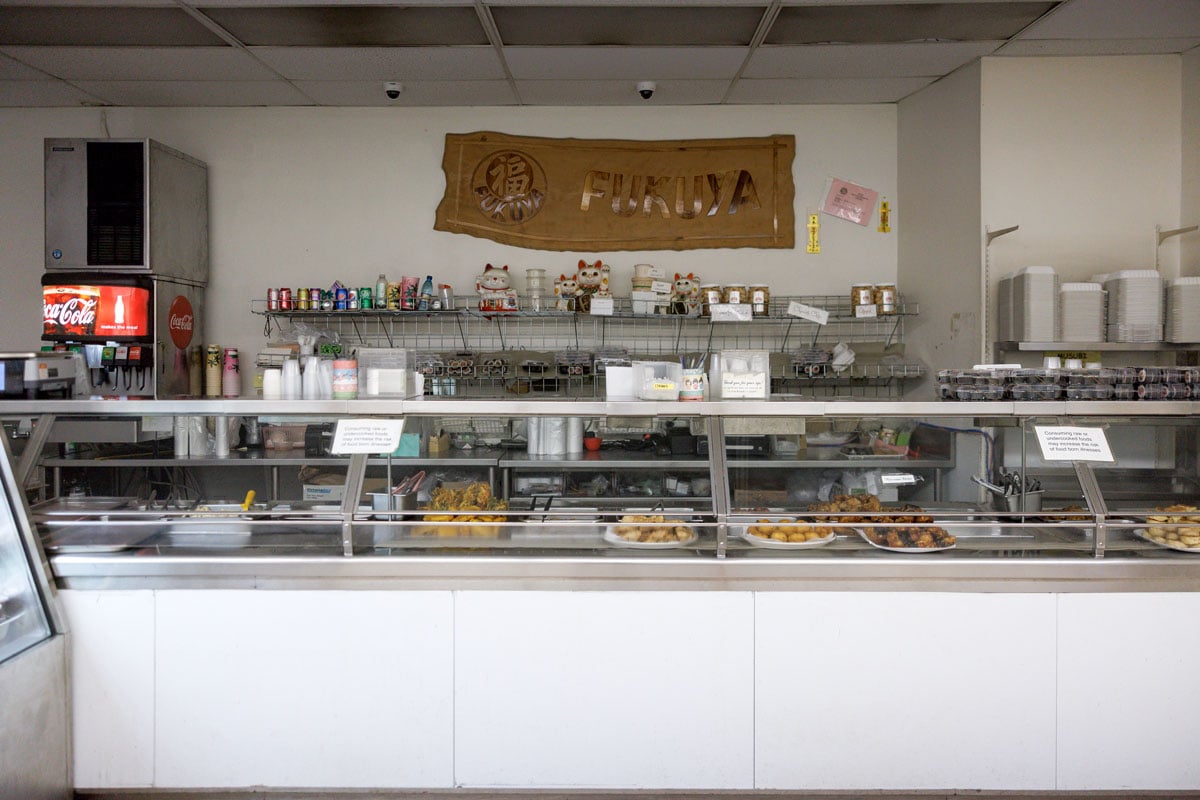
“I learned to cook from old-timers, my grandparents,” Iwahiro says. His great-grandparents started Fukuya in 1939, just down the street from where it is now. By age 5, he was hanging around the okazuya. By intermediate school, he was helping to cut vegetables for nishime and namasu. By high school, he could drive and make deliveries and cook shoyu chicken and chow fun. His parents took over in 1975, five years before Fukuya moved to its current location at what used to be Kupacha Racing Parts. His father gutted the shop and designed the kitchen and storefront—he preferred construction over cooking.
8:15 a.m.
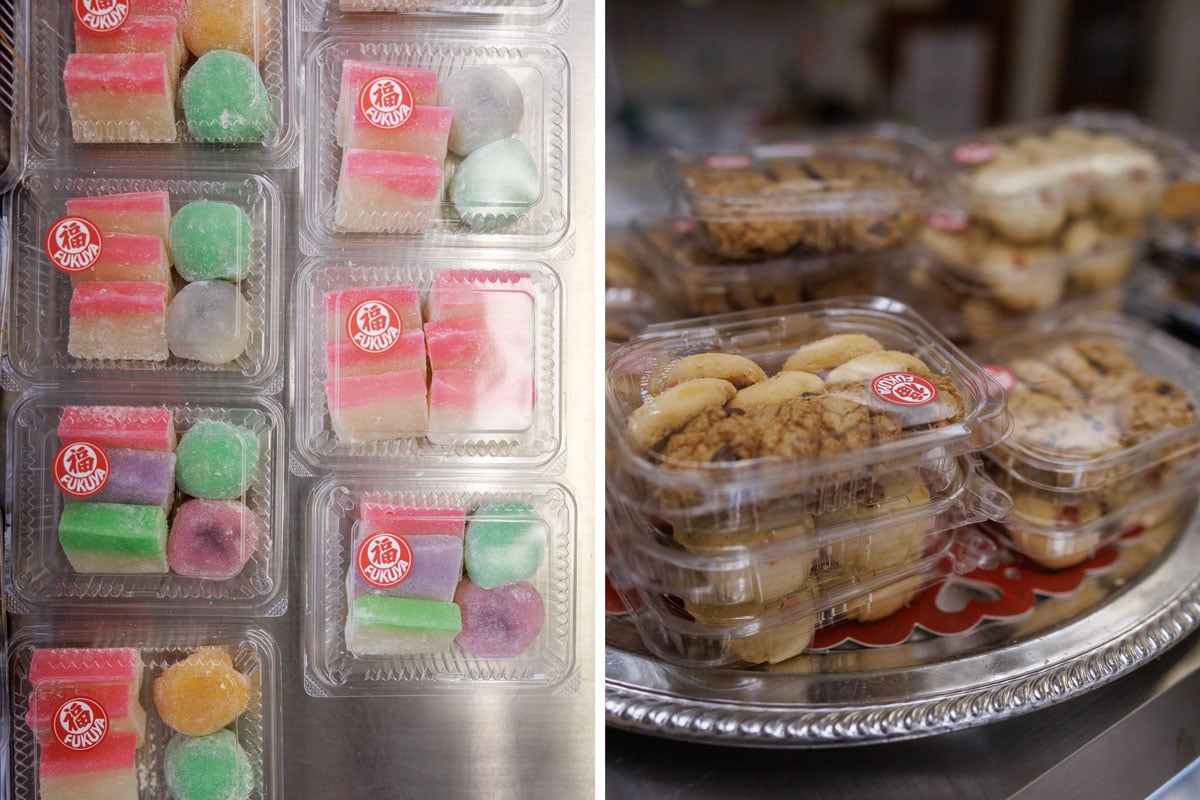
Past the kitchen and a cluttered space that looks like it could have been his father’s repair shop (there are tools, ladders, WD-40) is the bakery. This is where Fukuya’s cookies and mochi are made. Eriko Nagano arranges mochi platters with chichi dango and mochi stuffed with peanut butter or azuki.
In the corner is a stone rice-pounding machine that Iwahiro guesses is nearly a century old. It’s used solely for kagami mochi at New Year’s. (Everyday mochi is made with rice flour.) Iwahiro remembers when Fukuya needed 5,000 pounds of rice for the holidays; now, the shop pounds less than a third of that. “The tradition is dying,” he says.
9 a.m.
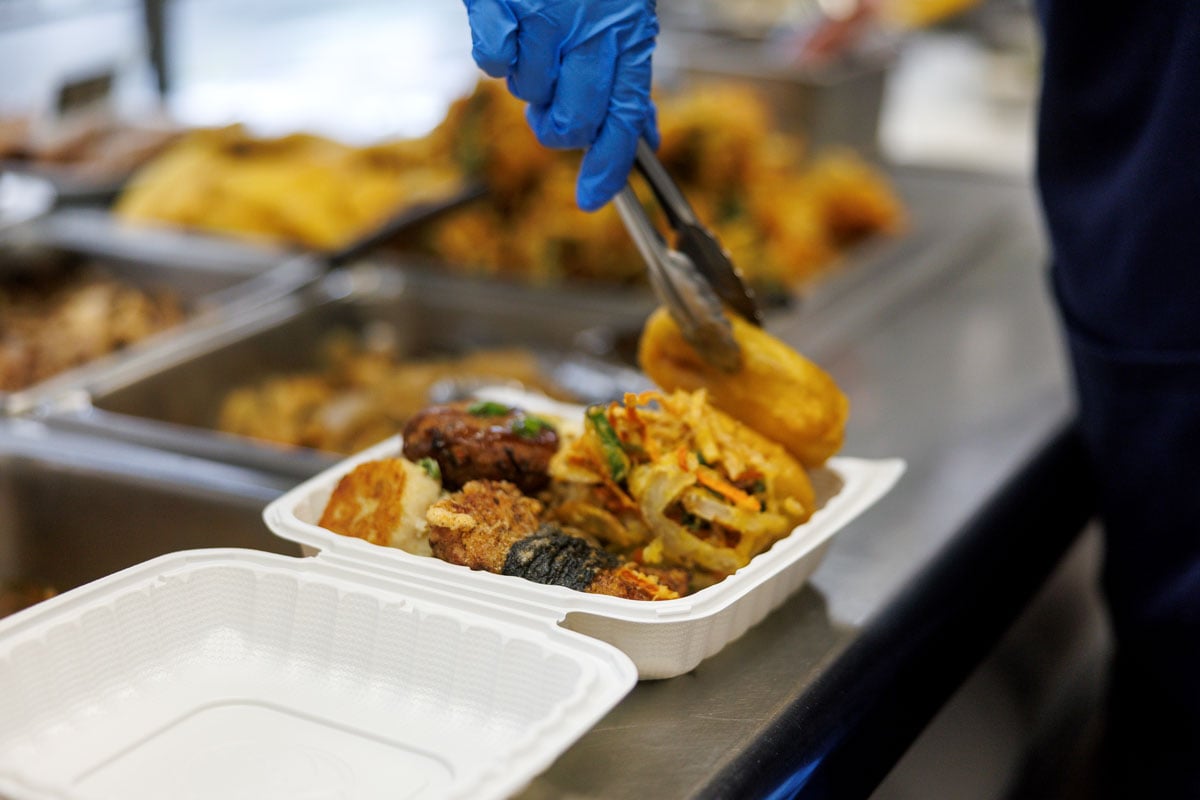
At the front counter, a customer collects a 72-piece mochi platter. “My mom ordered it,” he says. “It’s actually for my dad’s service—celebration of life party.”
Of visits to Fukuya, he says, “It’s either birthday or funeral, right?”
9:30 a.m.
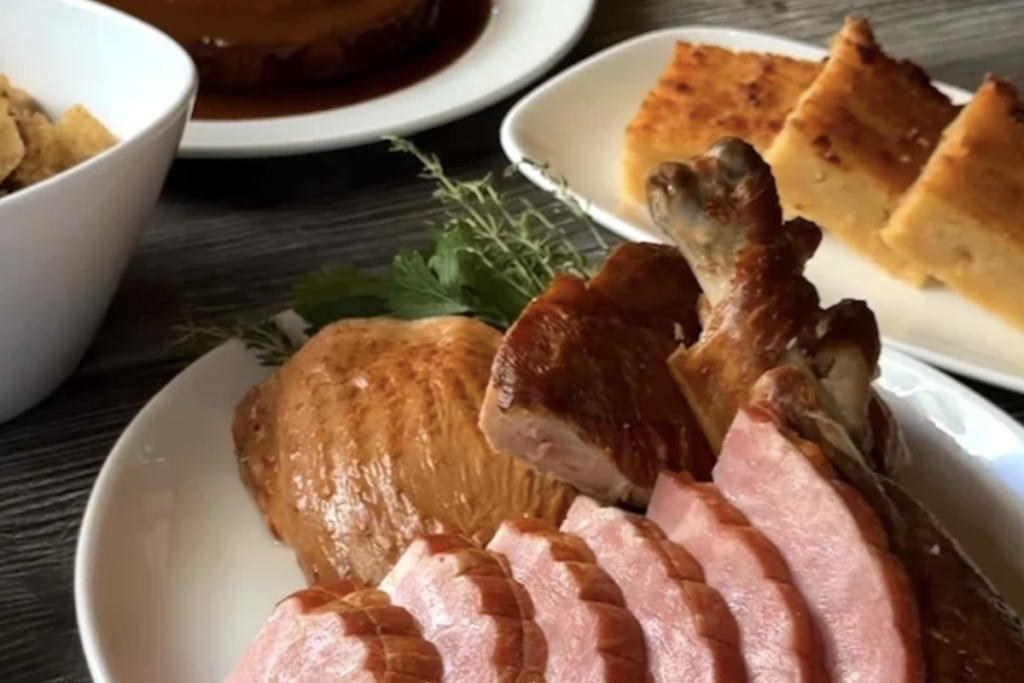
Iwahiro loads the van for a 10 a.m. delivery to Hosoi. Platters of sushi and mochi and a pan of namasu are stacked in a custom wooden box with shelves, made by a family friend. Foil-wrapped pans of hot food—including baked ham with extra glaze, egg omelet, beef teriyaki and tofu fish burger—go into a metal rack, also custom made. For a gathering of 75, the organizer has ordered 20 different dishes. In contrast, another funeral order in the evening has just eight different items for 200 people. Iwahiro can tell when regulars order. “Maybe it’s the deceased’s favorite stuff. It’s not a standard catering menu,” he says.
How did Fukuya come to be known as a funeral caterer?
It wasn’t always that way. “We used to do a lot of weddings,” Iwahiro says. “Back in the day, weddings were all done in churches, or we used to do a lot at Blaisdell. As time went on, it became less and less as people went to hotels.”
Iwahiro’s father started giving the mortuaries menus, and the business there “really took off.” Other okazuya also catered funerals, but over time, many have closed: Hisago and Ebisu in McCully, Honda Delicatessen in Liliha, Kaneda’s in Nu‘uanu.
We lay out the platters of nori-wrapped musubi and maki rolls and pans of simmered pumpkin and shoyu chicken at Hosoi. “These are our favorites,” one of the organizers says in delight.
10:15 a.m.
Back at Fukuya, a woman with two small children laughs when asked how often she stops in. She’s been a customer since her parents started bringing her as a child. “How often do we come here?” she asks her kids.
“Every day!” yells the younger one, a boy.
“No, not every day. Maybe once every couple weeks.” She often picks up for her son’s sports events. “You can call in your order. They always answer the phone,” she advises.
“They already know their orders. What’s your order?” she asks the kids.
“Chow fun, hot dog, mochiko chicken, vegetable tempura,” the older one recites.
“The fried one!” says her brother.
The vegetable tempura,” translates the mom.
The little girl waves to an elderly man waiting on the side as they leave, and someone by the door opens it for them.
10:30 a.m.
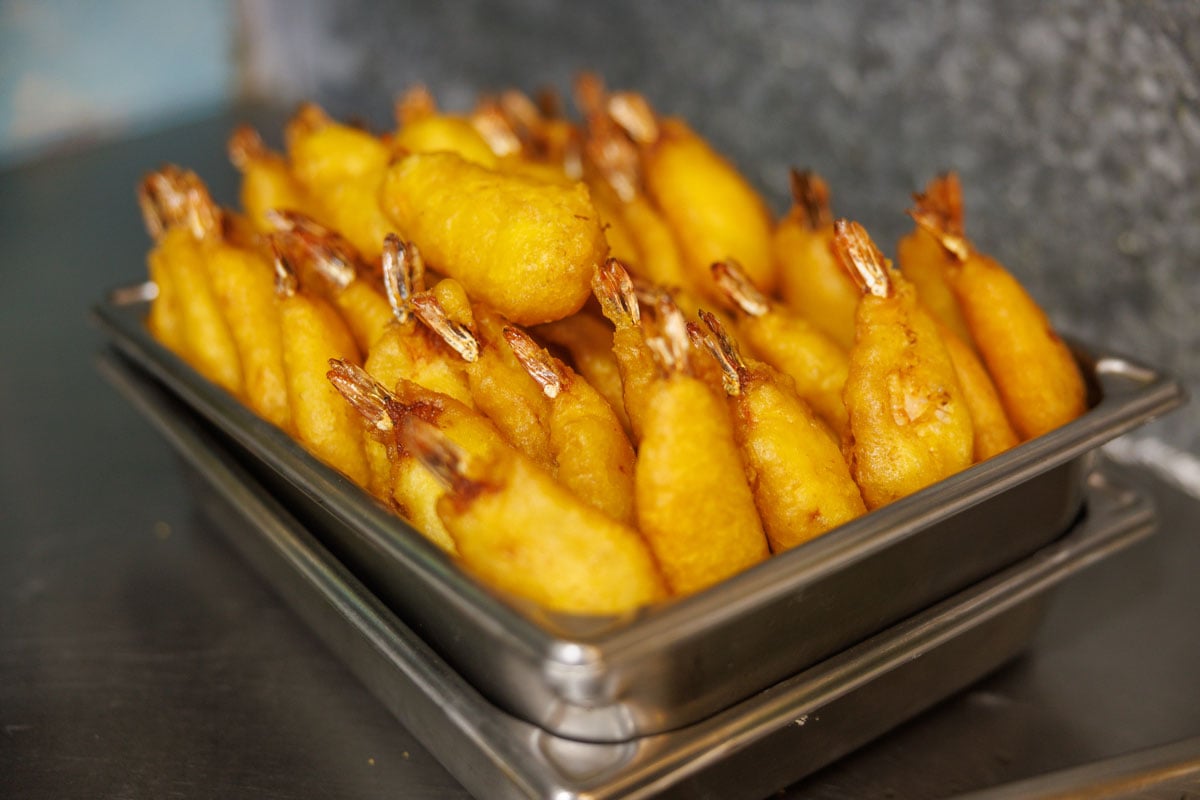
More rice is washed and poured into rice cookers that can steam 17 pounds at a time. Still more batches of chicken go into the fryer, and an army of shrimp tempura is arranged in a deli pan. Both are headed for the display case—an intercom lets the kitchen know what items are running low in the front.
When Fukuya opened, it was just Iwahiro’s great-grandparents. Workers at the quarry by UH—many of them Japanese—were the main customers. “Back then, the two of them would cook in the morning, and then the two of them go out in the front, sell it out, and that’s it.”
Noon
The kitchen stops preparing food for the deli and starts prepping for the next day’s okazuya items and a catering order in the evening. Meaning, as anyone who’s shown up after 12 has found out: Get here early lest your favorites run out.
Iwahiro has told me about the bread hash, one of the oldest items on the menu. But when I look for it at the counter, it’s long gone. The cooks usually only make one plateful a day. “It’s really old school. I don’t think anyone else makes it,” Iwahiro says. Sometimes, he wonders about keeping it, but he hates disappointing people, even if it’s only a few. He scoops a few balls of the bread hash and drops them into a cast-iron pot of hot oil so I can try it. The mix is made with bread soaked in water, corned beef and instant mashed potatoes. “My thinking is that back in the old days, our grandparents, they were very thrifty. So they wouldn’t want to waste the bread.”
The warm bread hash tastes like deep-fried stuffing, a cross between andagi and Thanksgiving. As I leave, a young man escorts an elderly woman, perhaps his popo, inside. I suddenly think of what Judy Foster Long, the owner of Anyplace Lounge, once told me: that she kept her bar going because she wanted a place where Old Hawai‘i still existed, where people still looked each other in the eye and said hello. It occurs to me that Fukuya is one of those places—that all day I have seen customers caring for each other through the smallest of gestures: holding open the door, helping to carry items, being patient. When we were here, for even the shortest of moments, we were looking out for each other.
2710 S. King St., Mō‘ili‘ili, (808) 946-2073, fukuyadeli.com, @fukuyadeli