3 Alfresco Dining Spots in Kaka‘ako
At the end of a long day, sometimes all we want is casual alfresco dining with free parking. We rounded up three easy-breezy spots.
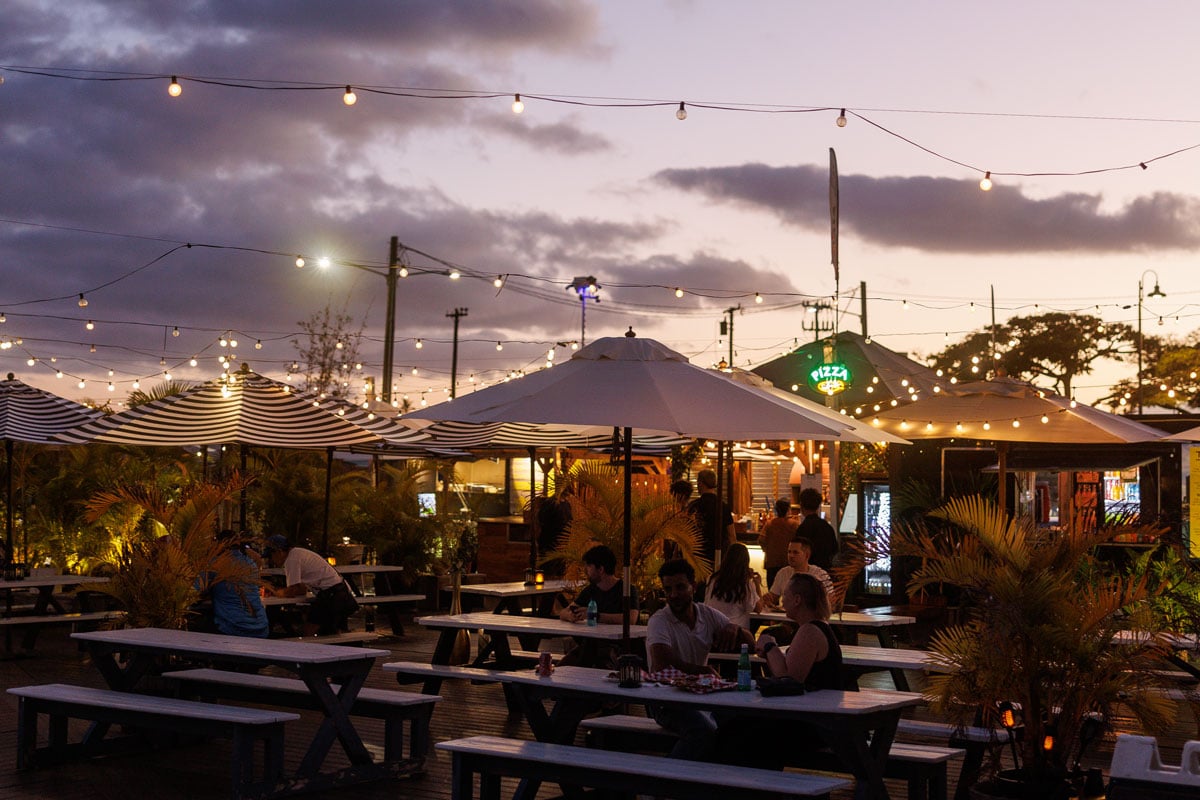
Name three places where you can sit under the stars, eat good food that keeps you coming back—and find parking without having to make a Faustian pact. Not easy, huh? It’s a rare trifecta, but in a city where the average evening temperature is 75 degrees, dining alfresco can be a restorative antidote to an overtaxing day of soul-crushing work and traffic. On a clear cool night, the simple act of eating outdoors is one of the things that makes you think, O‘ahu nō ka ‘oi. We all deserve more of it.
With that in mind, here are three spots that fit the bill and won’t break the bank in these budget-vaporizing times. All within walking distance of each other, they reveal the still-diverse facets of Kaka‘ako, a neighborhood that has seen massive change over the past 20 years. Say hello to the moon.
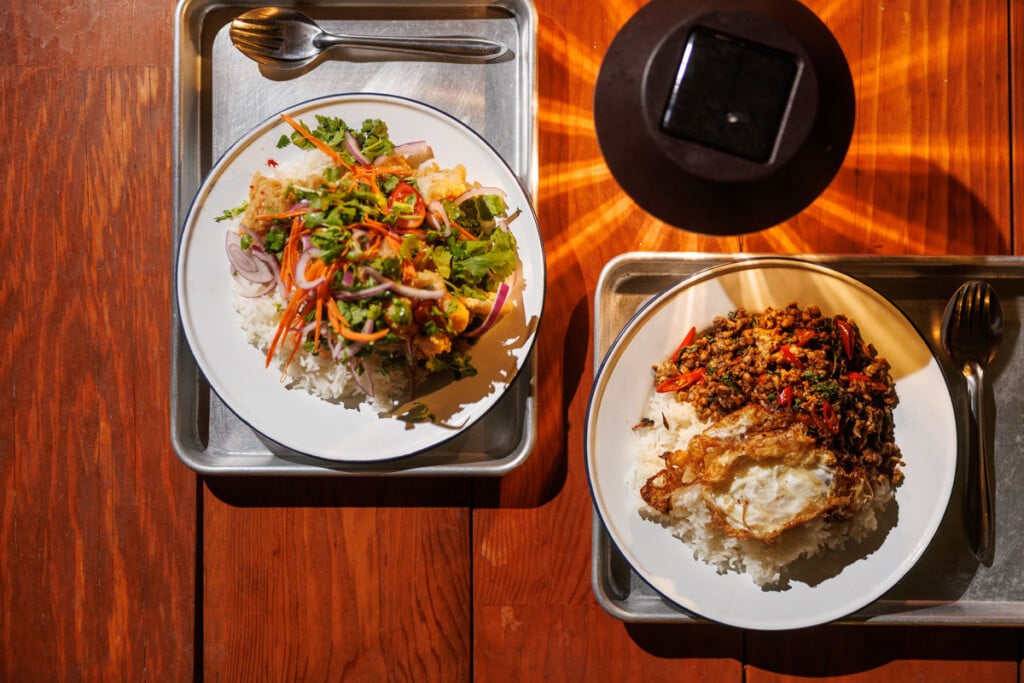
Thai street food in Honolulu: kapow (top) and yum pla. Photo: Aaron K. Yoshino
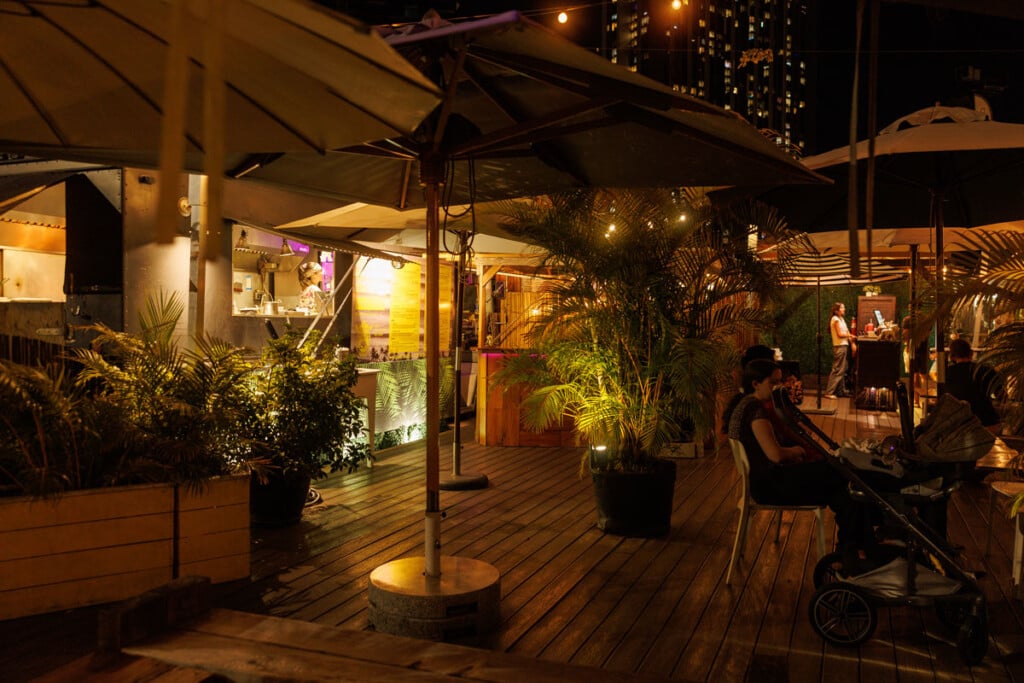
Photo: Aaron K. Yoshino
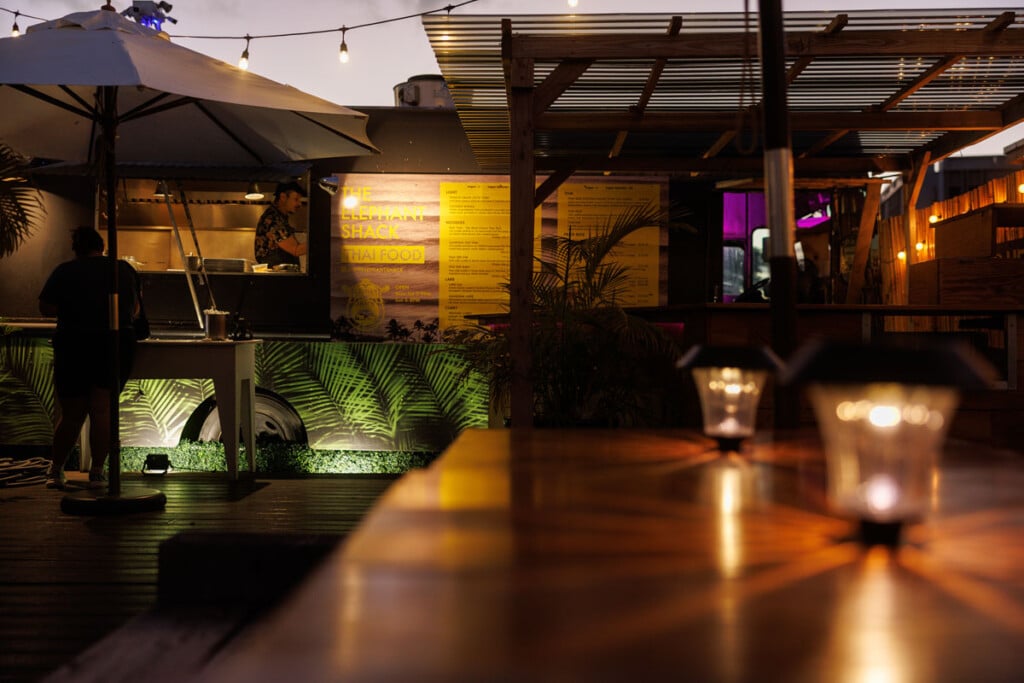
Elephant Shack is part of the new dining scene at the former Fisherman’s Wharf site. Photo: Aaron K. Yoshino
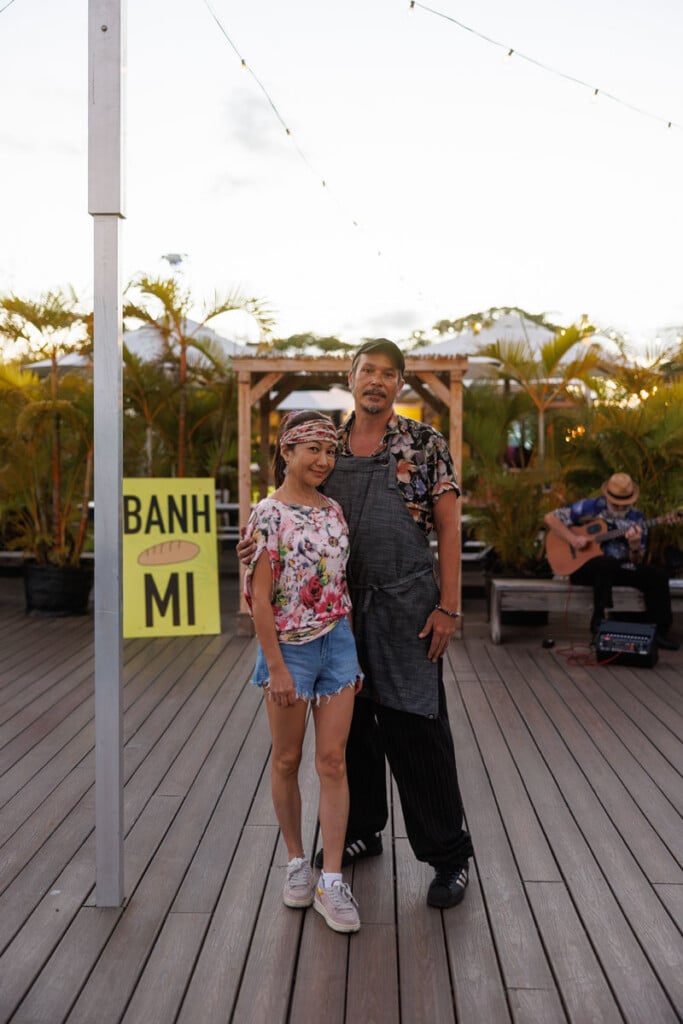
Kevin Suthavee with his wife, Wen Kai Tan. Photo: Aaron K. Yoshino
Elephant Shack
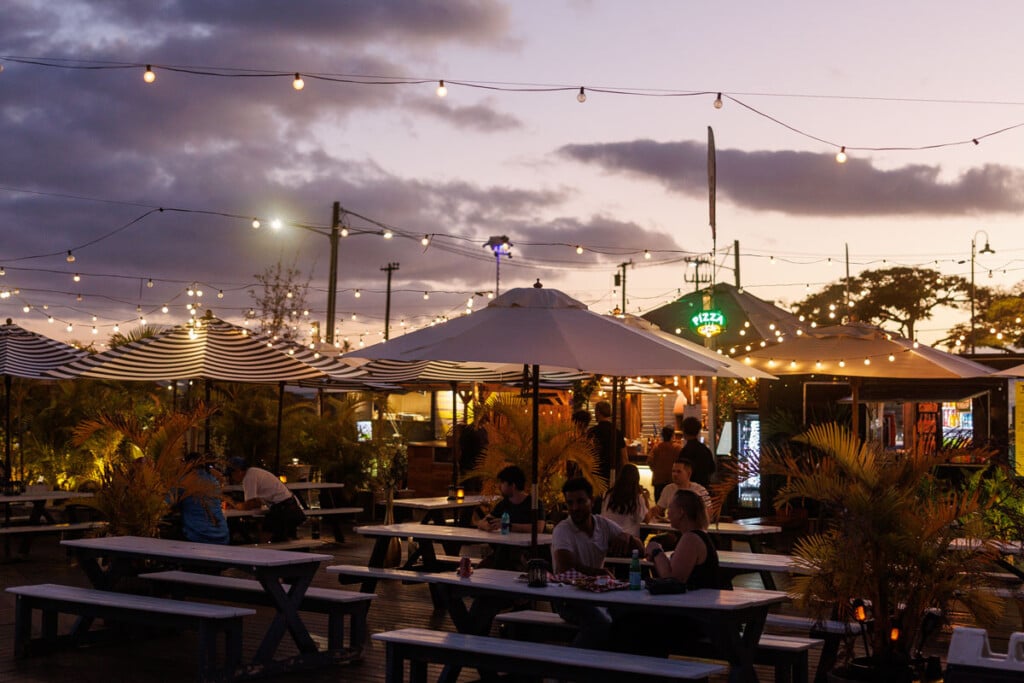
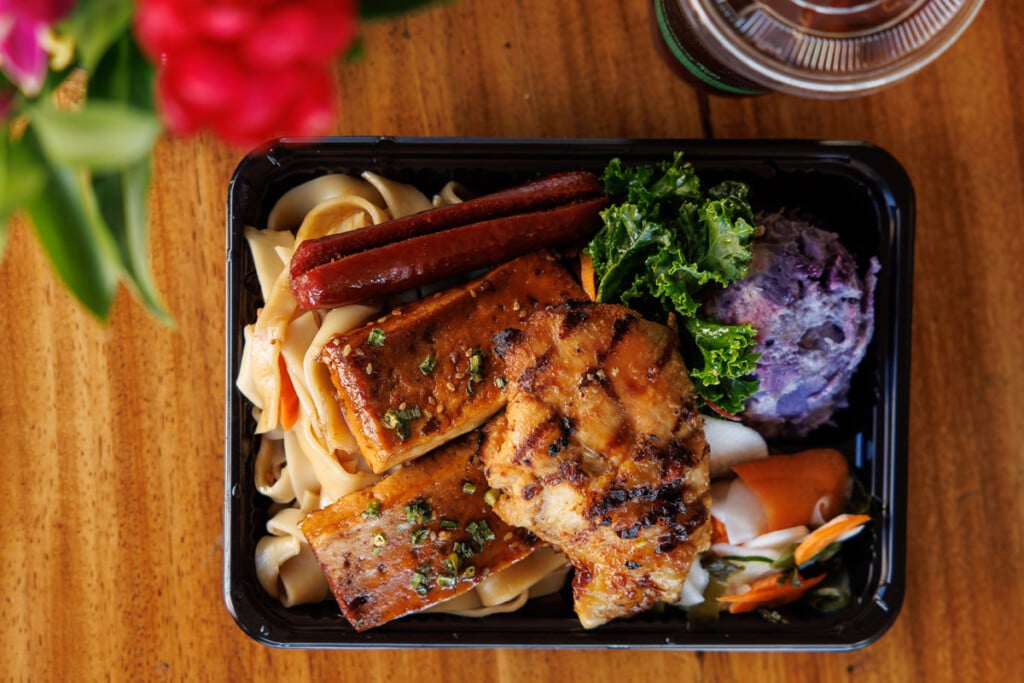
In 2022, when Kevin Sutavee moved his Thai food truck to the oceanfront parcel where Fisherman’s Wharf once reigned, I thought I had died and gone to easy-breezy dining heaven. As dusk darkened Diamond Head, I knew from the first bite of Sutavee’s kapow (or pad krapow, $16)—stir-fried minced chicken fragrant with holy basil and topped with a fried egg—and the hip tunes of BBC Radio 1 coming from a speaker that I had found a new go-to eatery. With lots of free parking and few people, Elephant Shack was an effortless place to eat soul-satisfying Thai street food.
Four years later, I am still a regular on my way home from work. These days, Fisherman’s Wharf at Kaka‘ako Makai is on more diners’ radars, and half the parking now requires payment through a pesky QR code (the spaces behind the food trucks are still free), but Elephant Shack remains a prime outdoor dining destination.
The handsomely hapa Thai Sutavee grew up between his divorced parents’ homes in New York and Boston and spent summers with his grandmother in Bangkok. “There was a food cart across from her house,” Sutavee says. “This lady made kapow. It was food from a tiny cart that was so good, you’d eat it when you’re not even hungry.”
Sutavee, who was an East Coast surfer, has had a colorful past. He’s been an indie magazine publisher and DJ and even ran a hotel and restaurant in Puerto Rico. But the memory of the kapow maker and her cart stuck with him, and when he moved to Hawai‘i in 2012, the wave chaser followed his humble muse and opened Elephant Shack on the North Shore.
While largely self-taught, Sutavee did go to Thailand to “work with the best of the best,” such as French-Israeli physician-turned-Thai-food historian and cook Hanuman Aspler in Chiang Mai. Cooking Thai food is about mastering the wok, he says. “You come to understand that it’s an ancient technology for a reason—it works quite perfectly.”
He has passed his skills to key members of his staff, who in turn have trained more hires. The result is that visit after visit, I know my favorite order of yum pla ($16) will be lightly battered saba, fried so it’s almost fluffy, and made utterly addictive by the sweetly tangy lime-chile jus. Strings of white lights, umbrella-sheltered picnic tables and bobbing boats in Kewalo Basin make this the most romantic budget option on the island. And you can BYOB.
“This operation comes after hundreds of lashings,” Sutavee says, laughing. “Luckily, it comes down to people that care about the food. My job used to be making food that tastes great; now, it is making sure my staff have a great job so the food tastes great.”
Scaling up has always been a goal for Sutavee—Elephant Shack started out with two trucks in Lā‘ie and Sunset Beach before migrating to town. In July, he opened Kapow Thai Flying Saucer in Austin, Texas, serving simple street-food classics.
“That cart showed me what the bull’s-eye is,” Sutavee says. “My goal has always been to come as close to what she did as possible.”
Fisherman’s Wharf at Kaka‘ako Makai, 1011 Ala Moana Blvd., Kaka‘ako, 808elephant.com, @theelephantshack
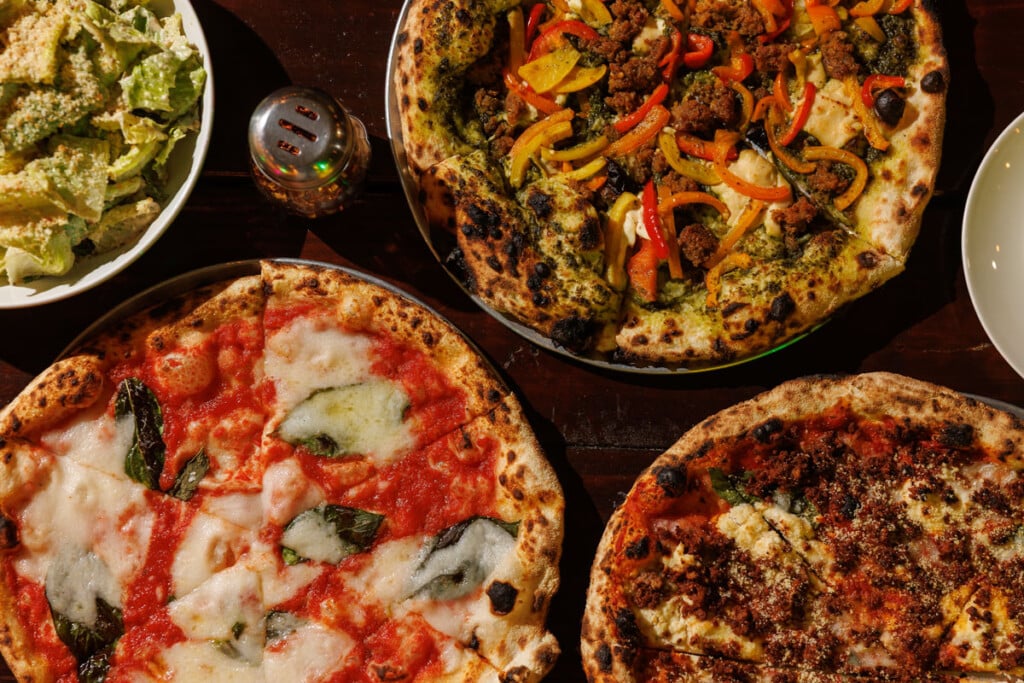
From top left: Caesar salad and Pesto Royale, Brooklyn and Margherita pizzas. Photo: Aaron K. Yoshino
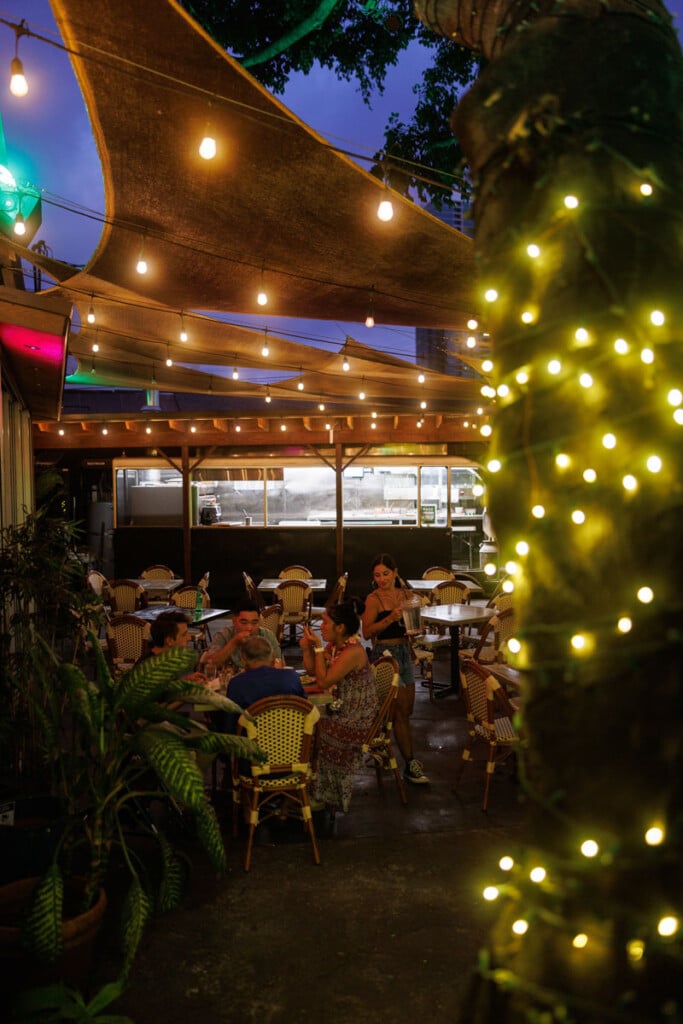
An oasis on a side street in town. Photo: Aaron K. Yoshino
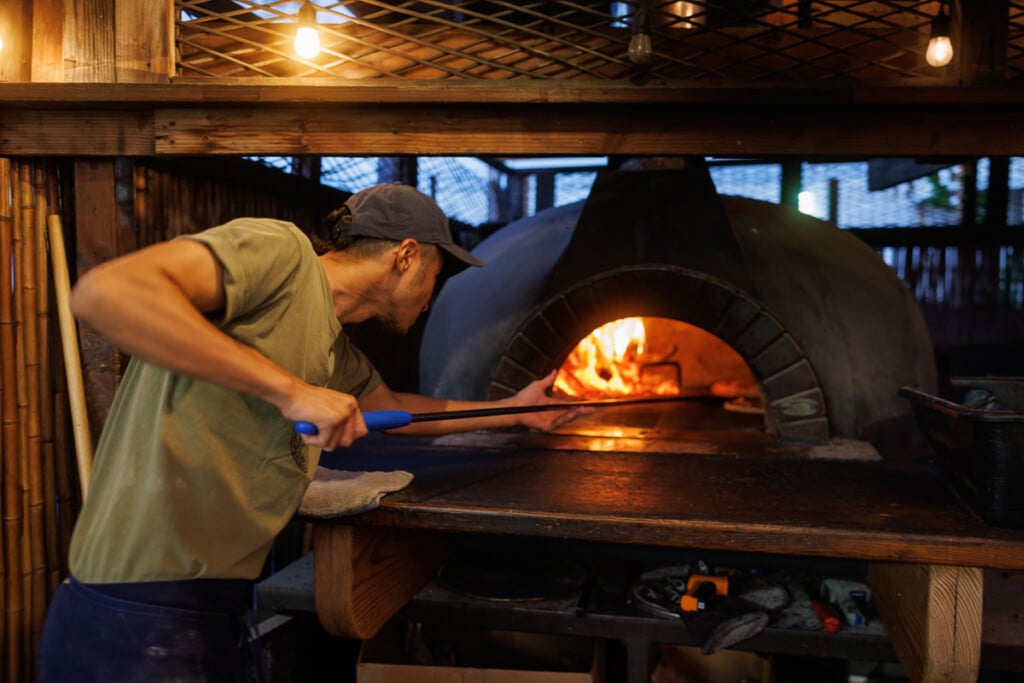
Pizzaiolo Jinya Tokuyama slides a pizza into the kiawe-burning oven. Photo: Aaron K. Yoshino
Floralia
Off Kapi‘olani Boulevard, snuggled between Hawai‘i Gas and Shon’s Auto Body Repair & Painting, is an unlikely oasis serving pizza cooked in a Valoriani oven imported from Tuscany, orange with flaming kiawe. Owner Kip Praissman has turned the chain-link-fenced yard that once housed Ala Moana Surfboards into Floralia, an appealing mix of European café—complete with rattan bistro chairs—and tropical hangout. You sit under the canopy of a huge Chinese banyan, its trunk wrapped with white lights. Nothing fancy, but kind of magical. Opened in 2022, Floralia doesn’t take reservations but usually has a table open and free parking across the street—oh, and it’s vegan.
Praissman uses Italian flours, including the vaunted Caputo brand from Naples, to make the dough, which ferments for several days. The result is a flavorful, chewy crust, blistered just so. It’s mesmerizing watching pizzaiolo Jinya Tokuyama’s choreographic moves with the pizza peel as he waves pies around inside the oven to get the right char.
Long Island-born Praissman grew up in an Italian American family that prioritized shared meals. When his career in finance took him to Los Angeles to work for Sony Pictures, he couldn’t find pizza that compared with New York-style pies. So he began making it at home as a hobby. “What started as weekend experiments in my apartment gradually turned into an obsession,” he says. “I became fascinated by every variable—the flour, the fermentation, the tomatoes, the oven—and spent years studying what made the great New York pizzerias so special and how to re-create that experience. That curiosity has never really gone away.”
The experiments have paid off. Like Kin Lui at Tane Vegan Izakaya, Praissman doesn’t try to re-create animal products with plants. Instead, he and his team, including Tokuyama and Quinn Kalani, a kama‘āina whose mother is from the Bronx, create their own vegan alternatives. “We wanted vegan cheeses that were made from real ingredients and actually complemented the pizza instead of simply imitating dairy. We spent a long time developing recipes that focus on texture, balance and flavor rather than trying to create an exact copy of traditional cheese,” he says. “Many of our meat alternatives are made in-house, while others are sourced from carefully selected producers whose products meet our standards. We evaluate everything based on flavor, texture and how it performs on a pizza.”
While Praissman eats largely plant-based, he isn’t officially vegan. The bestselling pie at Canio’s Pizza, which he opened in Waikīkī in June, is pepperoni. “Floralia grew out of a simple observation: There weren’t many places where vegans and nonvegans could genuinely enjoy pizza together,” he says. “Rather than creating a restaurant centered around what people couldn’t have, we wanted to create one focused on abundance, craftsmanship and delicious food that just happens to be plant-based. We often hear from guests who aren’t vegan but return simply because they love the food.”
This isn’t a one-sauce-fits-all joint. The Margherita ($22) is bright with a fresh, light San Marzano sauce, while the Brooklyn ($26) is topped with a richly tomatoey New York-style sauce that marries well with the vegan meatball, ricotta, mozzarella and Parmesan and makes a hell of a flavorful pie. Pesto Royale ($25) is tangy with marinated peppers. Do get the Caesar salad—Praissman figured out how to make one of the most delicious versions in town with cashews, miso, nori and lemon juice. And there’s a full bar, so you can enjoy it all with a nice lambrusco or Aperol spritz.
1124 Kona St., Ala Moana, floraliapizza.com, @floraliapizza
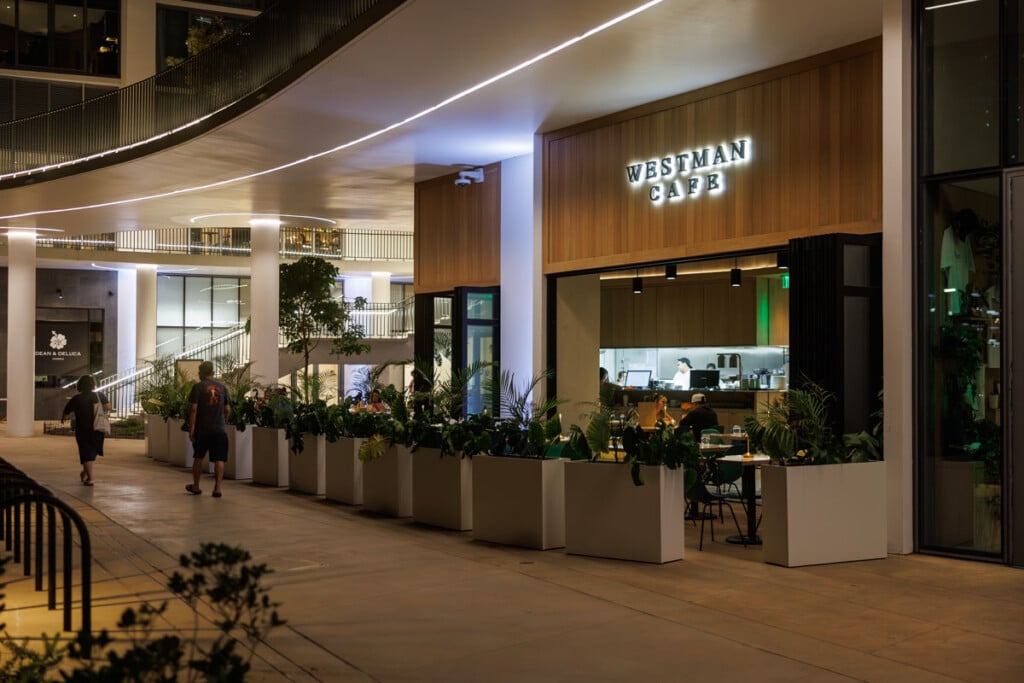
Westman Café sits between Kō‘ula’s open corridor and Ward Village Park. Photo: Aaron K. Yoshino
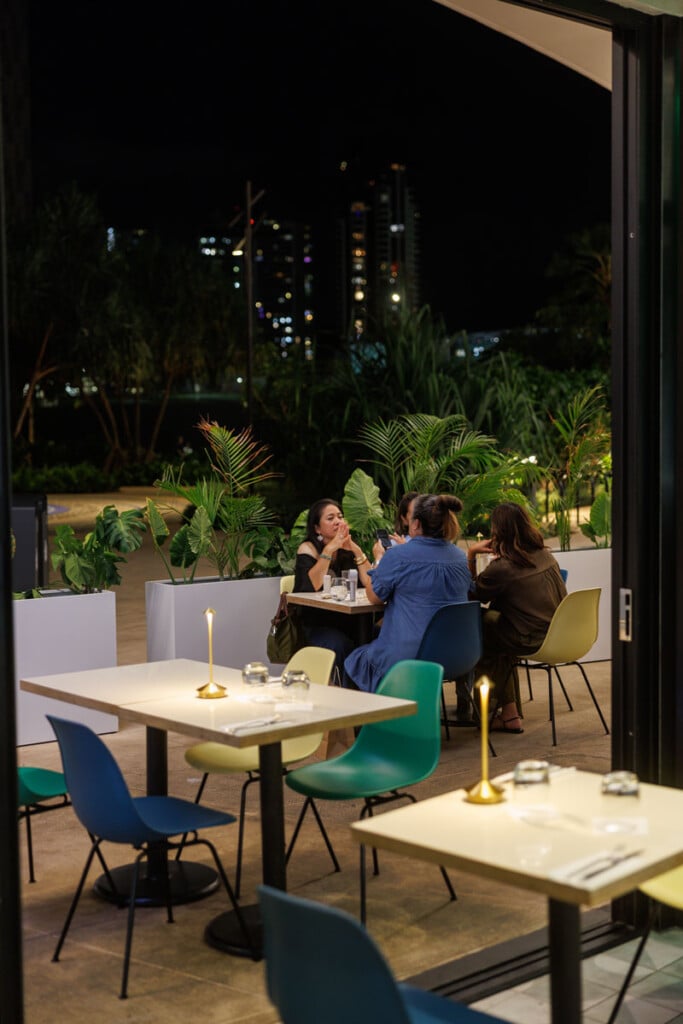
Westman Café sits between Kō‘ula’s open corridor and Ward Village Park. Photo: Aaron K. Yoshino
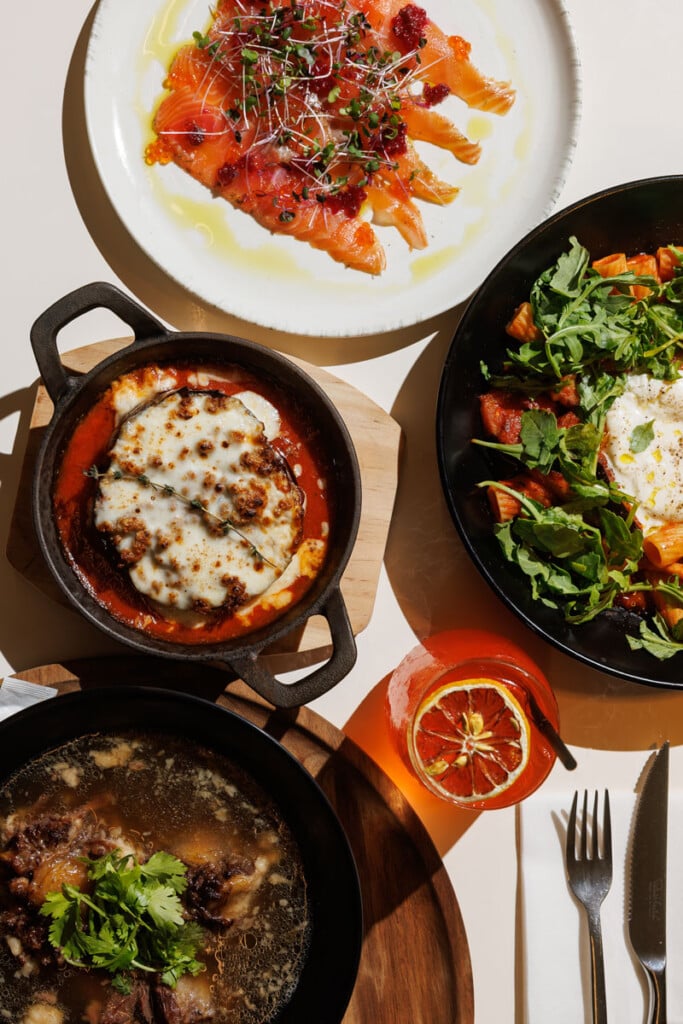
Clockwise from top: salmon gravlax with smoked trout roe, rigatoni arrabbiata, Yuzu Lei cocktail, oxtail soup, local eggplant-chorizo gratin. Photo: Aaron K. Yoshino
Westman Café
On the other end of the spectrum from Elephant Shack and Floralia, whose settings show off the DNA of the area’s past, is Westman Café. It looks out on Ward Village Park, the concrete plaza (where not one disk of old chewing gum mars the sandstone-colored expanse) leading to a play area carpeted with artificial turf. During a recent dinner, I watched the sun go down behind a giant crane silhouetted against its golden glow. Westman Café is enjoyable in a SoCal gated community kind of way, part of the resortification of the Howard Hughes swath of Kaka‘ako. That’s exactly what people who gravitate to the surrounding condos want.
The revival of a spot in Waikīkī that closed in 2024, the café is the perfect accessory to the glass tower above it. Opened in March, the new iteration is done in neutral shades of tan, with pops of Crayola color—it feels like the ’gram-ready lobby restaurant of a cool boutique hotel. On any given evening, the place is busy with young urbanites laughing over cocktails and dishes from an eclectic menu of food trends of the past 15 years (shakshouka, roasted Brussels sprouts), Euro favorites (gravlax, pasta), and interpretations of local nods (‘ahi poke tartine, mahi mahi loco moco), all filtered through a Japanese lens.
Many Japanese cafés that adopt Western cuisines serve the food equivalent of a white wine spritzer—it’s wine, but dialed down. For example, the interplay of sweet and herbiness that makes gravlax such a Swedish treat is more like salmon sashimi at Westman ($15). Rigatoni arrabbiata ($24), with barely a trace of red pepper anger, could be called a fresh marinara. But the thick-cut eggplant-chorizo gratin ($16) is a satisfying dinner appetizer, and the soufflé pancakes ($22) that were a hit at the Waikīkī location reappear at breakfast with all their eggy fluffiness, along with a popular washugyu loco moco ($24 breakfast, $22 dinner) and a Japanese breakfast with grilled fish ($18). Westman Café, which opens at 7:30 a.m. with free parking at Whole Foods and the Ward Entertainment Center, draws different crowds throughout the day.
The eatery joins the Westman Group led by Michael Nishi, a stable that includes the French-Japanese James Beard Award semifinalist Paris Hawai‘i, rustic neighborhood izakaya Kaimukī Shokudo and Waikīkī Mexican rooftop spot Búho. While Elephant Shack and Floralia are oases in their corners of the city, what is perhaps most notable about Westman Café is the community vibe you watch unfold from its lānai—kids on the net climber letting out cries of delight, two halmoni catching up at one of the green bistro tables, couples walking their dogs. While character and history may have been paved over on this corner of Ward Village, there is no denying that this spot is alive and creating new meaning for next generations.
1000 Auahi St., Kaka‘ako, westman-cafe.com, @westmancafe
Lesa Griffith is the Senior PR and Communications Manager at Honolulu Museum of Art and a contributor to HONOLULU Magazine.