Hawaiian ™
There's a small but skilled group of local artisans who practice crafts that were important to ancient Hawaiians. How can they make a living when foreign imitations of their work sell for much less?
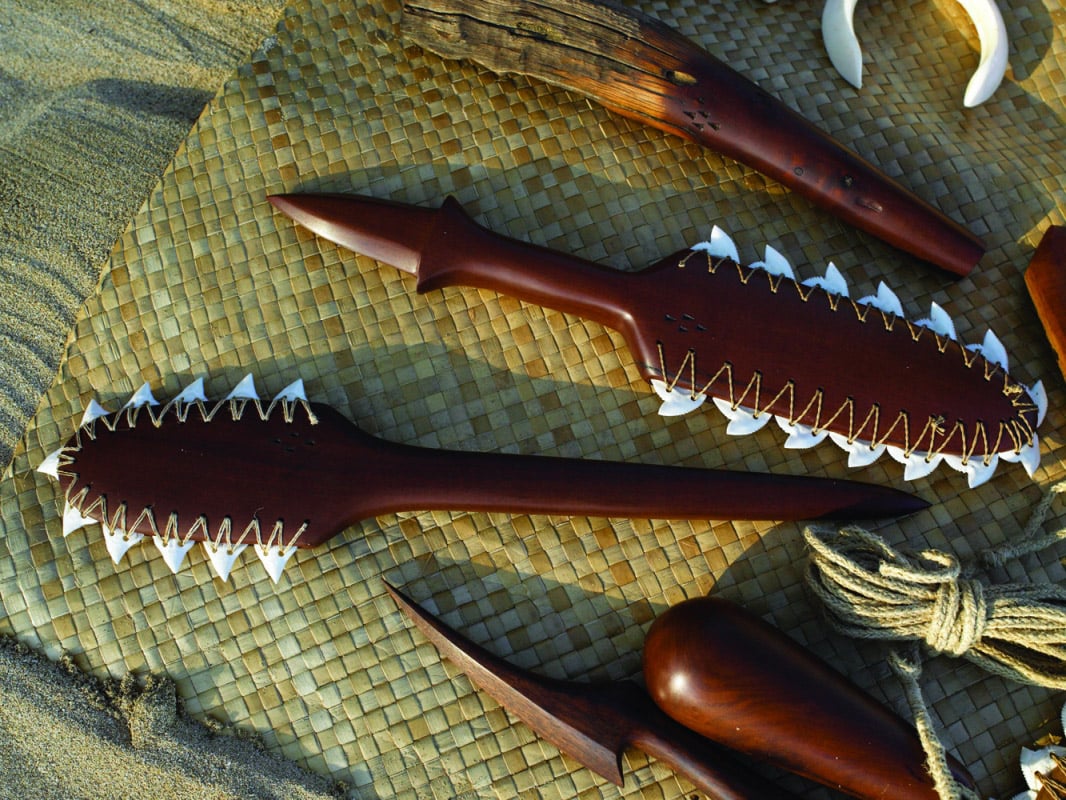
UMI KAI WAS 17 YEARS OLD WHEN HE carved his first Hawaiian weapon. He used some wood from a mango tree in his backyard and, with no more experience than class at Kaimuki High School, fashioned it into a leiomano, a slender wood paddle about the size his hand, lashed with tiger shark teeth he got from a fisherman. Kai shaped the weapon from memory, after a similar piece he'd seen as a child at his uncle's house.
That was 30 years ago. Since then, Kai has studied the Bishop Museum's collection of Hawaiian weapons, read whatever he could on ancient implements, consulted others who were knowledgeable about woodworking and became one of the most esteemed weapons makers in the Islands.
Today, on a Monday afternoon, he's giving a presentation about his craft to about 20 office workers in downtown's Pioneer Plaza. He grips an ihe (spear) made of ohia lehua, an extremely hard native wood found on the slopes of Kilauea and in other high altitudes.
"What do those marks mean?" a woman asks, referring to the marks on the weapon's handle—a cluster of isosceles triangles that look like points on a compass rose.
"It means Umi made it,'" Kai says. But the mark means a lot more than he's willing to tell a room full of strangers. The triangle is an ancient Hawaiian symbol. In this arrangement, it's his trademark, etched into nearly every item he makes. The mark is tattooed on his chest, representing what's important to him. It's who he is.
"These weapons are very beautiful," another woman in the audience says. "It's like art, really." Kai shrugs. He's never gotten used to being called an artist, even though he's been commissioned by collectors to create pieces like the one in his hand. These na mea Hawaii, things of Hawaii, that he makes—weapons, poi pounders and boards, kapa beaters and fishhooks—aren't art to him. They're implements that were once part of everyday living for Hawaiians, used for cooking, fishing and making war. Not showpieces to put on a mantle where no one could touch them.

Woodworker Umi Kai is considering registering the trademark he carves into his creations, including the weapons seen above. The symbol means so much to him that it's tattooed on his chest.
PHOTO BY MARK ARBEIT
He still marvels at how ancient Hawaiians created these implements without the power tools he uses today. No chainsaw, only a stone adze to chip away at the trunk of a tree; no electric drill to bore holes into wood, just a wili, an ancient version of a bow-drill that would takes hours to do what he can now do in minutes.
That's why it bothers Kai to see such ingenuity and craftsmanship reduced to cheap imitations. They're everywhere now – in Waikikı souvenir shops, the swap meet, drug stores, big boxes. Kai has spent years trying to perpetuate the craft of making tools that were once vital to his people. Now these items are imported from the Philippines, Indonesia and other countries where their makers probably know nothing about their origin.
He knows that, for a long time now, what passed for kukui nut lei have usually been just plastic necklaces from China. Same thing with puka shells. But these days, he's seeing more and more imports meant to resemble native works that require a higher level of skill—fishhooks made of boar's tusk, mats woven from pandanus and even weapons. Kai, and the artists like him, live by the double-edged sword of globalization. There's an entire world full of people willing to buy their stuff; and, there's an entire globe full of people willing to make these same crafts for pennies.
"[These foreign producers] should stick to making aloha shirts and muumuu instead of delving deeper in native Hawaiian implements," Kai says. "It's sad, and the losers are the artisans who are trying to sustain a continuation of their culture."
But Kai has no idea what he can do about it. He understands how the free market works. Making Hawaiian implements is his passion, but it's not his career. His day job is as a sales and marketing executive for a rental car company.
"If you're a tourist and all you really want is a fish hook to take back for a nephew and you have a choice between a $15 hook and a $100 one, which one would you buy?" Kai says. "Stores have to satisfy their buying public, but markups are key for them. They're usually going to bring in the $6 fish hook from the Philippines, where materials and labor are cheap, rather than pay a local crafter who wants $50 for it, because he spent four hours on it."
Nobody understands the tensions between culture and commerce more than Maile Meyer, owner of Native Books/Na Mea Hawaii. Her store sells only locally made products, most of them on consignment from artists who don't make art for a living. The more people around the world fall in love with Hawaii, the more commercial interest there is in Hawaiian products.
"It's one thing if you're making soap or hair picks; it's another when you talk about feather lei, stone, bone and wood things," Meyer says. "These things have lineage, and there are artists in a continuum trying to perpetuate that culture.
|

"Under federal law, imports must be labeled with their country of origin. But those little "Made in China" stickers don't guarantee that consumers know what they're buying. In 2004, for instance, the state passed a new law to protect Niihau shell jewelry. Made of various shades of pink shells from the private island, a genuine necklace can retail for $2,500 or higher, while imitations go for a fraction of the cost. The new law prohibited jewelry from being labeled "Niihau," unless a majority of its shells came from the island (similar to how any coffee labeled "Kona" must contain at least 10 percent Kona beans). To celebrate the law, Meyer invited the public to her Ward Warehouse to have their own jewelry authenticated by Niihau artisans.
Over three days, they verified the authenticity of more than 5,000 lei, but what surprised Meyer was that "there were plenty of people whose lei were not authentic," she says. "One of those people was my sister. It was interesting how many people couldn't tell."
Fakes not only affect an artists' ability to make a living from craft, they dilute the value of their work, Meyer says. Buyers "need to care more, so they know what they're getting. Someone tells you you're buying a Niihau shell lei and it's $9.99—are you kidding? They have the ability to say, 'No, I'm not gonna buy that ridiculous thing you're selling me, because these shells are a finite supply, made by a small group of makers. But we live in a capitalist society that wants cheap and lots of it."
Meyer and others, including kumu hula Vicky Holt Takamine and Hawaiian studies professor Maile Andrade, formed the Hale Kuai Study Group to help Hawaiian artists overcome these economic realities. The group knows it can't stop foreign imitations from being made, because producers and sellers of these imports aren't doing anything illegal. Instead, Hale Kuai's focus is distinguishing native products from imitations, so consumers know exactly what they're buying.
After conducting a yearlong study funded by the Office of Hawaiian Affairs, the group decided that the best answer was to create a trademark for native works. Other indigenous groups already use cultural trademarks. For more than 40 years, Alaska native artists have used a silver hand emblem to identify their works. Maori artists brand their works with the toi iho trademark. Under the Indian Arts and Crafts Act passed by Congress in 1990, any item marked with terms like "Indian" or "Native American" must have been made by a member of a recognized tribe. Someone selling Hopi jewelry that wasn't made by a Hopi tribe member could be fined hundreds of thousands of dollars or jailed.
"The Indian arts market was practically on its last legs, and native artists were unable to compete against machine-made goods being sold," says Leighton Chong, an intellectual property attorney in Honolulu. "That changed once that enforcement program started. Now the Indian arts market is a billion-dollar market, because these items are no longer being sold at commoditized prices and people will pay more for the intrinsic value of an authentic object."
In Hawaii, there are already informal associations of such crafts as woodworking and lauhala weaving. There are also kumu who are recognized as leading authorities within these communities. These master artists could become the first recipients of the Hawaiian cultural trademark, Chong says.
Hale Kuai has applied for local grants to further research the idea. That would include holding public meetings and working with existing Hawaiian organizations to answer many difficult, and possibly divisive, questions: What types of arts should be trademarked? Which artists would be eligible? Should it be reserved exclusively for Native Hawaiians or extended to non-Hawaiians who also produce quality work? Who determines what is quality work? And how?
Attorney Mark Bernstein represents clients in Hawaii's music industry, an area of the arts where there are already clear-cut rules when it comes to intellectual property. He warns Hawaiian artists not to make the issue of cultural trademarking an emotional one. "What is important to ask is: What is it exactly that you want to protect? And what exactly do you want to protect it from?" Bernstein says. "Until you get those answers, you can't start to address the nature of the problem. That's where it becomes important that people listen to each other."
Until Hawaiian artists can figure out a collective way to promote their works, individual producers have other options. They can't copyright bowls, weapons, jewelry and baskets—people have been making these things for ages, so they're part of the public domain. But Hawaiian artists can copyright any original designs that they add to a traditional work, such as a unique kapa pattern. Artists can also register their trademarks with the federal government, whether it's their name, their business name or a distinctive symbol like the triangles that Umi Kai carves into his woodwork.
Meyer often cites the example of Hauula artisan Buddy Makaiau, who is renowned among local hula halau for his pahu drums. He engraves the base of his instruments with three distinctive bands. "Everyone in the hula community knows that's his thing," Meyer says.
But because Makaiau had never copyrighted his design or registered his trademark, there was little he could do when an acquaintance in the Islands copied his design. That person mass-produced drums out of cheaper materials overseas and sold them at much lower prices in Japan.
"So Uncle Buddy signs all his drums now," Meyer says.

PHOTO BY MARK ARBEITGwen Kamisugi is a member of Ulana Me Ka Lokomaikai, a lauhala weaving club with a reputation for quality work. |
IT'S 10 A.M. ON A SATURDAY IN November. The previous weekend, there had been heavy thunder showers on Oahu, but today, sunlight streams into the open-air barracks on the grounds of Iolani Palace. About a dozen women sit around a fold-up table, weaving thin strips of lauhala (pandanus leaves) into bags, baskets and hats. They pause every few minutes to squirt water from spray bottles onto their work to keep the dried leaves pliable. The women will stay there till 2 p.m., breaking only to eat a potluck lunch or answer questions from tourists, who stop by their table after buying their tickets to tour the palace.
The women are all members of Ulana Me Ka Lokomaikai, a lauhala weaving club that is well known among collectors for its fine work. Their teacher is Auntie Gladys Grace, one of a handful of people in the Islands who are considered master kumu of the craft. Now in her late 80s, Grace doesn't weave as much as she used to, but she attends the club's weekly gatherings to coach her students through their own projects.
Today, Grace shows one of the members how to weave her first anoni hat. The pattern, which incorporates both beige and brown strips to create a two-tone effect, is Grace's specialty. She won't teach it to just anyone, only to students who prove to her that they are serious about the craft. "Hats are the hardest to make, it takes a very long time," Grace says. "Once you can make that, everything else is easy."
They're also the only thing that lauhala weavers have left, Grace says. The woven baskets, bags and other weavings in Longs and elsewhere are usually imports from the Philippines, made of foreign pandanus by foreign workers. But producers abroad have yet to create comparable versions of Hawaii's distinctive hats.
That's something that Gwen Kamisugi, one of Grace's longtime students, would hate for her kumu to see. Kamisugi is a retired state worker who has followed in Grace's footsteps by teaching others, including students at Kamehameha Schools and residents at Honolulu's halfway houses. To her, foreign imitations disrespect the native people who keep these traditional arts alive.
Kamisugi teaches more than just the mechanics of weaving. She educates her students about how lauhala was part of everyday life for early Hawaiians, who used the fiber to create fine mats and thatch their walls. She reminds them how physically demanding it is to harvest lauhala, requiring that gatherers wear long sleeves and pants to avoid thorns and bugs that reside in trees. She encourages them to replenish what they take by cultivating their own trees.
"We're not just teaching weaving, we're perpetuating a culture," Kamisugi says. "We do it with manao (wisdom)."
It's hard to blame everyday consumers for overlooking the difference between locally made weavings and imports, Kamisugi says. She can tell whether an item is made of Hawaiian lauhala by its smell, something that's only familiar to her because of her 35 years practicing the art.
Kamisugi would like the members of her club to brand their work, maybe weave a trademark into their products so buyers know they're made by a respected local source. She mentions the idea again at this Saturday gathering, but the idea is forgotten once the women start talking about their upcoming craft fair.
Some Hawaiian artists are skeptical about using the Western legal system of trademarks and copyrights to protect their ancient traditions. It's not right in their eyes, because the two concepts appear contradictory. Hawaiians have long believed in sharing their knowledge with their communities, while Western law, to them, focuses on individual ownership.
The issue can become heated, says attorney Chong. Last summer, he gave a presentation about Hale Kuai to Hawaiians at an international gathering of indigenous artists on the Big Island. He informed the artists about the various legal steps they could take to safeguard their works—and was heckled. Audience members yelled out that he was using "the language of the oppressors," that they didn't need copyrights but kapu (taboo) rights.
"There's a deep ambivalence among Hawaiian artists about Western law," Chong says. "It's probably a vestige of those bad feelings from the overthrow and distrust of Western machinery."
Says Meyer: "It's like you're having conversations that don't have an intersection. But these things that we're talking about weren't of interest commercially back then. Now they are, and they're being exploited. We can't be stupid about it."
Trademarks aren't solely a Western concept. Ancient Hawaiian artists often put marks on their works, because they were proud of their creations. The appearance of Niihau shell lei, for instance, varies from one family to another, distinguishing their makers.
Woodworker Umi Kai is looking into registering his trademark-the cluster of four elongated triangles that he carves into his pieces. He knows that the individual triangle is an ancient Polynesian mark, so he wants to ensure that whatever he does, it doesn't infringe on other artists' right to use the symbol.
Kai is still uncomfortable with the idea of submitting something that's so personal to him as paperwork to the federal government. At the same time, he can't bear the thought that someone who doesn't care about the meaning behind the mark could one day steal it from him. If he registers his mark, it will always mean "Umi made it." And it will belong to his children, and their children, as long as they continue his work after he's gone.
Says Kai, "Maybe it's about time."