Out-of-Control Energy Costs
That’s what we face and why we’re diving into renewables.
Why start the new year with a cover story on alternative energy, a weighty topic that’s difficult to discern and explain?
For me, it comes down to energy bills.

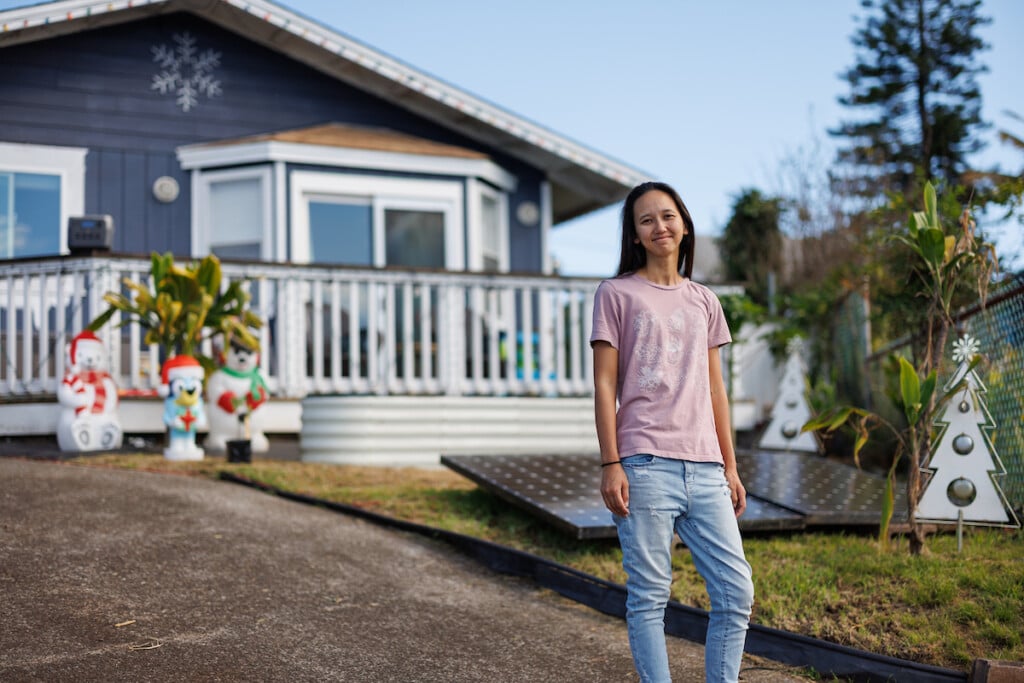
Stacey Alapai at her home in rural Makawao, where she set up solar power. Photo: Aaron K. Yoshino
I recently attended a dinner and sat across from a woman in her 20s who works in marketing. We started chatting about Hawai‘i’s hot weather, which led her to explain that she has to run the AC at her ‘Ewa Beach townhouse, and that her monthly electricity bill now exceeds $700.
“Seven hundred dollars?!” Before I sold my three-bedroom East O‘ahu home four years ago, I was paying about $225 a month to HECO, and I hadn’t realized how much costs had risen. “How can you afford that?” I asked. “I can’t,” she said.
I couldn’t stop thinking about our conversation well after that dinner, and I began asking others about their electric bills. Costs ran the gamut, but the bottom line: $700 a month wasn’t an anomaly for a middle-income O‘ahu homeowner.
Our state holds the unwanted distinction as having the highest electricity costs in the country, primarily because we rely so heavily on imported petroleum for our electricity generation, according to the U.S. Energy Information Administration. Over the past decade, Hawai‘i’s electricity prices have risen a terrifying 51%.
It’s clear why so many in Hawai‘i are getting priced out, and saying we’re in crisis mode is hardly hyperbole. For locals to remain here, we have to drastically reverse our trajectory and collectively get serious about our state’s goal of achieving net-zero greenhouse gas emissions by 2045.
So, with this objective, I tapped veteran reporter Mary Vorsino, who was more than eager to dig into the topic, well aware of its urgency. What she learned was that the future is cloudy.
“While the state’s renewable energy goals are robust, the Islands are now lagging other parts of the country when it comes to renewable energy production and we are still very reliant on imported fossil fuels to power our homes, fuel our cars and keep our economy running,” she says. “The good news is there are options; but everyone I spoke to—from government officials to environmentalists and industry experts—agreed that the time for implementing them is running out. Hawai‘i must act now, they say, because the status quo could soon no longer be viable.”
Diane Seo is the editorial director of HONOLULU Magazine.