The Local Queen that Dethroned a Kouign Amann from France
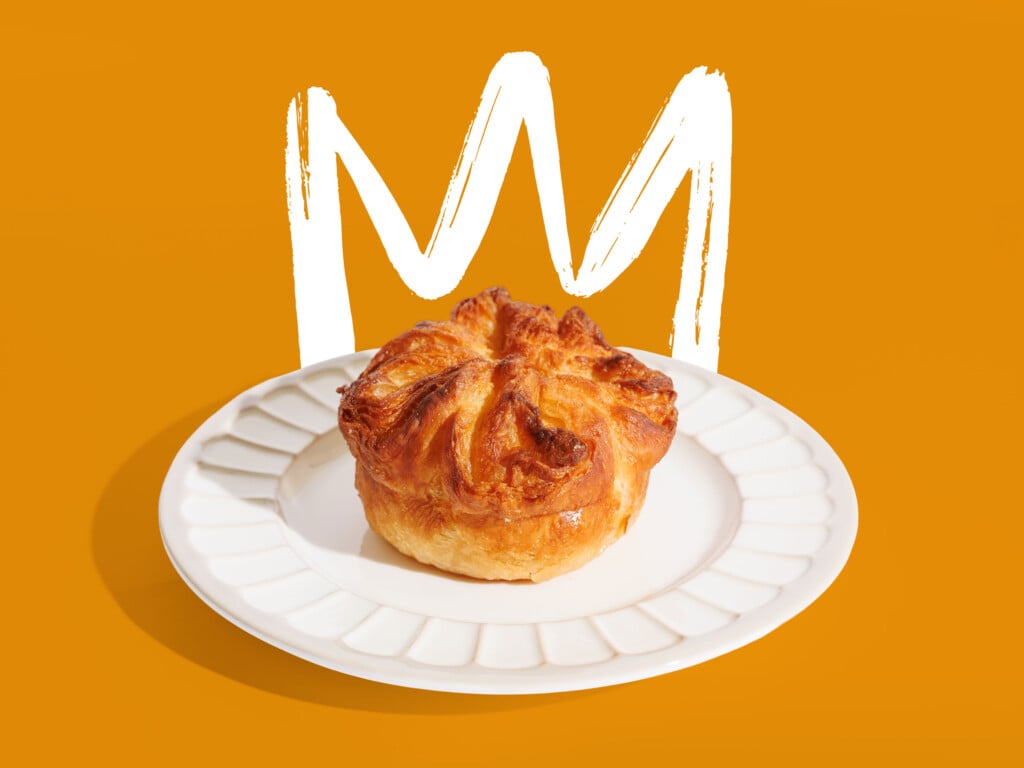
I only indulged in the kouign amann while in Brittany, France, where it originated—until I tasted a local version that kicked it to the curb.

Photo: Aaron K. Yoshino
I like pastries. A lot. My wife says too much, but I’ve learned to delay gratification. (Don’t ask her about that.) For instance, I know a mediocre pastry eaten impulsively diminishes my appreciation for its kin. So I can deny myself Krispy Kreme forever and hold out for Liliha Bakery poi doughnuts.
This is adulthood as practiced in Honolulu. You can extrapolate an entire code from it, too, so no, we will never order poke in Chicago or Paris. And not from half the places in Honolulu, either. It’s a moral stance.
But now I have to say I just met my moral pastry match.
Like Hawai‘i, Brittany has its own language, a separatist culture, and in kouign amann, created in the 1860s in Douarnenez, its own malasada.
Every other year or so we go to Brittany, France’s Big Sur-like fairyland of cliffs, beaches, lush green meadows, cows and goats. There, I met my pastry queen—the kouign amann—after bicycling 40 minutes on a three-speed steed to town for provisions. In that grim winter of 1981, it was the only sweet available, a golden extrusion of sugar-crusted dough that resembled the Breton triskell symbol, which can be a knot, a pattern on a fisherman’s sweater, a tattoo or a metal band’s logo. It symbolizes family.
Like Hawai‘i, Brittany has its own language, a separatist culture, and in kouign amann, created in the 1860s in Douarnenez, its own malasada. That’s why I was astounded in 2013 when I saw what looked like a kouign amann at the La Tour Bakehouse stand at the KCC Farmers Market. And, I have to admit, I was offended—between bites. It was just OK, so I stopped. But within months, kouign amann went global. Every bakery had one, or dozens, in multiple flavors, colors, permutations. This honest peasant delight had become just another fad.
I never gave in. I stood by my kouign, only having it on Belle‑Île, the island where we stay. But in the past decade, the local kouign lost her luster, became a bit slack around the middle, a bit bready. This year, I didn’t have any, deciding Le Trend had diluted her DNA. And then, on my return from Brittany, I again saw one at KCC, took it home, microwaved it for 25 seconds, then another 10, cut it open and—My god, this thing is drooling! Eat it quickly!
My wife and I looked at each other and said, “My gosh, what is this thing?”
It was incredible. And, truth be told, it kicked my Belle‑Île kouign to the curb. It seemed that while she was yielding to creeping complacency, La Tour’s had unlocked the code.
So I called Rodney Weddle, La Tour’s executive pastry chef. He started by crediting an ex-pat Breton, pastry chef Michel Suas. “I go to his San Francisco Baking Institute every year, take a bread course,” Weddle said. “In February of 2013, I had my first kouign amann at Michel’s B. Patisserie. My wife and I looked at each other and said, ‘My gosh, what is this thing?’ Soon as I got back to Hawai‘i, I started testing and researching. So we were definitely the first to bring it in, but Michel’s was the inspiration for me.”
Weddle’s is the result of nonstop tinkering while never deviating from the base elements. “I use a different ratio of bread flour and pastry flour, an 80/20 blend,” he said. “It gives a nice texture, not too chewy but still crispy and flaky. For butter, I use Plugra 82% butterfat. It’s basically a croissant dough, then you laminate sugar in between at a ratio of 45% butter to 45% sugar.”
And the drooling I saw? “That’s a gel where the butter and sugar meet,” he confirmed. “That’s what I’m looking for, that’s the best part. It’s almost a haupia gel. That’s what I love.”
How does it compare to ones in Brittany? “I’ve never been to France,” he laughed. This gave me pause because if haupia gel can improve kouign amann, we’re all on notice not to take our cultural inheritances for granted.
Though I’ll still never have poke in Paris.
Don Wallace is HONOLULU’s contributing editor and the author of The French House: An American Family, a Ruined Maison, and the Village that Restored Them All.